



Choosing a frontier large language model used to look simple: find the model with the highest benchmark score and build around it.
That approach is becoming less useful.
Several models now sit within a few points of the top position on major LLM leaderboards. Yet their prices, output speeds, context limits, reasoning settings, and agent capabilities can differ sharply. A model that leads by one point may cost more than twice as much to complete the same benchmark workload. Another model may rank slightly lower but respond faster, consume fewer tokens, or offer open weights.
The market is also becoming less concentrated. A recent release wave brought models from OpenAI, Moonshot AI, SpaceXAI, and Meta into or closer to the frontier. In the Artificial Analysis snapshot used for this comparison, six laboratories had a model scoring above 50 on its Intelligence Index. Only Anthropic and OpenAI had reached that level in early June. ([Artificial Analysis][1])
This does not mean every model above 50 is interchangeable. It means that the question has changed.
Instead of asking only, “Which LLM is smartest?” developers should ask:
Best Frontier LLMs at a Glance
The table below compares representative configurations rather than every reasoning level offered by each model family.
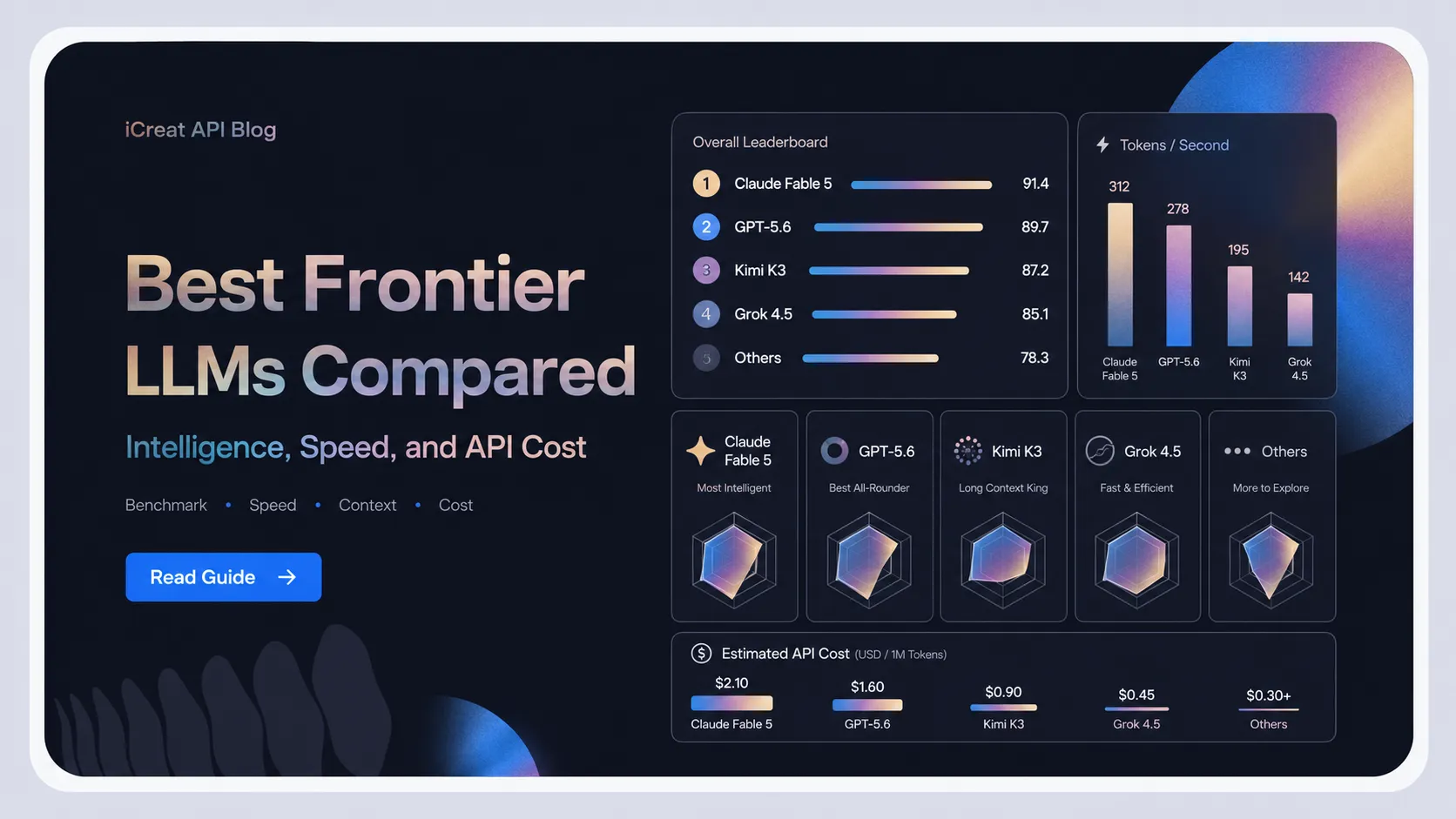
| Frontier LLM | Intelligence Index | Cost per index task | Context window | Median output speed | Best suited to |
|---|---|---|---|---|---|
| Claude Fable 5, with fallback | 60 | $2.75 | 1M | 67 tokens/s | Maximum benchmark performance and long-horizon knowledge work |
| GPT-5.6 Sol, max | 59 | $1.04 | 1M | 66 tokens/s | Advanced reasoning, coding agents, research, and professional work |
| Kimi K3 | 57 | $0.94 | About 1M | 62 tokens/s | Open-model deployment, agentic knowledge work, and large codebases |
| Claude Opus 4.8, max | 56 | $1.80 | 1M | 60 tokens/s | High-autonomy agents and complex professional workflows |
| Grok 4.5, high | 54 | $0.31 | 500K | About 80 tokens/s | Cost-efficient coding, technical agents, and high-volume reasoning |
| GPT-5.6 Luna, max | 51 | $0.21 | 1M | 200 tokens/s | Fast, high-volume workloads that still need near-frontier ability |
| Muse Spark 1.1, xhigh | 51 | $0.26 | About 1M | 124 tokens/s | Tool use, computer use, multimodal agents, and application orchestration |
The Intelligence Index and cost-per-task figures come from Artificial Analysis. Speed represents the median output rate shown in the comparison snapshot and can change by provider, region, traffic, and reasoning configuration. ([Artificial Analysis][1])
The quick recommendation
Claude Fable 5 holds the highest overall score, but its fallback configuration and higher task cost make it less straightforward than the headline ranking suggests.
GPT-5.6 Sol offers the strongest overall balance of peak intelligence, coding-agent performance, and cost.
Kimi K3 is the leading choice for teams that want frontier-level capability with an open-model strategy.
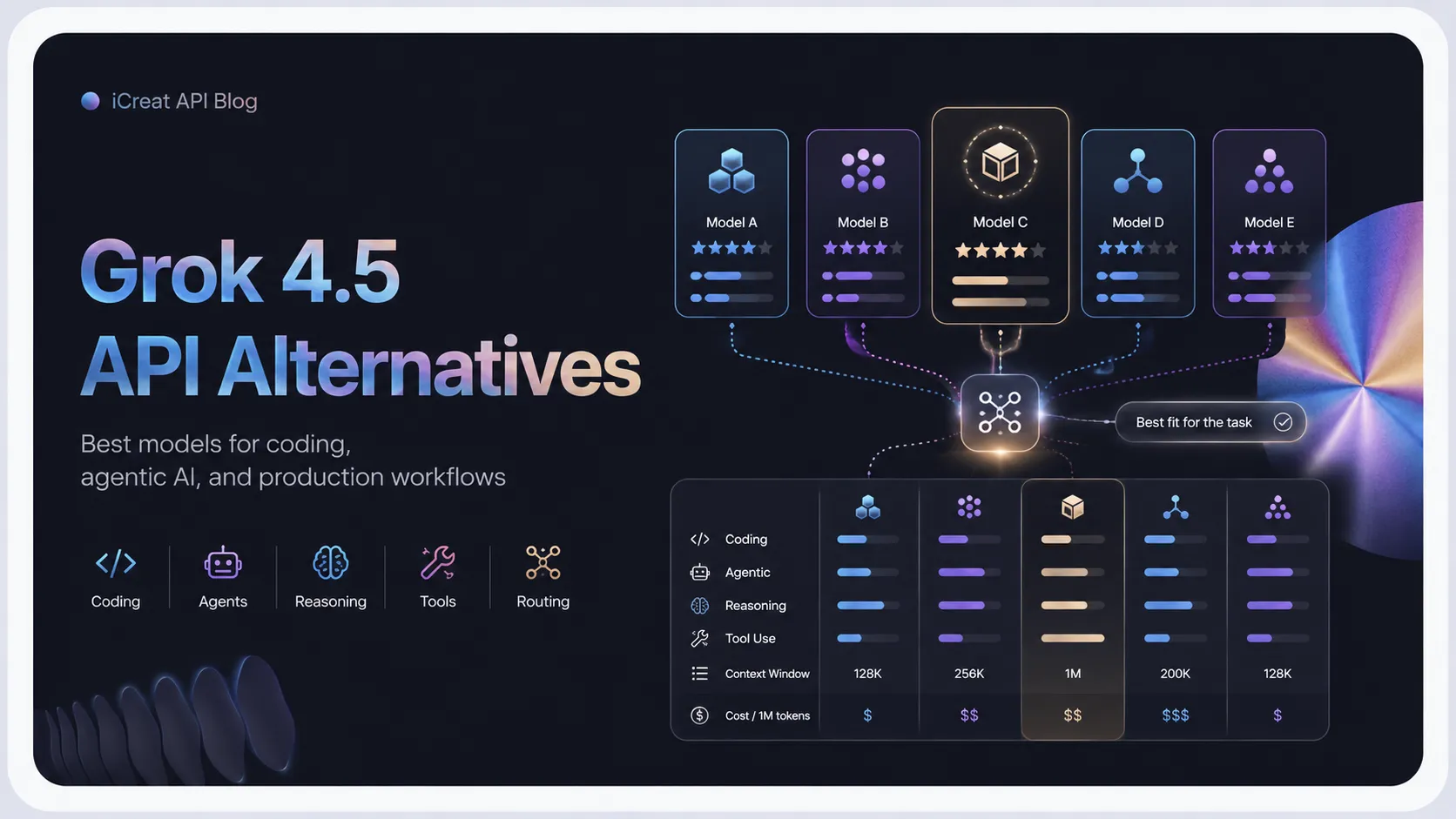
Grok 4.5 provides the most attractive intelligence-to-cost ratio among the higher-scoring models in this comparison.
GPT-5.6 Luna and Muse Spark 1.1 are stronger options for workloads where throughput and unit economics matter more than achieving the final few points of benchmark performance.
How We Compared the Best Frontier LLMs
There is no universal definition of a frontier LLM. In this article, the term refers to models scoring around 50 or higher on the Artificial Analysis Intelligence Index. This is a practical cutoff for comparison, not an official industry standard.
The Artificial Analysis LLM leaderboard combines several evaluations covering real-world professional tasks, coding, scientific reasoning, factual knowledge, long-context reasoning, and agentic workflows.
Its current Intelligence Index includes nine evaluations:
- GDPval-AA v2
- τ³-Banking
- Terminal-Bench v2.1
- SciCode
- AA-LCR
- AA-Omniscience
- Humanity’s Last Exam
- GPQA Diamond
- CritPt
The weighting has shifted toward harder agentic work, including tasks that require models to operate tools, complete multi-stage assignments, and produce professional deliverables. The full Intelligence Index methodology also notes that a composite benchmark is useful for comparison but may not represent every production workload. ([Artificial Analysis][2])
We therefore consider five factors:
Intelligence measures broad capability across the benchmark set.
Cost per task estimates how much it costs to complete the benchmark workload, including input, output, reasoning, and cache tokens. It is often more informative than the advertised price per million tokens.
Output speed affects long responses and interactive applications.
Latency determines how quickly the model begins responding. A fast output rate cannot compensate for a very long wait before the first token.
Workload fit considers whether the model is better suited to coding, research, office work, computer use, real-time chat, or high-volume processing.
Claude Fable 5: Best Benchmark Score
Claude Fable 5 occupies the top position in the current snapshot with an Intelligence Index score of 60. It also leads the AA-Briefcase benchmark for long-horizon knowledge work, where models must complete realistic assignments and produce deliverables such as reports, spreadsheets, and presentations. ([Artificial Analysis][1])
However, the exact configuration matters. Artificial Analysis labels the leading entry as Claude Fable 5 with adaptive reasoning, maximum effort, and an Opus 4.8 fallback.
That makes it better understood as a deployed model system rather than a simple, fixed endpoint. Routing, fallback behavior, and maximum reasoning effort can improve task completion while increasing latency and cost.
Its estimated cost of $2.75 per Intelligence Index task is also much higher than GPT-5.6 Sol at $1.04, Kimi K3 at $0.94, and Grok 4.5 at $0.31. ([Artificial Analysis][1])
Choose Claude Fable 5 when: maximum completion quality matters more than cost or response time.
Look elsewhere when: you need predictable low latency, simple endpoint behavior, or economical high-volume processing.
GPT-5.6 Sol: Best Overall Frontier LLM
GPT-5.6 is divided into three main tiers:
- Sol for the most demanding reasoning and professional tasks
- Terra for balanced everyday work
- Luna for lower-cost, higher-volume use
OpenAI positions Sol as the flagship, Terra as the balanced option, and Luna as the most cost-efficient member of the family. ([OpenAI][3])
GPT-5.6 Sol reaches 59 on the Intelligence Index, only one point behind Claude Fable 5. More importantly, it reaches that level at an estimated $1.04 per benchmark task rather than $2.75.
Sol also leads the Artificial Analysis Coding Agent Index in the Codex environment and performs strongly on economically valuable professional tasks and long-horizon knowledge work. ([Artificial Analysis][4])
This combination makes Sol the strongest general recommendation for teams that need high-end reasoning but still care about production economics.
The family structure is equally important. Not every request needs Sol. A sensible deployment might use Luna for classification, extraction, and straightforward tool calls, then route difficult tasks to Terra or Sol.
Choose GPT-5.6 Sol when: you need advanced coding, research, complex reasoning, professional deliverables, or high-capability agents.
Choose Luna instead when: the application processes many requests and the final few benchmark points do not justify higher cost.
Kimi K3: Best Open Frontier LLM
Kimi K3 entered the Intelligence Index at 57, placing it close to the highest proprietary systems and ahead of Claude Opus 4.8 in the overall snapshot.
Its most notable results come from agentic and professional work. Kimi K3 scored 1668 Elo on GDPval-AA v2 and 1547 Elo on AA-Briefcase. Its analytical-quality score on AA-Briefcase was almost tied with Claude Fable 5. ([Artificial Analysis][1])
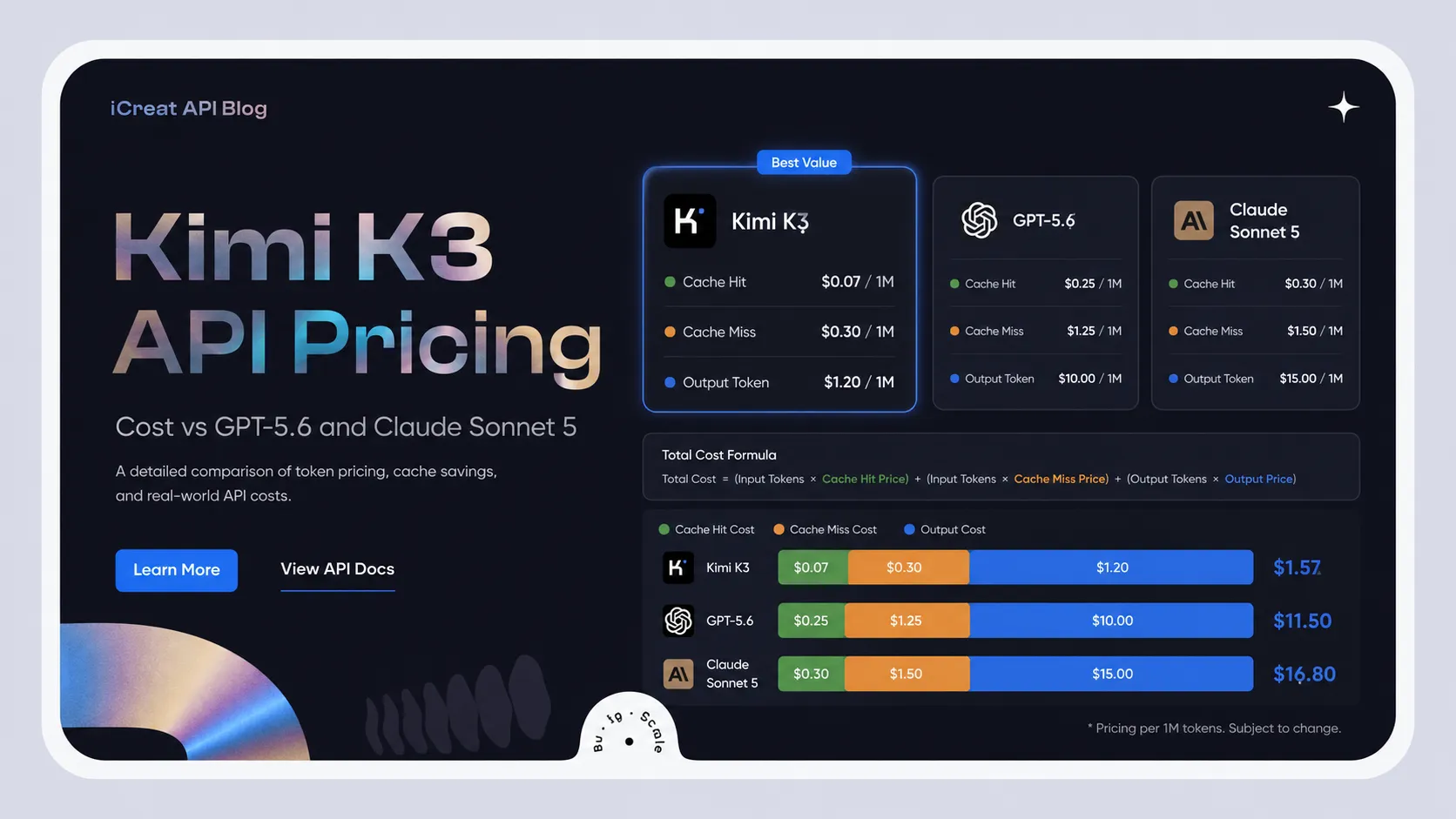
Kimi K3 costs an estimated $0.94 per Intelligence Index task. That is close to GPT-5.6 Sol and about half the cost of Claude Opus 4.8 for the same benchmark workload. ([Artificial Analysis][5])
Moonshot AI describes Kimi K3 as a 2.8-trillion-parameter, open, mixture-of-experts model. It supports approximately one million tokens of context and is designed for coding, long-running agents, visual understanding, and large-scale knowledge work. ([Kimi AI][6])
Its main trade-off is speed. At roughly 62 output tokens per second in the measured endpoint, it is not slow, but it is well behind high-throughput choices such as GPT-5.6 Luna and Muse Spark 1.1. ([Artificial Analysis][7])
Choose Kimi K3 when: open deployment, long-context work, coding agents, or control over future infrastructure matters.
Look elsewhere when: low latency and maximum throughput are more important than model openness.
Claude Opus 4.8: Best Proven High-Autonomy Option
Claude Opus 4.8 scores 56 on the Intelligence Index. Although newer releases have moved ahead of it, the model remains competitive for complex reasoning, long-running coding agents, and professional work.
It is also an important reference point for price-performance comparisons. Artificial Analysis estimates its cost at $1.80 per Intelligence Index task, compared with $0.94 for Kimi K3 and $0.31 for Grok 4.5. ([Artificial Analysis][5])
The argument for Opus 4.8 is therefore not that it is the cheapest or highest-scoring model. Its value is its combination of mature Claude behavior, strong agentic performance, a large context window, and suitability for tasks that require sustained autonomy.
Developers can currently access the Claude Opus 4.8 API through iCreat for complex reasoning and long-horizon agent workflows.
Choose Claude Opus 4.8 when: you value a proven high-autonomy model and already use Claude-oriented workflows.
Look elsewhere when: cost per completed task is the primary constraint.
Grok 4.5: Best Price-to-Performance Ratio
Grok 4.5 does not lead the overall ranking, but its economics are difficult to ignore.
It scores 54 on the Intelligence Index while costing only $0.31 per benchmark task. It also reaches 76 on the Coding Agent Index in Grok Build, placing it close to more expensive leading systems. ([Artificial Analysis][8])
SpaceXAI prices Grok 4.5 at $2 per million input tokens and $6 per million output tokens. The company reports output speeds around 80 tokens per second and emphasizes reduced token usage on engineering tasks. ([SpaceXAI][9])
That combination makes Grok 4.5 attractive for coding agents, technical support, engineering automation, and other workloads where a small reduction in peak intelligence is acceptable in exchange for a much lower operating cost.
There is an important limitation. Artificial Analysis found that Grok 4.5 improved its factual accuracy on AA-Omniscience but also showed a higher hallucination rate. Teams using it for research, compliance, or factual reporting should add retrieval, citations, verification, and refusal rules rather than trusting unsupported answers. ([Artificial Analysis][8])
Choose Grok 4.5 when: you want strong agentic and coding performance at a low cost.
Look elsewhere when: factual calibration is more important than answer coverage and cost.
Muse Spark 1.1: Best Emerging Multimodal Agent Model
Muse Spark 1.1 reaches 51 on the Intelligence Index and costs approximately $0.26 per task. Its overall score is lower than Sol, Kimi K3, and Grok 4.5, but its value lies in a different area.
Meta built Muse Spark 1.1 around agentic tasks, computer use, tool orchestration, coding, and multimodal understanding. The model supports a one-million-token context window and is designed to retain important actions across extended workflows. ([Meta AI][10])
Its factual behavior also moved in a different direction from Grok 4.5. Artificial Analysis reported that Muse Spark 1.1 reduced hallucinations by refusing more questions when uncertain, while keeping accuracy roughly stable. ([Artificial Analysis][11])
Muse Spark is therefore a promising option for personal agents, cross-application automation, interface navigation, and workflows that combine visual information with tools.
Choose Muse Spark 1.1 when: computer use, tool coordination, multimodal context, and low task cost are priorities.
Look elsewhere when: your application needs the highest possible reasoning score on difficult standalone tasks.
Similar Intelligence Does Not Mean Similar Economics
The most important change in frontier LLMs is not that one new model has permanently won the leaderboard.
It is that near-frontier intelligence has become much cheaper.
GPT-5.6 Sol trails Claude Fable 5 by one point but costs approximately 62% less per Intelligence Index task. Kimi K3 trails by three points at roughly one-third of Fable’s task cost. Grok 4.5 delivers a score of 54 at $0.31 per task. GPT-5.6 Luna and Muse Spark 1.1 both reach 51 for close to a quarter per task. ([Artificial Analysis][1])
This gap exists because advertised token price is only one part of the bill. Two models with the same output price may use very different numbers of reasoning and answer tokens to solve the same problem.
A cheaper model can also become expensive when it:
- produces unnecessarily long reasoning traces;
- requires repeated attempts;
- fails tool calls;
- returns outputs that need human correction;
- cannot complete the task within one agent run.
For production evaluation, cost per successful task is more useful than cost per million tokens.
Which Frontier LLM Should You Choose?
| Workload | Strong starting choice | Why |
|---|---|---|
| Maximum-quality professional work | Claude Fable 5 | Highest composite score and leading long-horizon knowledge work |
| Advanced coding and reasoning | GPT-5.6 Sol | Near-top intelligence with stronger cost efficiency |
| Open-model infrastructure | Kimi K3 | Frontier performance, long context, and open deployment path |
| Cost-efficient coding agents | Grok 4.5 | Strong coding-agent results with low task cost |
| Mature high-autonomy workflows | Claude Opus 4.8 | Proven agentic behavior and large context |
| High-volume processing | GPT-5.6 Luna | Fast output and very low cost per benchmark task |
| Computer-use and multimodal agents | Muse Spark 1.1 | Built around tools, applications, and multimodal context |
These recommendations are starting points, not replacements for testing.
Build a small evaluation set from your own workload. Include easy, medium, and difficult requests. Record task success, unsupported claims, tool errors, first-token latency, total response time, token use, and total cost.
A three-point public benchmark advantage may disappear on your internal tasks. A lower-ranked model may also win because it follows your output schema more reliably or completes the work with fewer retries.
Why a Multi-Model API Matters More Than One Winner
Frontier rankings now move faster than most production applications can be rebuilt.
Hard-coding an application around one provider creates several problems. Each migration can require a new SDK, request structure, authentication method, billing account, error-handling system, and monitoring workflow. Even when two providers support similar features, their tool schemas and response formats may differ.
With iCreat, developers can use one OpenAI-compatible API to access models from multiple providers. A single integration supports model switching, unified billing, pay-as-you-go usage, and multimodal capabilities without maintaining a separate connection for every provider.
The current model catalog already includes options for different workload tiers:
- Use the GPT-5.5 API for demanding reasoning and coding.
- Use the Claude Opus 4.8 API for high-autonomy professional work.
- Use the Gemini 3.5 Flash API when faster agentic execution is more important than maximum benchmark performance.
- Follow the iCreat API documentation to integrate through an OpenAI-compatible interface.
The goal is not to switch models every time a new leaderboard appears. It is to keep that option available.
A practical routing system can send ordinary requests to a fast, economical model, difficult requests to a stronger reasoning model, and failed requests to a fallback. This can reduce cost without forcing the entire product to accept the limitations of the cheapest model.
Frequently Asked Questions
Final Verdict
The frontier LLM market no longer has one obvious winner for every use case.
Claude Fable 5 leads the benchmark. GPT-5.6 Sol offers the strongest overall balance. Kimi K3 brings open-model competition close to the top. Grok 4.5 pushes down the cost of capable agentic reasoning. GPT-5.6 Luna and Muse Spark 1.1 show how much performance is becoming available at lower prices.
The durable strategy is therefore not model loyalty.
It is building an evaluation and API layer that lets you choose, compare, route, and replace models as your workload—and the market—changes.