



GPT-Live is not only another voice model release. It represents a shift in how developers should think about real-time voice APIs.
OpenAI describes GPT-Live as a new generation of voice models for natural human-AI interaction. The key architectural change is full-duplex conversation: GPT-Live can listen and speak at the same time instead of waiting for fixed turns. OpenAI says this allows the model to acknowledge that it is listening, respond in quick back-and-forth exchanges, or stay quiet when the user needs time to think. (OpenAI)
That may sound like a user experience improvement, but for developers it has deeper implications. A full-duplex AI voice model changes the product architecture behind voice agents, live assistants, customer support bots, translation tools, mobile copilots, and hands-free workflows.
The old question was: How do we add speech input and speech output to an AI app?
The new question is: How do we build AI systems that can stay inside a live conversation while reasoning, calling tools, and completing tasks in the background?
This is where GPT-Live becomes especially important. OpenAI says GPT-Live can delegate questions that require web search, deeper reasoning, or more complex work to a frontier model in the background, with GPT-5.5 used at launch. OpenAI also says GPT-Live models are planned for the API soon. (OpenAI)
For teams building real-time voice products, the immediate takeaway is clear: do not wait for the final voice layer before designing the intelligence layer. Developers can already start testing OpenAI models such as GPT-5.5, GPT-5.4, GPT-5.4 mini, and GPT-5.3 Codex on iCreat API, using one OpenAI-compatible API workflow with official channel access, unified billing, and pay-as-you-go pricing.
What does full-duplex mean in AI voice?
Full-duplex means that communication can happen in both directions at the same time. In human conversation, this is normal. People can speak while listening, acknowledge another speaker, interrupt gently, pause, correct themselves, or continue a thought while the other person reacts.
In AI voice systems, that behavior is difficult. A model has to process incoming audio while generating outgoing audio. It must decide whether the user is still speaking, whether a pause means the user is thinking or done, whether an interruption should stop the current response, and whether the system should answer directly or call a tool first.
OpenAI says GPT-Live continuously processes input while generating output, instead of processing a sequence of separate messages. This allows the model to make interaction decisions many times per second, including whether to speak, continue listening, pause, interrupt, or invoke a tool. (OpenAI)
For developers, that means full-duplex is not just about lower latency. It is about conversation control.
A full-duplex model must manage timing, interruption, listening behavior, user hesitation, background noise, tool use, and response pacing. Those details are what make a voice assistant feel useful instead of robotic.
Why older voice AI systems felt limited
Before full-duplex voice models, many AI voice experiences were built as pipelines. A typical cascaded voice system used speech-to-text to transcribe the user, a language model to generate the response, and text-to-speech to read the answer back. OpenAI describes this kind of cascaded system as slow and stilted, with possible information loss across models. (OpenAI)
This architecture was useful because it made voice AI possible, but it also created friction. Every step added delay. Emotion, emphasis, accent, and timing could be lost as speech became text and text became speech again. OpenAI’s earlier Realtime API announcement also explained that traditional voice assistant pipelines could lose emotion, emphasis, and accents while adding noticeable latency. (OpenAI)
Turn-based voice models improved the experience by processing and generating audio inside a single model. But OpenAI notes that even turn-based voice models still had to wait for the user to stop speaking before responding. Because turn detection often depends on silence, short pauses or background noise could be misread as the end of a turn, causing unnatural interruptions. (OpenAI)
That is the problem GPT-Live is designed to address. It moves voice AI from rigid turn-taking toward continuous interaction.
Full-duplex is different from simple real-time audio
It is easy to confuse “real-time audio” with “full-duplex conversation.” They are related, but they are not the same.
A real-time audio API may stream audio input and output with low latency. That is already useful. OpenAI’s Realtime API was introduced to help developers build low-latency multimodal experiences, including natural speech-to-speech conversations, and it supports streaming audio inputs and outputs. It can also handle interruptions automatically. (OpenAI)
Full-duplex goes further. It means the model is not only streaming audio quickly. It is continuously listening while speaking and making conversation decisions during the interaction.
This difference matters because many production voice products do not fail only because latency is too high. They fail because the conversation control is weak.
The assistant interrupts too early.
It waits too long before responding.
It talks over the user.
It misses corrections.
It cannot keep the conversation moving while a tool call is running.
It cannot show that it is listening without taking over the conversation.
Full-duplex voice models aim to solve these interaction problems, not just reduce response time.
What GPT-Live changes for real-time voice APIs
GPT-Live changes expectations for real-time voice APIs in three ways.
First, users will expect live AI conversations to feel more natural. They will expect the AI to handle interruptions, pauses, partial thoughts, and background noise better. OpenAI says ChatGPT Voice with GPT-Live can now wait when users take a moment to think, stay quiet when asked to listen, and focus better on the user’s voice when there is background noise. (OpenAI)
Second, developers will expect voice APIs to support tool use and deeper work without breaking the conversation flow. GPT-Live can keep talking with the user while delegating harder questions to backend models like GPT-5.5. (OpenAI)
Third, voice products will need stronger backend architecture. A full-duplex interface is valuable only if the system can also reason, search, classify intent, call tools, use business data, and produce reliable answers.
This is why real-time voice APIs are moving away from simple call-and-response interfaces. OpenAI’s 2026 API voice update described voice as an interface between people and products, with emerging patterns such as voice-to-action, systems-to-voice, and voice-to-voice. It also emphasized that useful voice products need more than fast turn-taking or a natural voice; they need to understand meaning, keep context, use tools, and respond appropriately as a conversation unfolds. (OpenAI)
For developers, this is the real shift: voice AI is becoming a product workflow layer, not just an audio feature.
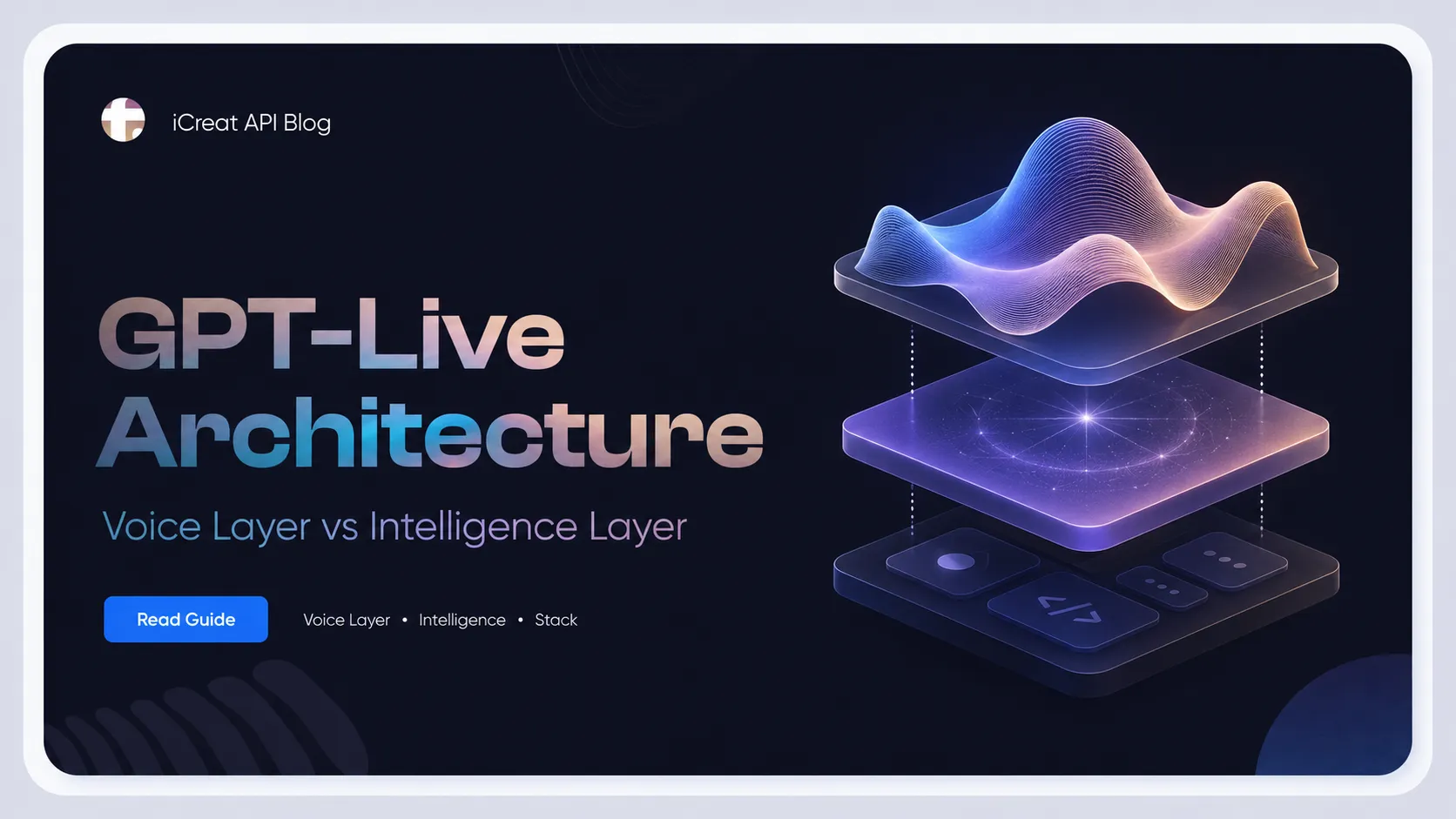
The new voice API stack
A full-duplex voice product needs more than a microphone and a model. It needs a stack.
A practical real-time voice API stack can look like this:
User speech → full-duplex voice layer → intelligence model → tool calls and business logic → response planning → voice, text, or visual output
Each layer solves a different problem.
The voice layer handles listening, speaking, timing, interruptions, turn-taking, and live conversation flow.
The intelligence layer handles reasoning, intent understanding, context synthesis, task planning, and answer generation.
The tool layer connects the AI to search, calendars, CRMs, ticketing systems, product databases, codebases, order systems, or other external services.
The routing layer decides whether a request is simple, complex, code-related, urgent, unsafe, or better handled by another model.
The output layer decides how the result should be returned: spoken response, text summary, visual card, workflow action, or human escalation.
GPT-Live is mainly relevant to the full-duplex voice layer. GPT-5.5 is relevant to the intelligence layer. GPT-5.4 mini can be useful for lightweight routing. GPT-5.3 Codex can support developer workflows.
That layered view makes voice AI easier to build and easier to scale.
Why GPT-5.5 matters for full-duplex voice agents
Full-duplex voice interaction solves the conversation flow problem. It does not automatically solve the reasoning problem.
A voice agent can listen and speak naturally but still fail if it cannot understand complex requests. It can handle interruptions but still fail if it cannot use tools correctly. It can respond quickly but still fail if it gives shallow or unreliable answers.
This is why GPT-5.5 matters. OpenAI says GPT-Live can delegate questions that require web search, deeper reasoning, or more complex work to a backend frontier model, and GPT-5.5 is used at launch. (OpenAI)
In other words, GPT-Live shows that future voice products may use multiple models together. The voice model manages the live interaction. The backend model handles harder intelligence work.
For developers building now, GPT-5.5 is the most natural model to evaluate for advanced voice agent backends. It can support complex reasoning, multi-step workflows, policy explanation, research synthesis, agentic tasks, and high-quality assistant responses.
On iCreat API, GPT-5.5 can be used as the intelligence layer behind assistants, voice agents, support workflows, and agentic applications. Developers can start with a small recharge, test real prompts, compare output quality and cost, and decide where GPT-5.5 should sit in the backend architecture.
Real-time voice APIs need model routing
One of the biggest mistakes in voice AI is assuming one model should handle every request.
That approach is simple, but it is rarely optimal. Real-time voice conversations can generate many small interactions: greetings, clarifications, corrections, short answers, tool confirmations, escalation decisions, and complex reasoning tasks. Sending all of them to the strongest model may increase cost unnecessarily. Sending all of them to the smallest model may reduce answer quality.
A better architecture uses model routing.
| Task type | Suggested model |
|---|---|
| Greeting, short FAQ, simple intent detection | GPT-5.4 mini |
| General assistant answer or customer support reply | GPT-5.4 |
| Complex reasoning, search synthesis, agentic workflow | GPT-5.5 |
| Coding task or developer workflow | GPT-5.3 Codex |
| Code task requiring broader reasoning | GPT-5.3 Codex + GPT-5.5 |
This routing strategy helps teams balance quality and cost. GPT-5.4 mini can handle high-volume lightweight work. GPT-5.4 can support common assistant tasks. GPT-5.5 can handle complex reasoning. GPT-5.3 Codex can support code-related workflows.
iCreat API is useful here because it gives developers one API for multiple model types, including image, video, audio, 3D, avatar, and LLM models. For OpenAI models, developers can use OpenAI-compatible access through an official channel with unified billing and pay-as-you-go pricing.
Pricing matters more in voice AI
Voice AI products can become expensive if backend usage is not designed carefully. Live conversations often create many turns, partial responses, tool calls, clarifications, and summaries. A voice agent may process more requests per user session than a normal text chatbot.
That is why developers should think about backend model cost early.
On iCreat API, the current OpenAI model pricing is pay-as-you-go:
| Model | Input price | Output price | Cache read price |
|---|---|---|---|
| GPT-5.5 | $0.5000 / 1M tokens | $3.0000 / 1M tokens | $0.0500 / 1M tokens |
| GPT-5.4 | $0.2500 / 1M tokens | $1.5000 / 1M tokens | $0.0250 / 1M tokens |
| GPT-5.4 mini | $0.0750 / 1M tokens | $0.4500 / 1M tokens | $0.0070 / 1M tokens |
| GPT-5.3 Codex | $1.7500 / 1M tokens | $14.0000 / 1M tokens | $0.1750 / 1M tokens |
Always check the latest pricing page before building production workloads.
The purpose of showing pricing is not to choose the cheapest model for everything. It is to design a cost-aware architecture. A simple classification request does not need the same model as a complex agentic workflow. A short support answer does not need the same model as a coding assistant solving a difficult bug.
Full-duplex voice will make AI interaction more natural, but backend model strategy will determine whether the product can scale.
Example: full-duplex customer support agent
Imagine a customer support voice agent for a subscription product.
The user says:
“I think I was charged twice. One payment says pending, one says completed, and I’m not sure if I should contact my bank.”
A full-duplex voice layer should listen without interrupting too early. It should allow the user to add details. It should respond naturally with phrases that show attention. If the user interrupts or corrects the order number, the system should adapt.
But the intelligence layer has to solve the actual problem. It must classify the issue, call billing tools, inspect payment status, explain pending versus completed charges, and decide whether escalation is needed.
A practical backend could work like this:
| Step | Model or layer |
|---|---|
| Listen, speak, handle pauses and interruptions | Full-duplex voice layer |
| Classify the request as billing-related | GPT-5.4 mini |
| Explain common billing behavior | GPT-5.4 |
| Reason through the user’s specific account state | GPT-5.5 |
| Generate escalation summary if needed | GPT-5.5 |
This is the difference between a voice feature and a voice product. The feature lets the user speak. The product solves the user’s problem.
Example: full-duplex language learning assistant
A language learning app is another natural use case.
The user is practicing Spanish and pauses mid-sentence to think. A weak voice system may interrupt too early or assume the user is finished. A full-duplex model should recognize that the pause might be part of the learning process and wait.
OpenAI says GPT-Live can stay quiet when users need time to think and can support more natural back-and-forth. (OpenAI)
But the backend still matters. The assistant may need to detect pronunciation issues, explain grammar, translate a phrase, adjust difficulty, remember the learning goal, and provide feedback without discouraging the user.
That requires more than audio streaming. It requires context, reasoning, and product logic.
A model strategy could use GPT-5.4 mini for lightweight classification, GPT-5.4 for normal tutoring responses, and GPT-5.5 for deeper grammar explanation or personalized lesson planning.
Example: full-duplex coding assistant
A voice-driven coding assistant shows why full-duplex interaction and backend intelligence must work together.
The developer says:
“Look at this error, explain what caused it, and suggest the smallest safe fix.”
A full-duplex voice layer makes the experience hands-free and responsive. The developer can interrupt, clarify, or add context without restarting the session.
But the assistant still needs to understand the code. It may need to inspect logs, explain the error, propose a fix, generate tests, and discuss tradeoffs.
That is where GPT-5.3 Codex and GPT-5.5 become useful. GPT-5.3 Codex can support code-specific reasoning, while GPT-5.5 can help with broader explanation, architecture reasoning, and agentic workflow planning.
Voice improves access. Backend model choice improves results.
What developers should build before GPT-Live API is widely available
OpenAI says GPT-Live models are planned for the API soon, but developers should wait for official documentation, pricing, rate limits, and integration details before treating GPT-Live API as a production-ready dependency. (OpenAI)
That does not mean teams should wait to build.
Before GPT-Live API becomes widely available, developers can already build the parts of the product that do not depend on the final voice layer. They can test prompts, connect tools, design model routing, evaluate GPT-5.5 for complex tasks, use GPT-5.4 mini for classification, estimate cost, and define escalation behavior.
They can also test real user prompts through iCreat API. For LLM models, the practical path is to start with a small recharge, run real API requests, compare output quality, and decide which model should power each workload.
When GPT-Live API becomes available, teams with a prepared intelligence layer will be able to evaluate the voice layer faster.
What full-duplex voice APIs will need from developers
As full-duplex voice APIs mature, developers will need to think beyond “send audio, receive audio.”
They will need to design behavior rules. When should the assistant interrupt? When should it stay quiet? When should it acknowledge the user with a short phrase? When should it call a tool in the background? When should it summarize? When should it ask for confirmation before taking action?
They will need to design recovery flows. If a tool call fails, the assistant should not break the conversation. OpenAI’s newer realtime voice models emphasize recovery behavior, tool transparency, and the ability to keep conversation moving while tools are called. (OpenAI)
They will need to design safety and user expectations. Voice feels more personal than text, so developers must be careful about transparency, guardrails, and escalation.
Most importantly, they will need to design model routing. Full-duplex interaction may increase the number of micro-decisions a system makes during a session. That makes routing and cost control more important, not less important.
How iCreat API fits into real-time voice development
iCreat API is not presented here as a GPT-Live API replacement. The better role is preparation for the backend layer.
iCreat API gives developers one API for image, video, audio, 3D, avatar, and LLM models. For OpenAI models, it provides OpenAI-compatible access through an official channel, unified billing, and transparent pay-as-you-go pricing.
For teams building real-time voice products, iCreat API can help answer practical backend questions:
Which model gives the best answers for real user prompts?
Which tasks can safely use GPT-5.4 mini?
When is GPT-5.5 worth the higher cost?
Should code-related workflows route to GPT-5.3 Codex?
How should the backend split simple, general, and complex tasks?
These questions can be tested before the final voice interface is available. That is the main advantage.
Final thoughts: full-duplex voice is the interface shift, but model strategy is the product shift
GPT-Live shows where real-time voice AI is going. Full-duplex interaction can make AI conversations feel more natural because the model can listen and speak at the same time. It can handle pauses, interruptions, and conversation flow more like a real interaction. (OpenAI)
But full-duplex voice is only one part of the product.
A useful voice agent also needs reasoning, tool use, context management, workflow logic, safety behavior, and cost control. OpenAI’s own GPT-Live architecture points in that direction by separating continuous interaction from deeper work and delegating complex tasks to GPT-5.5 in the background. (OpenAI)
For developers, the practical takeaway is simple: build the intelligence layer now.
Use GPT-5.5 for complex reasoning and agentic workflows. Use GPT-5.4 for general assistant tasks. Use GPT-5.4 mini for lightweight routing and high-volume requests. Use GPT-5.3 Codex for developer workflows.
With iCreat API, developers can test these OpenAI models through one OpenAI-compatible API workflow, with official channel access, unified billing, and pay-as-you-go pricing.
Full-duplex voice may define the next interface. Model routing and backend intelligence will define whether the product actually works.