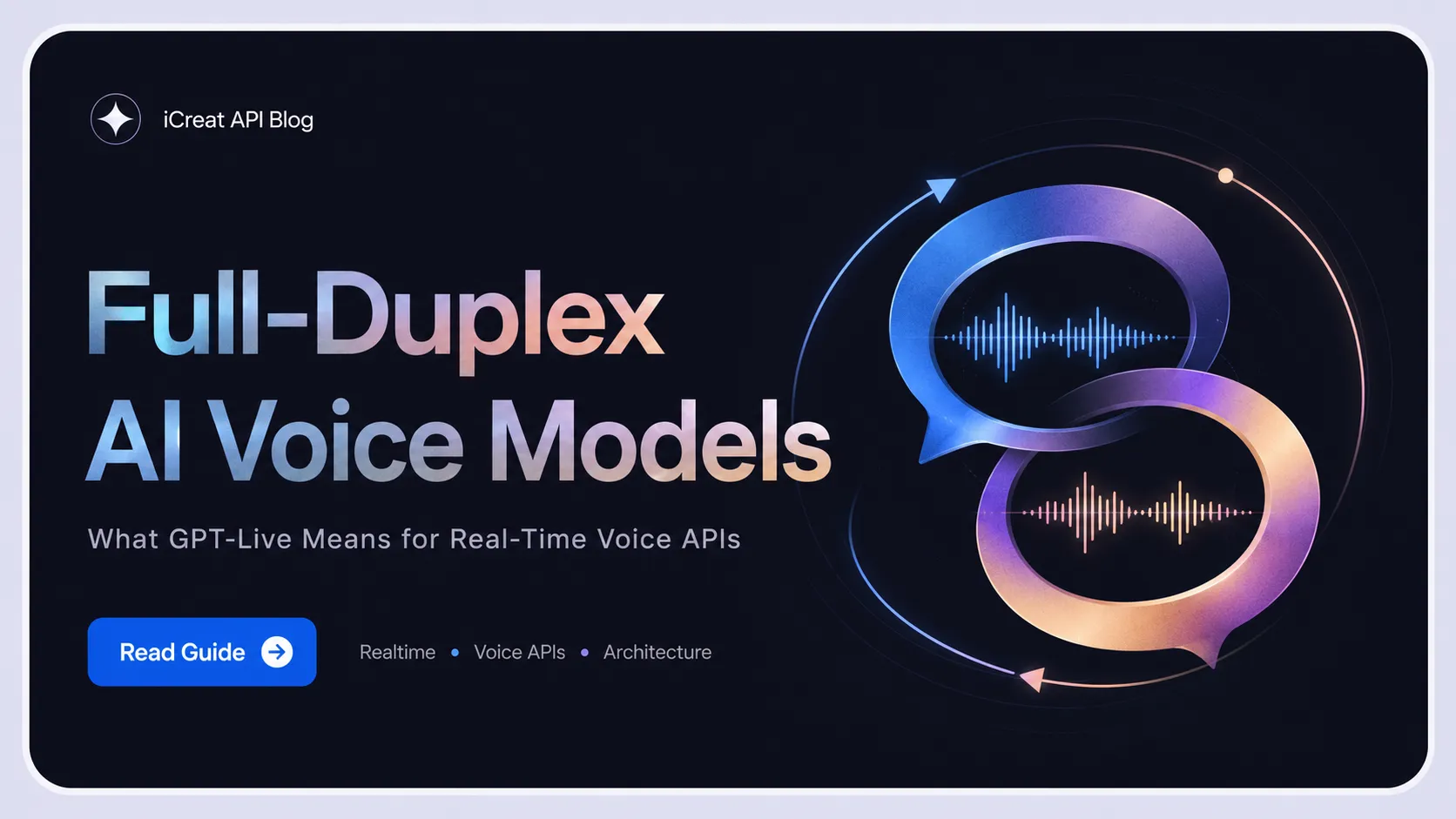




OpenAI's GPT-Live is one of the most important voice AI updates for developers to watch. It introduces a new generation of voice models designed for more natural human-AI interaction, with a full-duplex architecture that allows the model to listen and speak at the same time. OpenAI says GPT-Live now powers ChatGPT Voice and plans to bring GPT-Live models to the API soon. (OpenAI)
For developers, GPT-Live is not just another voice feature. It points to a new application architecture for real-time AI products. Instead of treating voice as a simple speech-to-text and text-to-speech pipeline, GPT-Live suggests a future where AI can stay in the flow of conversation, handle interruptions, keep listening while speaking, and delegate deeper reasoning work to a stronger backend model.
That architecture matters for anyone building voice agents, customer support assistants, live translation tools, tutoring products, mobile AI companions, hands-free workflows, or voice-driven developer tools.
The most practical question is not only "What is GPT-Live?" It is also: what should developers build now while waiting for GPT-Live API access?
The answer is to separate the voice layer from the intelligence layer. GPT-Live is the real-time voice interaction layer. Models such as GPT-5.5, GPT-5.4, GPT-5.4 mini, and GPT-5.3 Codex can already help developers build the reasoning, routing, tool-use, and workflow backend behind future voice AI products.
On iCreat API, developers can access OpenAI-compatible model APIs through an official channel, with one API for multiple models, unified billing, and pay-as-you-go pricing. That makes iCreat a practical place to start testing the intelligence layer before GPT-Live API becomes widely available.
What is GPT-Live?
GPT-Live is OpenAI's new generation of voice models for natural human-AI conversations. OpenAI describes GPT-Live as a full-duplex system, which means it can listen and speak at the same time rather than forcing the conversation into separate turns. (OpenAI)
This is different from many older AI voice systems. A traditional system usually waits for the user to finish speaking, transcribes the audio, sends the text to a language model, generates a response, and then converts that response back into speech. That can work, but it often makes conversations feel delayed, rigid, or unnatural.
GPT-Live is designed to make the interaction feel more continuous. It can acknowledge that it is listening, respond in quick back-and-forth exchanges, remain quiet when the user needs time to think, and handle interruptions more naturally. OpenAI says the model can make interaction decisions many times per second, including whether to speak, keep listening, pause, interrupt, or invoke a tool. (OpenAI)
For users, this means ChatGPT Voice can feel more like a live conversation. For developers, it means voice AI is becoming a serious interface layer, not just an add-on output format.
What does full-duplex mean in voice AI?
Full-duplex means both sides of a communication system can send and receive information at the same time. In a human conversation, this is normal. People can nod, say "mm-hmm," interrupt politely, pause, or adjust based on what the other person is saying.
In AI voice systems, full-duplex is harder. The model needs to process incoming audio continuously while also generating outgoing speech. It must decide whether the user is still speaking, whether a pause means the user is done, whether an interruption should stop the model's current answer, and whether a tool call or deeper reasoning step is needed.
OpenAI says GPT-Live continuously processes input while generating output, instead of processing a sequence of separate messages. That continuous interaction is what allows it to make real-time conversation decisions many times per second. (OpenAI)
This is why GPT-Live is important. The model is not only improving voice quality. It is improving the structure of the conversation itself.
For developers, that changes product design. A voice assistant is no longer just a text chatbot with audio attached. It becomes a real-time interaction system with multiple layers: audio input, conversation flow, model reasoning, tool use, business logic, and output.
How is GPT-Live different from older voice AI systems?
Older voice AI systems often use a cascaded architecture. That means different models handle different steps: one model transcribes speech, another model reasons over the text, and another model turns the answer into speech. OpenAI's earlier Realtime API announcement described this older approach as a sequence of transcription, inference, and text-to-speech, which can lead to latency and loss of emotional cues, emphasis, or accents. (OpenAI)
Realtime APIs already improved this by enabling low-latency multimodal experiences and speech-to-speech conversations. OpenAI's Realtime API supports streaming audio inputs and outputs and can handle interruptions automatically. (OpenAI)
GPT-Live pushes the idea further. It is designed around continuous interaction and full-duplex behavior. Instead of waiting for clean turns, GPT-Live can stay active while the conversation unfolds. This matters for product experiences where timing, interruptions, pauses, and emotional flow affect usability.
For example, a customer support voice agent should not interrupt every time a user pauses for half a second. A language learning assistant should let the user think without rushing them. A coding assistant should allow a developer to correct the request mid-sentence. A medical intake assistant should listen carefully before jumping to conclusions.
These details are interaction problems, not just reasoning problems. GPT-Live focuses on that interaction layer.
GPT-Live API: what do developers need to know?
OpenAI says GPT-Live-1 and GPT-Live-1 mini are rolling out to ChatGPT users globally and that the company plans to bring them to the API soon. (OpenAI)
That "soon" matters. It means developers should pay close attention, but they should not design production plans as if all GPT-Live API details are already finalized. Before production adoption, developers will need official API documentation, pricing, rate limits, supported input and output formats, latency expectations, session behavior, tool-calling details, and safety requirements.
In the meantime, developers can still prepare.
The best preparation is not to wait for the voice layer. The best preparation is to build the intelligence layer first. That means testing which OpenAI model should handle reasoning, which model should handle lightweight routing, which model should handle code-related tasks, and how the product should connect to tools and business systems.
When GPT-Live API becomes available, teams that already have their intelligence layer, tool logic, and model routing strategy in place will be able to evaluate GPT-Live faster.
GPT-Live architecture: voice layer and intelligence layer
One of the most important parts of OpenAI's GPT-Live announcement is delegation. OpenAI says GPT-Live can delegate questions that require web search, deeper reasoning, or more complex work to a frontier model in the background. At launch, GPT-Live uses GPT-5.5 in the background. (OpenAI)
This means GPT-Live should not be understood as a single isolated model that does everything by itself. It is better understood as part of a layered AI system.
| Layer | What it does | Example model or system |
|---|---|---|
| Voice interaction layer | Listening, speaking, interruption handling, turn-taking, conversation flow | GPT-Live |
| Intelligence layer | Reasoning, planning, search synthesis, complex answers, agentic workflows | GPT-5.5 |
| Routing layer | Decides whether a task is simple, complex, coding-related, or tool-related | GPT-5.4 mini or application logic |
| Application layer | Connects the AI to your product, database, CRM, calendar, codebase, or workflow | Your product backend |
| Output layer | Returns speech, text, visual cards, summaries, or actions | App interface |
This separation is useful because not every part of a voice AI product has the same job. The voice layer controls how the conversation feels. The intelligence layer controls whether the system can solve the user's problem.
A voice agent that sounds natural but cannot reason well will not be useful. A model that reasons well but cannot handle real-time interaction may feel awkward in a live conversation. The best systems will combine both.
Why GPT-5.5 matters for GPT-Live-style products
GPT-5.5 matters because OpenAI itself describes it as the backend model GPT-Live can use for deeper work at launch. (OpenAI)
This is a strong signal for developers. If you are building a voice agent, the voice model may not be the only model you need. The user may ask questions that require reasoning, search, context synthesis, long explanations, tool calls, or multi-step decisions. Those tasks need an intelligence model.
For example, imagine a user says:
"Can you check why my subscription renewal failed, explain what happened, and tell me the safest next step?"
The voice layer must listen and respond naturally. But the intelligence layer has to identify the user's intent, call account or billing tools, inspect the renewal state, explain the issue clearly, and decide whether to escalate.
That is where GPT-5.5 fits. It can act as the reasoning backend behind a voice interface.
On iCreat API, GPT-5.5 is the primary model to consider if your product needs high-quality reasoning, advanced assistants, or agentic workflows. Developers can start with a small recharge, run real requests, compare output quality and cost, and decide where GPT-5.5 belongs in their backend.
OpenAI models developers can use today on iCreat API
GPT-Live API is worth watching, but developers do not need to wait to start testing OpenAI models for the intelligence layer.
On iCreat API, developers can use OpenAI-compatible access to multiple OpenAI models through one API workflow. That matters because production AI systems rarely use one model for every task. A scalable product may use a smaller model for lightweight requests, a stronger model for complex reasoning, and a specialized model for coding workflows.
| Model | Best for | Role in a GPT-Live-style product |
|---|---|---|
| GPT-5.5 | Complex reasoning, advanced assistants, agentic workflows | Core intelligence layer for high-quality voice agents. |
| GPT-5.4 | General assistants, customer support, content workflows | Balanced model for common assistant tasks. |
| GPT-5.4 mini | Lightweight, high-volume, cost-sensitive requests | First-pass routing, intent classification, short answers. |
| GPT-5.3 Codex | Coding assistants and developer tools | Code explanation, debugging, test generation, developer workflows. |
This model mix is important because real-time products can generate frequent requests. If every request goes to the strongest model, the product may become unnecessarily expensive. If every request goes to the cheapest model, answer quality may suffer.
A better approach is model routing.
Model routing strategy for voice AI backends
A GPT-Live-style product should not treat every user request the same. Some requests are simple. Some are complex. Some require code reasoning. Some require a tool call. Some require a human escalation.
A practical model routing strategy could look like this:
| User request type | Suggested model |
|---|---|
| Simple greeting, short FAQ, intent detection | GPT-5.4 mini |
| General assistant answer or support explanation | GPT-5.4 |
| Complex reasoning, search synthesis, multi-step workflow | GPT-5.5 |
| Code explanation, debugging, developer workflow | GPT-5.3 Codex |
This strategy gives developers more control over both quality and cost. GPT-5.4 mini can handle lightweight work. GPT-5.4 can support general conversations. GPT-5.5 can handle the harder reasoning tasks. GPT-5.3 Codex can support code-related workflows.
That is also why a model aggregation platform is useful. iCreat API gives developers one API for multiple model types, including image, video, audio, 3D, avatar, and LLM models, with unified billing and transparent pay-as-you-go pricing. For LLM models, teams can start with a small recharge, test real prompts, compare outputs, and scale only after they understand model behavior and cost.
Example: building a customer support voice agent
Suppose you are building a customer support voice agent for a SaaS product.
The user speaks naturally into the app. In the future, GPT-Live could handle the real-time voice layer: listening, speaking, interruption handling, and conversation flow. But before GPT-Live API is widely available, you can already build the backend.
First, GPT-5.4 mini can classify the request. Is it billing, product usage, cancellation, technical support, or account access?
Then GPT-5.4 can handle standard support questions. It can explain common product features, summarize help center content, and guide the user through basic troubleshooting.
If the issue becomes more complex, GPT-5.5 can take over. It can reason through a multi-step problem, summarize account context, explain a policy, or prepare a human escalation summary.
If the product serves developers and the user asks a code-related question, GPT-5.3 Codex can handle that specialized workflow.
This architecture is useful even before GPT-Live API arrives. By the time the voice layer is available, the backend logic, prompts, tools, and routing rules can already be tested.
Example: building a voice-driven coding assistant
A second example is a voice-driven coding assistant.
The developer says:
"Look at this error, explain what caused it, and suggest the smallest safe fix."
The voice layer must support a hands-free interaction. It needs to listen while the developer adds context, handle interruptions, and respond naturally. GPT-Live could eventually be useful for that experience.
But the hard part is not only voice. The system must understand the code context, identify the error, reason about possible causes, propose a safe fix, and maybe generate tests.
That is where the intelligence layer matters. GPT-5.3 Codex can support code-specific workflows. GPT-5.5 can support broader reasoning, explanation, and agentic planning. GPT-5.4 mini can classify small requests or route tasks before a stronger model is needed.
Again, GPT-Live is the interface. The backend model strategy decides whether the product actually works.
What developers should build before GPT-Live API is available
If your team is waiting for GPT-Live API, the worst strategy is to do nothing. A better strategy is to prepare the parts of the product that do not depend on the final voice interface.
Before GPT-Live API becomes widely available, developers can already define the assistant's role, build prompt templates, test real user requests, connect tool calls, design model routing, estimate cost, and decide which tasks require GPT-5.5 instead of a smaller model.
They can also test how the assistant should respond in difficult scenarios. For example, what should happen when the user asks an ambiguous question? When should the assistant ask a follow-up? When should it escalate to a human? When should it refuse an unsafe request? When should it summarize instead of answering directly?
These are not voice-layer problems. They are product and intelligence-layer problems. They can be designed now.
Pricing considerations for GPT-Live-style applications
Pricing will matter for voice AI because live conversations can create frequent model calls. Even if GPT-Live API pricing is not the focus of this article, developers should think about backend model cost early.
On iCreat API, current OpenAI model pricing is pay-as-you-go:
| Model | Input price | Output price | Cache read price |
|---|---|---|---|
| GPT-5.5 | $0.5000 / 1M tokens | $3.0000 / 1M tokens | $0.0500 / 1M tokens |
| GPT-5.4 | $0.2500 / 1M tokens | $1.5000 / 1M tokens | $0.0250 / 1M tokens |
| GPT-5.4 mini | $0.0750 / 1M tokens | $0.4500 / 1M tokens | $0.0070 / 1M tokens |
| GPT-5.3 Codex | $1.7500 / 1M tokens | $14.0000 / 1M tokens | $0.1750 / 1M tokens |
Always check the latest pricing before building production workloads.
The point is not that one model is always better than another. The point is that different tasks should use different models. That is how developers can control cost without giving up quality where it matters.
How iCreat API fits into the GPT-Live developer workflow
iCreat API is not positioned as a GPT-Live API replacement. Instead, it helps developers prepare the model backend that a GPT-Live-style application will need.
With iCreat API, developers can test OpenAI models through one OpenAI-compatible API workflow, use official channel access, manage unified billing, and pay as they go with transparent pricing. This is especially useful when developers need to compare GPT-5.5, GPT-5.4, GPT-5.4 mini, and GPT-5.3 Codex across different workloads.
For LLM models, iCreat does not need to be treated as a Playground-first workflow. Developers can start with a small recharge, run real prompts through the API, compare output quality and cost, and then decide which model should power each part of the application.
This approach is practical for teams building AI assistants, voice agent backends, support workflows, coding assistants, and agentic tools. It lets them make progress now while tracking GPT-Live API availability.
Final thoughts: GPT-Live is the interface, but the backend matters now
GPT-Live is a major step toward more natural real-time AI conversations. Its full-duplex architecture allows the model to listen and speak at the same time, and OpenAI says it can delegate deeper work to GPT-5.5 in the background. (OpenAI)
For developers, the key lesson is that future voice AI products will not be built from one model alone. They will use a stack: voice interaction, intelligence models, routing, tools, business logic, and output.
GPT-Live may become a powerful voice interaction layer. But the intelligence layer can be built now.
If you are planning a voice agent, AI assistant, customer support system, coding assistant, or real-time workflow product, start by testing the OpenAI models that can power the backend. Use GPT-5.5 for complex reasoning, GPT-5.4 for general assistant tasks, GPT-5.4 mini for lightweight routing, and GPT-5.3 Codex for developer workflows.
With iCreat API, you can access these OpenAI models through one OpenAI-compatible API workflow, with official channel access, unified billing, and pay-as-you-go pricing.
Do not wait for the voice layer to start building the intelligence layer.