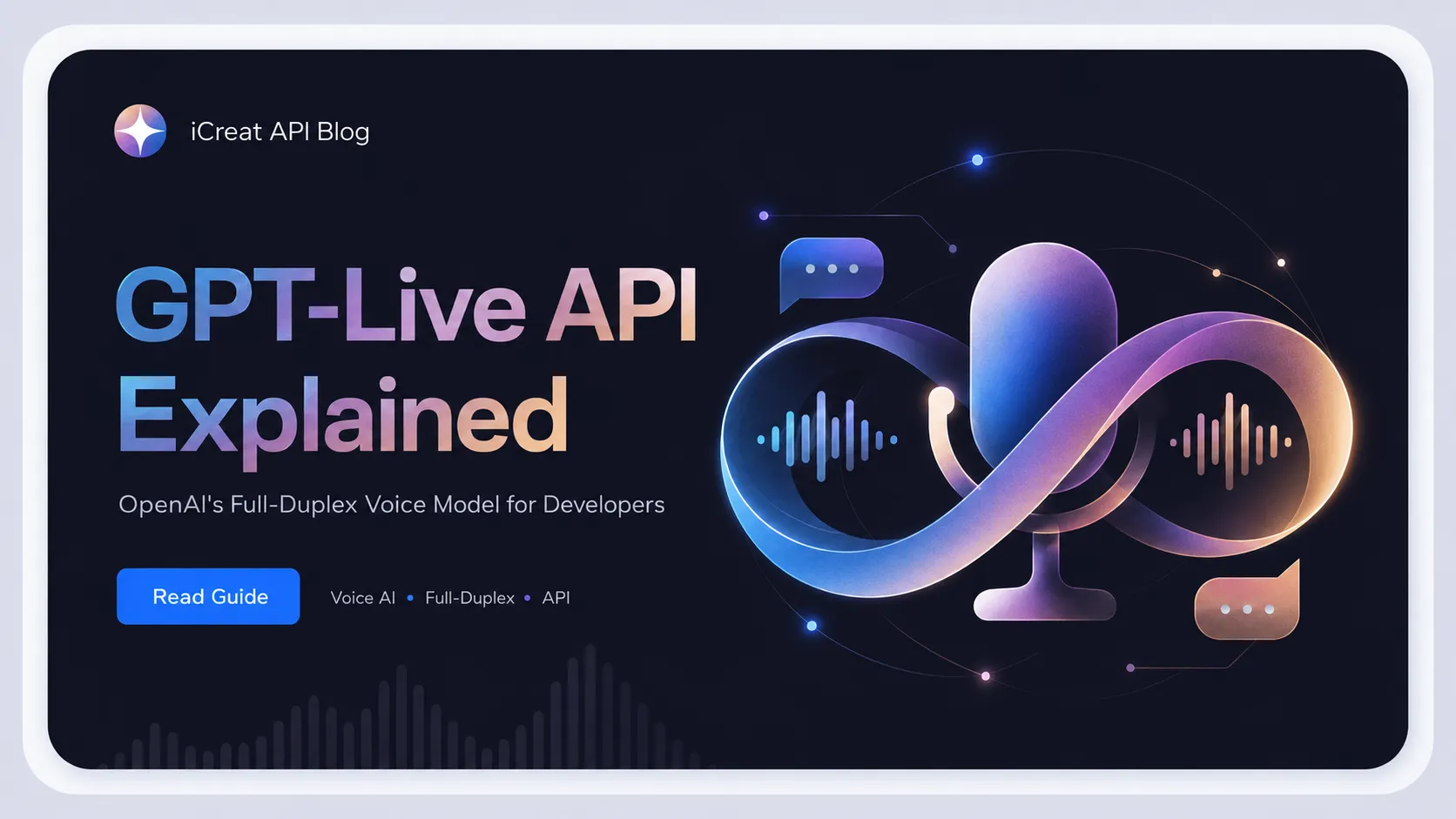




OpenAI's GPT-Live is often described as a breakthrough for real-time voice conversations. That description is accurate, but it is not the full story. For developers, the more important question is not only how GPT-Live sounds. The more important question is how it changes the architecture of AI products.
GPT-Live is built on a full-duplex architecture, which means it can listen and speak at the same time. OpenAI says this allows the model to acknowledge that it is listening, engage in quick back-and-forth exchanges, or stay quiet when the user needs a moment to think. (OpenAI)
But GPT-Live is not only a voice interaction model. OpenAI also says GPT-Live can delegate questions that require web search, deeper reasoning, or more complex work to a frontier model in the background. At launch, that backend model is GPT-5.5. (OpenAI)
That detail matters because it reveals the real architecture behind the next generation of voice AI products.
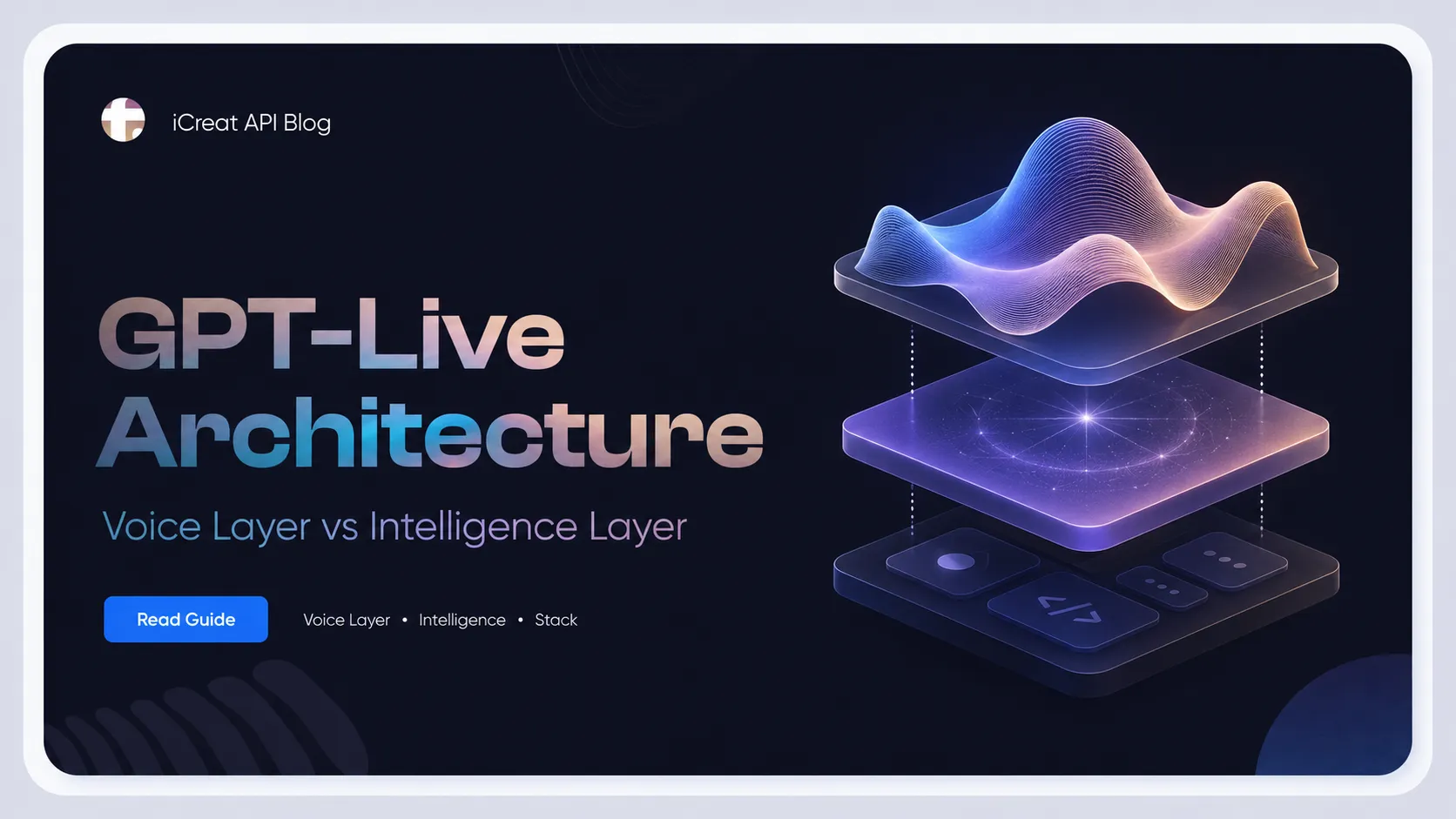
GPT-Live should be understood as the voice layer. GPT-5.5 should be understood as the intelligence layer. Your product logic, tools, database, CRM, codebase, or workflow system forms the application layer.
For developers building voice agents, customer support assistants, workflow tools, coding assistants, real-time tutors, or mobile AI products, this distinction is critical. A voice AI product is not one model. It is a system of layers.
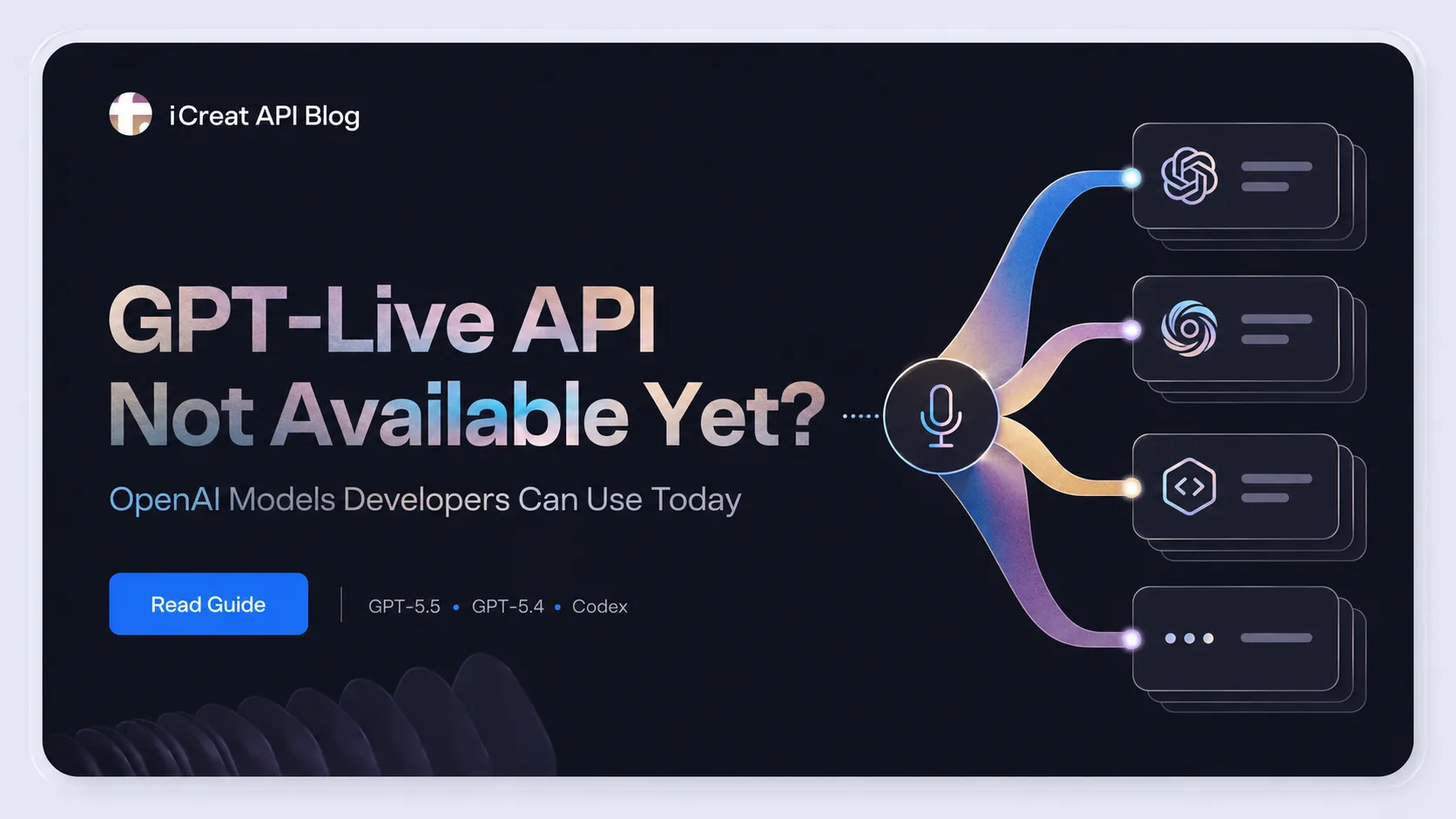
On iCreat API, developers can already start building the intelligence layer with OpenAI-compatible model APIs such as GPT-5.5, GPT-5.4, GPT-5.4 mini, and GPT-5.3 Codex. That means teams do not need to wait for GPT-Live API access to start designing the backend logic of a voice-first product.
The simple version: GPT-Live is the voice layer, GPT-5.5 is the intelligence layer
The easiest way to understand GPT-Live architecture is to separate what the user experiences from what the system has to solve.
The user experiences the voice layer. They hear the AI respond. They interrupt it. They pause. They add context mid-sentence. They expect the assistant to listen naturally and answer at the right moment.
The system also needs an intelligence layer. It must understand what the user wants, reason through the request, decide whether a tool is needed, call that tool, process the result, and generate an answer that is useful.
These two layers are connected, but they are not the same.
| Layer | What it handles | Example |
|---|---|---|
| Voice layer | Listening, speaking, turn-taking, interruptions, pauses, live conversation flow | GPT-Live |
| Intelligence layer | Reasoning, planning, search synthesis, tool use, complex answers, agentic workflows | GPT-5.5 |
| Application layer | Product logic, customer data, database, CRM, calendar, codebase, payment system, internal tools | Your app backend |
This is why GPT-Live and GPT-5.5 should not be treated as competitors. GPT-Live controls the real-time conversational experience. GPT-5.5 can power the deeper reasoning behind the experience.
In a real product, both layers matter.
A voice agent that sounds natural but cannot reason well will not solve real user problems. A model that reasons well but cannot interact naturally may feel awkward in live conversation. The strongest voice AI products will combine natural interaction with strong backend intelligence.
Why the voice layer matters
The voice layer controls how the AI conversation feels.
In older AI voice systems, the conversation often feels turn-based. The user speaks. The system waits. The model processes the message. Then the system speaks back. That can work for simple use cases, but it often creates awkward pauses, delayed responses, or unnatural interruption handling.
OpenAI's Realtime API was introduced to help developers build low-latency multimodal experiences and natural speech-to-speech conversations. It supports streaming audio input and output and can handle interruptions automatically. (OpenAI)
GPT-Live goes further by emphasizing continuous interaction. Instead of treating a conversation as a sequence of isolated messages, GPT-Live can process input while generating output. OpenAI says this allows the model to make interaction decisions during the conversation, including whether to speak, keep listening, pause, interrupt, or invoke a tool. (OpenAI)
That is why the voice layer matters. It is not just about speech quality. It is about timing, flow, and conversational control.
For example, a language learning assistant should not interrupt every time the learner pauses for a second. A customer support voice agent should allow the user to correct details mid-sentence. A mobile assistant should be able to acknowledge that it is listening without taking over the conversation. A hands-free workflow agent should know when to keep listening and when to act.
These are voice-layer problems. GPT-Live is designed to address them.
Why the intelligence layer matters
The intelligence layer controls whether the AI product actually helps the user.
A voice assistant can sound natural and still fail if it gives weak answers. A support agent can handle interruptions smoothly and still fail if it cannot understand the user's problem. A coding assistant can feel conversational and still fail if it cannot reason about the code.
That is why GPT-Live's delegation model is so important. OpenAI says GPT-Live can send questions that require web search, deeper reasoning, or more complex work to a frontier model in the background, and at launch it uses GPT-5.5 for that deeper work. (OpenAI)
The intelligence layer is responsible for tasks such as understanding intent, reasoning across multiple steps, summarizing context, choosing tools, generating accurate responses, and deciding when to ask a follow-up question.
For developers, this means GPT-5.5 is not just another model option. It can be the reasoning backend behind a GPT-Live-style application.
If a user asks, "Why was my invoice higher this month, and what should I do next?" the voice layer has to listen and respond naturally. But the intelligence layer has to inspect billing data, compare plans, explain the charge, identify possible next steps, and decide whether escalation is needed.
That is not a speech problem. That is a reasoning and workflow problem.
The architecture of a GPT-Live-style product
A GPT-Live-style product can be understood as a stack.
User voice input -> voice interaction layer -> intelligence model -> tools and business logic -> response generation -> voice, text, or visual output
Each layer has a different job.
The voice interaction layer handles the live conversation. It listens, speaks, manages pauses, handles interruptions, and keeps the flow natural.
The intelligence model understands the user's intent and decides what needs to happen. It may answer directly, ask a clarification question, call a tool, search information, summarize context, or route the task to another model.
The tools and business logic layer connects the AI to the real product. This could include your CRM, database, payment system, codebase, calendar, ticketing system, documentation, ecommerce backend, or internal workflow tools.
The output layer returns the result in the format the user needs. That might be spoken audio, text, a visual card, a summary, a recommended action, or an update inside the product.
This layered structure is important because it helps developers avoid one of the most common mistakes in voice AI: treating voice AI as only an audio problem.
A voice product is not just speech input and speech output. It is a real-time interface connected to a reasoning engine and application workflow.
Voice layer vs intelligence layer: a practical comparison
Developers should evaluate the voice layer and intelligence layer using different criteria.
| Question | Voice layer concern | Intelligence layer concern |
|---|---|---|
| Does the assistant respond at the right time? | Yes | No |
| Can the assistant handle interruptions naturally? | Yes | No |
| Can it stay quiet while the user is thinking? | Yes | No |
| Can it reason through a complex request? | No | Yes |
| Can it call tools and use business data? | Partly | Yes |
| Can it decide which model or workflow to use? | No | Yes |
| Can it generate a reliable final answer? | Partly | Yes |
| Can it control cost through model routing? | No | Yes |
This comparison shows why GPT-Live and GPT-5.5 solve different problems.
GPT-Live improves the live interaction. GPT-5.5 improves the reasoning and task-completion layer. Both are important, but they should be evaluated separately.
If your product feels slow, awkward, or unnatural in spoken conversation, you have a voice-layer problem. If your product gives shallow answers, fails at complex tasks, or cannot use tools correctly, you have an intelligence-layer problem.
Where iCreat API fits in this architecture
iCreat API fits into the intelligence layer and model routing layer.
iCreat API is built for developers who need one API for image, video, audio, 3D, avatar, and LLM models, with transparent pay-as-you-go pricing. For OpenAI models, developers can use an OpenAI-compatible API workflow, official channel access, and unified billing.
For a GPT-Live-style product, this is useful because the backend does not need to rely on one model for every request. Different tasks can use different models.
| Task | Suggested model on iCreat API |
|---|---|
| Advanced reasoning, agentic workflows, complex support issues | GPT-5.5 |
| General assistant responses, customer support, content workflows | GPT-5.4 |
| Intent detection, short answers, lightweight routing, high-volume tasks | GPT-5.4 mini |
| Code explanation, debugging, tests, developer tools | GPT-5.3 Codex |
This is the practical advantage of building with a model aggregation platform. You can test models on real prompts, compare output quality, estimate cost, and decide which model should power each layer of your application.
For LLM models, you do not need to frame the workflow as Playground-first. Teams can start with a small recharge, send real API requests, test output quality, and scale only after they understand how each model performs.
Example 1: customer support voice agent
Consider a customer support voice agent.
The user says:
"I was charged twice, one payment says pending, and I need to know whether I should contact my bank."
The voice layer needs to capture the user's speech, stay responsive, handle pauses, and make the conversation feel calm and natural. A GPT-Live-style interface could be useful for that part.
The intelligence layer has a different job. It must identify the issue, understand the difference between pending and completed charges, check customer data, call payment tools, explain what likely happened, and decide whether the issue should be escalated.
A practical backend could work like this:
| Step | Backend action | Model fit |
|---|---|---|
| Classify the request | Detect billing issue and urgency | GPT-5.4 mini |
| Handle standard explanation | Explain pending vs completed charges | GPT-5.4 |
| Investigate complex issue | Reason over payment data and policy | GPT-5.5 |
| Generate escalation summary | Prepare support handoff if needed | GPT-5.5 |
In this architecture, GPT-Live would improve the live conversation. GPT-5.5 would improve the quality of the reasoning. GPT-5.4 mini would reduce cost for simple routing tasks.
This is the kind of system developers can start building before GPT-Live API becomes widely available.
Example 2: voice-driven coding assistant
Now consider a voice-driven coding assistant.
The developer says:
"Look at this error, explain what caused it, and suggest the smallest safe fix."
The voice layer needs to support a hands-free experience. It needs to let the developer interrupt, add context, or change direction without restarting the whole interaction. GPT-Live could eventually make that experience feel more natural.
But the actual work happens in the intelligence layer.
The assistant must inspect the error, understand the surrounding code, identify the likely cause, suggest a fix, explain tradeoffs, and possibly generate tests. That requires code understanding and reasoning.
A practical backend could route the task like this:
| Task | Model fit |
|---|---|
| Detect that the request is code-related | GPT-5.4 mini |
| Explain the error in simple language | GPT-5.3 Codex |
| Propose a safe fix | GPT-5.3 Codex or GPT-5.5 |
| Reason through broader architecture tradeoffs | GPT-5.5 |
This shows why the intelligence layer should be designed separately from the voice layer. Voice makes the interaction easier. The backend model makes the answer useful.
Example 3: workflow assistant for internal teams
A voice-first workflow assistant might help employees update CRM records, summarize meetings, check project status, or create follow-up tasks.
The user might say:
"Summarize the last customer call, update the opportunity stage, and draft a follow-up email for tomorrow morning."
The voice layer has to understand the spoken request and keep the interaction smooth. But the intelligence layer has to split the request into actions, retrieve the call transcript, summarize it, update CRM fields, draft an email, and perhaps ask for confirmation before making changes.
This is a classic agentic workflow. It is not only a conversation. It is a task sequence.
A backend architecture could use GPT-5.4 mini to classify the request, GPT-5.5 to plan the workflow, and application tools to retrieve call data, update CRM fields, and create the draft email.
The voice layer is the interface. The intelligence layer is the planner. The application layer is where the work actually happens.
Why model routing matters
Model routing is one of the most important design decisions in a GPT-Live-style system.
If every request goes to the strongest model, the product may become unnecessarily expensive. If every request goes to the cheapest model, the product may fail on complex tasks. A good system should route requests based on complexity, risk, and expected value.
A simple routing strategy could look like this:
| Request type | Model choice |
|---|---|
| Simple intent classification | GPT-5.4 mini |
| Short FAQ answer | GPT-5.4 mini or GPT-5.4 |
| General conversation | GPT-5.4 |
| Complex reasoning | GPT-5.5 |
| Agentic workflow | GPT-5.5 |
| Coding task | GPT-5.3 Codex |
| Code task requiring broader reasoning | GPT-5.3 Codex + GPT-5.5 |
This matters even more for voice AI because conversations can produce many small requests. A user might ask clarifying questions, interrupt, correct details, or change direction. Without routing, every interaction may become more expensive than necessary.
iCreat API helps developers test this routing logic across multiple OpenAI models through one API workflow. That makes it easier to decide where GPT-5.5 should be used and where a smaller model is enough.
Cost structure: why the intelligence layer should be designed early
Voice AI products can become cost-sensitive quickly. Real-time sessions may involve repeated interactions, tool calls, summaries, follow-up questions, and context updates.
That is why developers should think about model cost early, not after the product is already built.
On iCreat API, the current OpenAI model pricing is pay-as-you-go:
| Model | Input price | Output price | Cache read price |
|---|---|---|---|
| GPT-5.5 | $0.5000 / 1M tokens | $3.0000 / 1M tokens | $0.0500 / 1M tokens |
| GPT-5.4 | $0.2500 / 1M tokens | $1.5000 / 1M tokens | $0.0250 / 1M tokens |
| GPT-5.4 mini | $0.0750 / 1M tokens | $0.4500 / 1M tokens | $0.0070 / 1M tokens |
| GPT-5.3 Codex | $1.7500 / 1M tokens | $14.0000 / 1M tokens | $0.1750 / 1M tokens |
Always check the latest pricing page before building production workloads.
The point is not that the lowest-cost model is always best. The point is that the intelligence layer should be intentional. Developers should know which tasks deserve GPT-5.5, which tasks can use GPT-5.4, and which tasks are better handled by GPT-5.4 mini.
That is how teams build products that are both capable and cost-aware.
What developers can build before GPT-Live API is available
Developers do not need to wait for GPT-Live API to design the intelligence layer.
Before GPT-Live API becomes widely available, teams can already define assistant behavior, write system prompts, test real user requests, connect tools, design model routing, build fallback logic, test cost assumptions, and decide when to escalate from a smaller model to GPT-5.5.
They can also build the application layer. For example, a support product can connect to ticketing systems and customer databases. A coding assistant can connect to repositories and IDE context. A workflow assistant can connect to CRM, calendars, and internal documents.
These pieces will still matter when the voice layer changes.
When GPT-Live API becomes available with official documentation, pricing, rate limits, and integration details, teams that already have backend logic in place can evaluate it as the live interface layer. They will not need to rebuild the entire product.
Common architecture mistake: one model for everything
A common mistake is assuming that a voice AI product needs one model to do everything.
That approach sounds simple, but it usually creates problems. If the model is optimized for voice interaction, it may not be the best choice for deep reasoning. If the model is optimized for deep reasoning, it may not be the best choice for real-time conversation flow. If every task uses the strongest model, cost can rise quickly. If every task uses the cheapest model, quality may suffer.
A layered architecture avoids this problem.
The voice layer can focus on interaction. The intelligence layer can focus on reasoning. The application layer can focus on product logic. The routing layer can decide which model fits each task.
This is especially important for model aggregation platforms like iCreat API. The value is not only that developers can call multiple models. The value is that developers can build smarter routing strategies across models.
Common architecture mistake: treating voice as the final product
Another mistake is treating voice as the final product.
Voice is an interface. It can make an AI product easier to use, more natural, and more accessible. But voice alone does not create value. The product still needs to solve a real problem.
A customer support voice agent must resolve support issues. A coding assistant must help developers write or understand code. A workflow assistant must complete tasks. A tutoring assistant must help users learn.
The voice layer makes the experience smoother. The intelligence layer determines whether the product is useful.
GPT-Live is exciting because it improves the interface. GPT-5.5 is important because it can power the deeper work behind the interface.
How to explain this architecture to your team
If your team is planning a voice AI product, a useful internal framing is:
Do not ask, "Should we use GPT-Live or GPT-5.5?" Ask, "Which layer are we designing?"
If you are designing live conversation flow, latency, interruptions, and turn-taking, you are designing the voice layer.
If you are designing reasoning, tool use, memory, workflow steps, routing, and answer quality, you are designing the intelligence layer.
If you are designing CRM updates, database lookups, order changes, codebase access, or user permissions, you are designing the application layer.
This framing helps teams make better technical decisions. It also prevents product planning from becoming too dependent on one model release.
Final thoughts: build the intelligence layer now
GPT-Live is a major step toward more natural real-time voice AI. Its full-duplex architecture allows the model to listen and speak at the same time, and OpenAI says it can delegate deeper work to GPT-5.5 in the background. (OpenAI)
For developers, the most important takeaway is architectural.
GPT-Live is the voice layer. GPT-5.5 can be the intelligence layer. Your tools, database, and business workflows form the application layer. A real voice AI product needs all of them.
That means developers do not need to wait for GPT-Live API access to start building. They can test prompts, compare OpenAI models, design model routing, connect tools, and prepare the backend now.
With iCreat API, developers can access GPT-5.5, GPT-5.4, GPT-5.4 mini, and GPT-5.3 Codex through one OpenAI-compatible API workflow, with official channel access, unified billing, and transparent pay-as-you-go pricing.
Build the intelligence layer now. When the voice layer is ready, your product will be ready to use it.