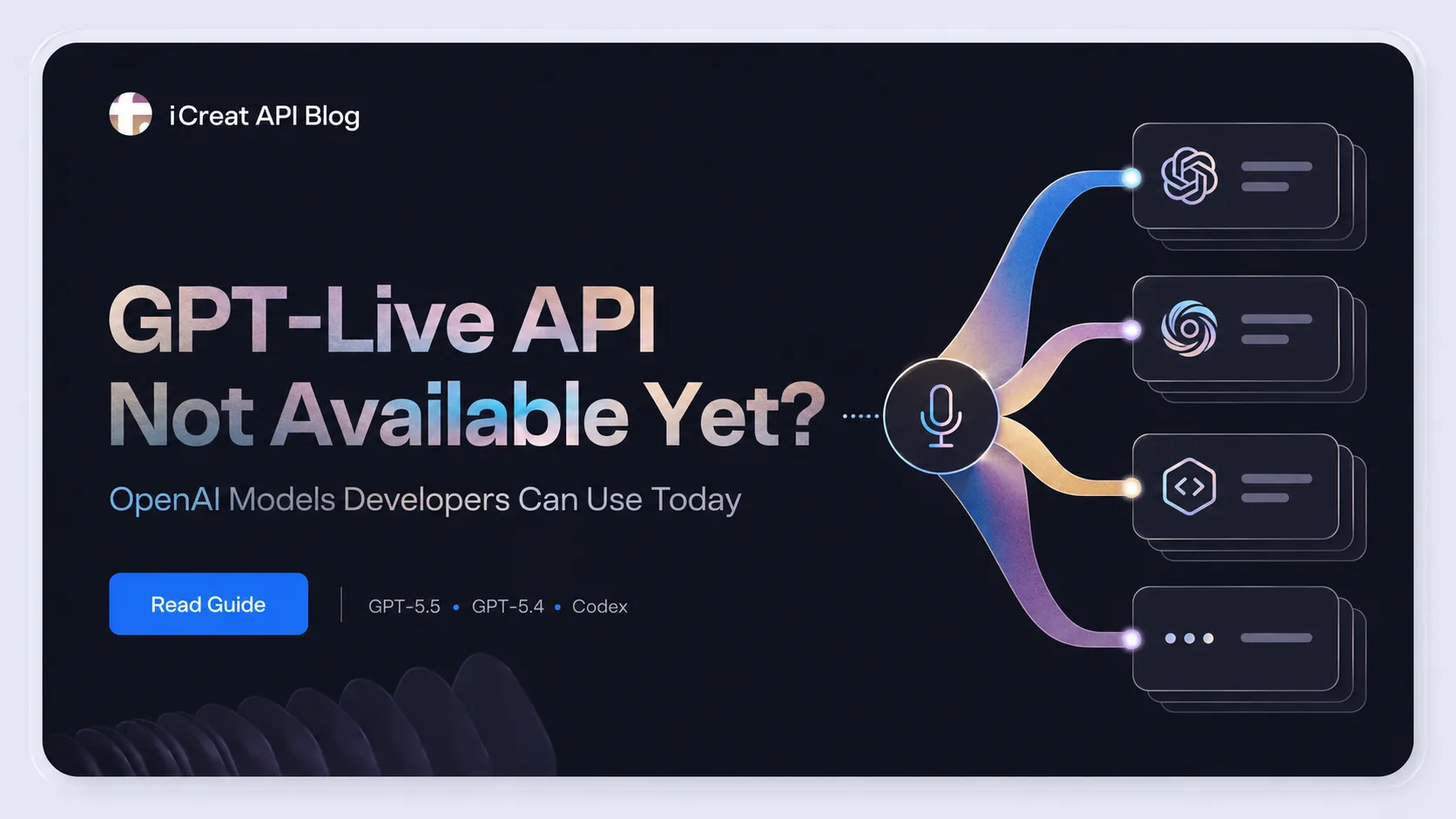




OpenAI's GPT-Live release has created a lot of interest around real-time voice AI. It is easy to understand why. GPT-Live is designed for more natural human-AI conversations, with a full-duplex architecture that allows the model to listen and speak at the same time instead of waiting for rigid back-and-forth turns. (OpenAI)
But this also creates confusion for developers. If GPT-Live is the new voice model, what is GPT-5.5? Is GPT-Live the same thing as GPT-5.5? Should developers wait for GPT-Live API, or start building with GPT-5.5 API today?
The short answer is: GPT-Live and GPT-5.5 are not the same thing.
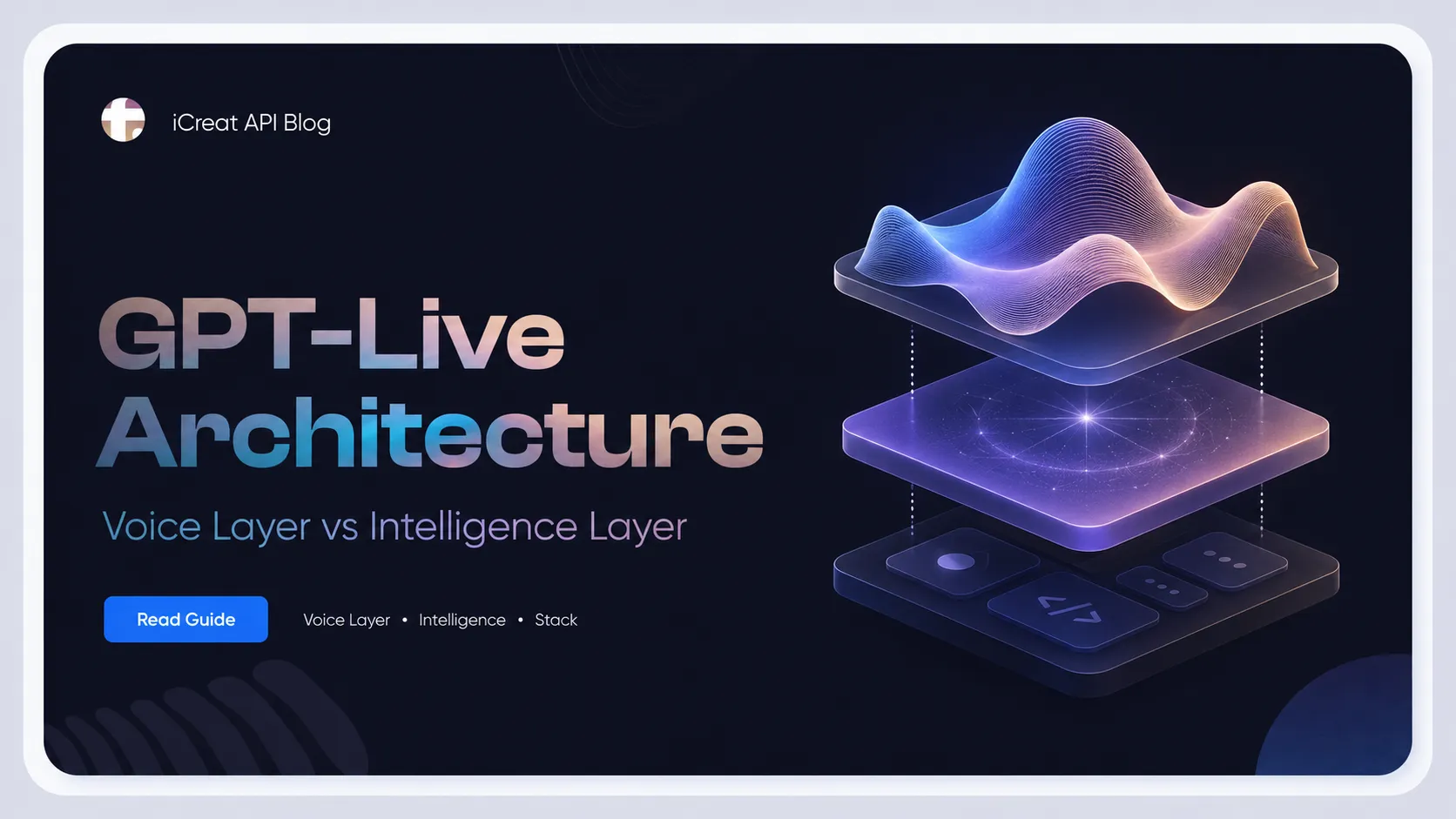
GPT-Live is best understood as the voice interaction layer. It handles real-time conversation flow, listening, speaking, pauses, interruptions, and natural turn-taking. GPT-5.5 is best understood as a powerful intelligence layer that can handle deeper reasoning, complex task execution, coding, research, data analysis, and agentic workflows. OpenAI says GPT-Live can delegate complex work to GPT-5.5 in the background at launch. (OpenAI)
For developers, that distinction matters. If you are building a voice agent, customer support assistant, AI workflow tool, or voice-driven product experience, you may not need to wait for GPT-Live API before building the backend. You can start with GPT-5.5 API today and design the intelligence layer first.
On iCreat API, developers can access GPT-5.5 and other OpenAI models through an OpenAI-compatible API, with official channel access, unified billing, and pay-as-you-go pricing.
Quick answer: GPT-Live vs GPT-5.5
GPT-Live and GPT-5.5 solve different parts of the AI product stack.
| Category | GPT-Live | GPT-5.5 API |
|---|---|---|
| Main role | Voice interaction layer | Intelligence and reasoning layer |
| Primary input/output | Real-time voice conversation | Text-based model API for reasoning and generation |
| Best for | Listening, speaking, interruption handling, natural conversation flow | Complex reasoning, agentic workflows, coding, research, analysis, backend AI logic |
| Developer use case | Real-time voice interface when API access is available | Backend model for assistants, agents, workflows, support tools, coding tools |
| Relationship | Can delegate deeper work to backend models | Can power the complex reasoning behind voice AI products |
The simplest way to think about it is this:
GPT-Live helps the AI conversation feel natural. GPT-5.5 helps the AI product think, reason, and complete complex work.
That is why GPT-5.5 matters even if your long-term goal is to build a voice-first product. The voice layer may change over time, but the intelligence layer still needs to be designed, tested, and optimized.
What is GPT-Live?
GPT-Live is OpenAI's new generation of voice models for natural human-AI interaction. It is designed to power ChatGPT Voice and make spoken conversations feel more fluid and responsive. Unlike older turn-based voice systems, GPT-Live can keep the conversation moving while listening and speaking in a more continuous way. (OpenAI)
OpenAI describes GPT-Live as a full-duplex voice model. In practice, that means it can listen and speak at the same time. It can also make real-time interaction decisions, such as when to talk, when to keep listening, when to stay quiet, when to handle an interruption, and when to call a tool. (OpenAI)
This is important because many older AI voice systems feel unnatural. They often wait for the user to finish speaking, process the message, generate a response, and then read the response out loud. Even when the model is smart, the interaction can feel slow or mechanical.
GPT-Live is trying to improve the conversation experience itself. It is less about writing a better paragraph and more about managing the rhythm of a live conversation.
For users, that means voice AI may feel more human. For developers, it means the voice interface is becoming a more serious product layer.
What is GPT-5.5 API?
GPT-5.5 is a frontier intelligence model built for complex work. OpenAI describes GPT-5.5 as strong in professional tasks such as coding, research, information synthesis, analysis, document-heavy work, and agentic workflows. (OpenAI)
In a developer product, GPT-5.5 API is not mainly about the sound of a conversation. It is about what happens after the user asks for something.
Can the model understand the request?
Can it reason through a multi-step problem?
Can it synthesize information?
Can it decide what tool to call?
Can it produce a reliable answer?
Can it support a workflow that takes more than one turn?
Those are intelligence-layer questions. GPT-5.5 is the kind of model developers use when answer quality, task completion, and reasoning depth matter more than simply producing a fast short response.
For example, GPT-5.5 API can be useful for:
| Use case | Why GPT-5.5 fits |
|---|---|
| Advanced voice agents | It can handle complex reasoning behind a spoken interface. |
| Customer support workflows | It can explain policies, summarize context, and support multi-step troubleshooting. |
| Research assistants | It can synthesize information and support document-heavy work. |
| Agentic workflows | It can reason across steps and support more complex task execution. |
| Coding assistants | It can help with code explanation, debugging, and engineering workflows. |
This is why GPT-5.5 API is directly relevant to the GPT-Live conversation. GPT-Live may handle the live voice experience, but GPT-5.5 can power the deeper intelligence behind it.
The key difference: interface layer vs intelligence layer
The most useful way to compare GPT-Live and GPT-5.5 is to separate the AI product stack into layers.
GPT-Live is closer to the interface layer. It is about how the user talks to the AI system. It manages the flow of a live voice conversation.
GPT-5.5 is closer to the intelligence layer. It is about how the AI system understands the request, reasons about it, and produces useful output.
A voice AI product may need both layers, but they are not the same.
Here is a simple architecture:
User voice input -> voice interaction layer -> intelligence model -> tools and business logic -> response -> voice or visual output
In this stack, GPT-Live belongs near the front. It makes the live conversation feel natural. GPT-5.5 belongs in the middle. It handles the deeper reasoning and decision-making that make the product useful.
This is also how OpenAI frames GPT-Live's deeper work. OpenAI says GPT-Live can delegate questions that require web search, deeper reasoning, or more complex work to GPT-5.5 in the background. (OpenAI)
That detail is important. It means GPT-Live is not replacing GPT-5.5. It is using GPT-5.5 for the kind of work that requires stronger intelligence.
Why developers should not confuse GPT-Live with GPT-5.5
Confusing GPT-Live with GPT-5.5 can lead to the wrong product decisions.
If you think GPT-Live is simply "the better GPT-5.5," you might wait for the wrong thing. If you think GPT-5.5 is a voice model, you may expect it to solve interaction problems that belong to the voice layer.
The better approach is to ask what your product actually needs.
If your problem is that the conversation feels too slow, too turn-based, or too awkward, then you are dealing with a voice interaction problem. GPT-Live is relevant to that layer.
If your problem is that the assistant gives weak answers, cannot reason through complex tasks, fails to summarize context, or cannot handle tool-based workflows, then you are dealing with an intelligence problem. GPT-5.5 is relevant to that layer.
Many real products need both. A customer support voice agent, for example, needs natural conversation flow. But it also needs to understand policies, check order data, summarize user history, explain next steps, and escalate edge cases. The voice layer controls how the interaction feels. The intelligence layer controls whether the system actually solves the problem.
Should developers wait for GPT-Live API?
Not necessarily.
GPT-Live is an important release, and developers building voice-first products should watch its API availability closely. But waiting for GPT-Live API before building anything may slow you down unnecessarily.
The reason is simple: the backend architecture of a voice AI product can be built before the final voice layer is ready.
Developers can already work on:
| Backend task | Why it matters |
|---|---|
| Prompt design | Defines how the assistant should respond across different scenarios. |
| Intent classification | Helps route user requests to the right model or workflow. |
| Tool calling logic | Connects the assistant to search, CRM, databases, calendars, codebases, or product systems. |
| Model routing | Sends lightweight requests to smaller models and complex requests to stronger models. |
| Cost control | Prevents every request from being routed to the most expensive model. |
| Response evaluation | Tests whether the model produces reliable answers for real user prompts. |
All of these can be started with GPT-5.5 and other OpenAI models.
When GPT-Live API becomes available with clear documentation, pricing, rate limits, and integration details, developers who already have a working intelligence layer will be in a stronger position. They can evaluate GPT-Live as the voice interface, rather than starting the whole product from zero.
When should you use GPT-5.5 API?
Use GPT-5.5 API when the quality of the answer matters more than using the lowest-cost model for every request.
GPT-5.5 is especially useful when your application needs advanced reasoning, task planning, context synthesis, or agentic behavior. OpenAI describes GPT-5.5 as strong for professional work such as coding, research, information synthesis, analysis, and document-heavy tasks. (OpenAI)
For a voice AI product, GPT-5.5 can be the backend model that handles the hard parts:
A user asks a complicated support question.
A customer wants an explanation of a policy.
A sales assistant needs to compare product options.
A workflow agent needs to summarize a database result.
A coding assistant needs to explain an error and propose a fix.
A research assistant needs to synthesize information across documents.
These are not just voice problems. They are reasoning problems. That is where GPT-5.5 API becomes useful.
On iCreat API, GPT-5.5 can be used as the high-quality intelligence layer behind AI assistants, voice agents, support workflows, research tools, and agentic applications.
When should you use GPT-Live?
Use GPT-Live when your main requirement is natural real-time voice interaction.
GPT-Live is relevant when the product experience depends on spoken conversation feeling smooth and responsive. This matters for hands-free assistants, live translation, voice-first mobile apps, call center experiences, tutoring products, accessibility tools, and any application where the user expects the AI to listen and respond in real time.
However, GPT-Live should not be treated as the entire product architecture. A natural voice interface still needs a strong backend if the product needs to solve complex problems.
A good way to think about GPT-Live is:
GPT-Live makes the conversation feel natural. GPT-5.5 makes the assistant useful for complex work.
If your product needs both, then the best strategy is not to choose one and ignore the other. The best strategy is to design the stack clearly: voice layer, intelligence layer, application logic, and output layer.
How iCreat API helps developers build the GPT-5.5 layer today
iCreat API is built for developers who need one API for image, video, audio, 3D, avatar, and LLM models. For OpenAI models, iCreat API provides OpenAI-compatible access through an official channel, with unified billing and transparent pay-as-you-go pricing.
For this article's topic, the most important model is GPT-5.5. If GPT-Live points toward the future of live voice interaction, GPT-5.5 is the model developers can use today to build the intelligence layer behind advanced assistants and agents.
Developers can use iCreat API to test GPT-5.5 with real prompts, compare it with other OpenAI models, and decide how it should fit into a production workflow. For LLM models, instead of relying on a Playground flow, teams can start with a small recharge, run real requests, and evaluate output quality and cost before scaling up.
This is useful because most production systems should not use one model for everything. A better architecture may look like this:
| Task type | Suggested model |
|---|---|
| Complex reasoning or agentic work | GPT-5.5 |
| General assistant responses | GPT-5.4 |
| High-volume lightweight tasks | GPT-5.4 mini |
| Developer or coding workflows | GPT-5.3 Codex |
This type of model routing is exactly where a model aggregation platform becomes valuable. Developers can compare output quality, pricing, and task fit without treating every model as interchangeable.
GPT-5.5 vs GPT-5.4 vs GPT-5.4 mini for voice AI backends
Although this article focuses on GPT-Live vs GPT-5.5, many developers will not want to send every backend request to GPT-5.5. For voice AI products, cost and routing matter.
On iCreat API, developers can choose between several OpenAI models depending on workload complexity.
| Model | Input price | Output price | Cache read price | Best fit |
|---|---|---|---|---|
| GPT-5.5 | $0.5000 / 1M tokens | $3.0000 / 1M tokens | $0.0500 / 1M tokens | Complex reasoning, high-quality assistants, agentic workflows |
| GPT-5.4 | $0.2500 / 1M tokens | $1.5000 / 1M tokens | $0.0250 / 1M tokens | General assistant use cases and support workflows |
| GPT-5.4 mini | $0.0750 / 1M tokens | $0.4500 / 1M tokens | $0.0070 / 1M tokens | High-volume lightweight tasks and first-pass routing |
| GPT-5.3 Codex | $1.7500 / 1M tokens | $14.0000 / 1M tokens | $0.1750 / 1M tokens | Coding assistants and developer workflows |
Always check the latest pricing before building production workloads.
The practical point is that GPT-5.5 is not always the cheapest model, and it does not need to handle every request. It should handle the requests where its stronger reasoning and task-completion capabilities matter.
For example, a voice agent could use GPT-5.4 mini to classify intent, GPT-5.4 to answer standard questions, GPT-5.5 to handle complex multi-step issues, and GPT-5.3 Codex to answer coding-related questions.
That is a more scalable backend strategy than sending every request to one model.
Example: GPT-Live and GPT-5.5 in a customer support voice agent
Imagine you are building a customer support voice agent.
The user speaks into the app and asks:
"I was charged twice, but one charge says pending and the other says completed. Can you check what happened and tell me what to do next?"
The voice layer needs to capture the user's speech, manage the conversation, and respond naturally. In the future, GPT-Live could be a strong fit for that interaction layer.
But the intelligence layer has a different job. It needs to understand the problem, identify the billing issue, call the right internal tools, read the account state, compare the two charges, explain the difference between pending and completed payments, and decide whether to escalate.
That is where GPT-5.5 is useful.
In this example, GPT-Live would help the conversation feel natural. GPT-5.5 would help the assistant reason through the billing problem and generate a useful response. The final product needs both layers to work well.
This is why developers should not think of GPT-Live and GPT-5.5 as competitors. They are different parts of the same future AI stack.
Example: GPT-Live and GPT-5.5 in a coding assistant
Now imagine a developer using a voice-driven coding assistant.
The user says:
"Look at this error, explain what caused it, and suggest the smallest safe fix."
The voice layer needs to make the interaction hands-free and responsive. If the developer interrupts, adds context, or changes direction, the interface should handle that smoothly.
But the intelligence layer has to do the hard work. It needs to understand the error, inspect the code context, reason about likely causes, propose a fix, and explain tradeoffs. Depending on the workflow, this could involve GPT-5.5 for reasoning or GPT-5.3 Codex for code-specific tasks.
Again, GPT-Live and GPT-5.5 are not the same. GPT-Live improves how the developer talks to the assistant. GPT-5.5 or GPT-5.3 Codex improves what the assistant can actually do.
Common mistake: treating voice AI as only a speech problem
One of the most common mistakes in voice AI planning is treating the product as only a speech problem.
Developers may focus entirely on latency, voice quality, turn-taking, and interruption handling. Those are important, but they are only part of the product.
A voice assistant that sounds natural but gives weak answers will still fail. A voice agent that speaks smoothly but cannot use tools will still be limited. A support bot that can listen well but cannot understand business rules will still frustrate users.
Voice AI products need both interaction quality and intelligence quality.
GPT-Live is exciting because it improves the interaction layer. GPT-5.5 is important because it can improve the intelligence layer.
The best developer strategy is to design for both.
Final thoughts: GPT-Live is the voice layer, GPT-5.5 is the intelligence layer
GPT-Live and GPT-5.5 are connected, but they are not the same.
GPT-Live is built for natural real-time voice interaction. It helps the AI listen, speak, handle interruptions, and maintain conversation flow. GPT-5.5 is built for complex work, reasoning, coding, research, analysis, and agentic workflows. OpenAI's own GPT-Live architecture shows the relationship clearly: GPT-Live can delegate deeper work to GPT-5.5 in the background. (OpenAI)
For developers, the practical takeaway is simple:
Do not wait for the voice layer to build the intelligence layer.
If you are planning a voice agent, AI assistant, support workflow, coding assistant, or real-time product experience, you can start testing GPT-5.5 API today. Build the backend logic, test prompts, design routing, connect tools, and understand cost before the final voice layer is available.
With iCreat API, developers can access GPT-5.5 and other OpenAI models through one OpenAI-compatible API workflow, with official channel access, unified billing, and pay-as-you-go pricing.
Start with GPT-5.5 for the intelligence layer, compare it with GPT-5.4 and GPT-5.4 mini for cost-sensitive tasks, and prepare your product for the next generation of voice AI.