



Introduction
Grok 4.5 has quickly become one of the most discussed AI model releases for developers, especially for teams working on coding agents, long-running tool-use workflows, and knowledge-heavy automation. According to the official xAI release page, Grok 4.5 is positioned as SpaceXAI's smartest model for coding, agentic tasks, and knowledge work. It was also trained alongside Cursor, which makes the release especially relevant for developers who care about real software engineering workflows rather than only benchmark scores. (SpaceXAI)
The attention around Grok 4.5 is understandable. Developers are not only asking whether the model is powerful. They are asking more practical questions: How much does the Grok 4.5 API cost? Is Grok 4.5 available through an API? How does it perform on coding benchmarks? Is it good for agents? And if Grok 4.5 is not available in a specific stack, region, or provider account, what other API-ready models can be used instead?
This article explains Grok 4.5 from a developer and API buyer perspective. We will cover its core capabilities, pricing, benchmarks, availability, and use cases. Then we will look at alternative LLM models developers can use for coding, reasoning, agentic workflows, and cost-sensitive production workloads.
What Is Grok 4.5?
Grok 4.5 is a new model release from SpaceXAI, described by the company as its strongest model so far for coding, agentic tasks, and knowledge work. The official release emphasizes that Grok 4.5 was trained on datasets across coding, science, engineering, and math, with a focus on real engineering tasks and efficient reasoning. (SpaceXAI)
What makes this release different from a typical general-purpose chatbot update is its positioning. Grok 4.5 is not only being presented as a model that can answer questions. It is being positioned as a model that can work through complex tasks, use tools, write and debug code, build applications, and handle broader knowledge work across business and technical domains.
Cursor's own release adds important context. Cursor says Grok 4.5 is a mixture-of-experts model trained jointly with SpaceXAI. It also states that the model was trained with trillions of tokens of Cursor data, capturing interactions with codebases, software tools, and developer-agent workflows. (Cursor)
That detail matters because many developers are now evaluating models based on how they behave inside real coding workflows, not only how they score on isolated reasoning prompts. A model that understands how developers interact with codebases, tools, terminals, and multi-step debugging processes may be more useful for agentic coding than a model optimized only for short question answering.
Grok 4.5 Main Capabilities
Coding and software engineering
The most direct use case for Grok 4.5 is coding. The official xAI release says Grok 4.5 is capable of handling challenging Rust and C/C++ tasks, as well as end-to-end app building from prompt to production. It also shows examples of apps built from a single prompt, which suggests that the model is being marketed not only for code completion, but also for larger software construction tasks. (SpaceXAI)
For developers, this means Grok 4.5 should be evaluated less like a simple autocomplete model and more like an agentic coding model. The relevant question is not only "Can it write a function?" A better question is: Can it inspect a codebase, identify a bug, plan a fix, use tools, recover from mistakes, and verify the result?
That is where Grok 4.5's positioning becomes interesting. The model is being released into a market where developers increasingly expect LLMs to act as coding agents. These agents need to handle longer context, make multi-step decisions, work with files and tools, and maintain consistency across a task.
Agentic tasks and tool use
Cursor describes Grok 4.5 as a model for difficult, long-running tasks that require creative tool use. The examples are not limited to software engineering. Cursor also mentions data science, finance, legal work, and other computer-based tasks. (Cursor)
This is important because the model's real market is broader than "AI coding assistant." Many teams are now building internal agents that combine code, search, documents, spreadsheets, APIs, and business workflows. A useful model for these workloads must do more than produce fluent text. It needs to investigate a problem, decide what tools to use, recover from errors, and produce a verifiable output.
Cursor's release also says the reinforcement learning environments for Grok 4.5 were designed around realistic software engineering and broader knowledge work. These environments were meant to teach the model to investigate problems, use tools, recover from mistakes, and verify results. (Cursor)
That makes Grok 4.5 especially relevant for developers evaluating models for AI agents, not just chat interfaces.
Knowledge work beyond code
One of the more interesting parts of the Grok 4.5 release is that Cursor says the model was built for more than software engineering. While Cursor's previous model, Composer 2.5, was trained as a coding specialist, Grok 4.5 used a broader training mix that included high-quality STEM tasks, research papers, and other knowledge work. (Cursor)
This helps explain why the official release repeatedly connects Grok 4.5 with "knowledge work." The model is meant to operate across technical and business tasks, not only programming tasks. For teams building AI products, this matters because real users rarely stay inside one clean category. A single workflow might involve code, documentation, spreadsheets, finance data, legal text, and web research.
A model that can move across these domains may be more useful for end-to-end automation than a model that is excellent at only one narrow task.
Office work: Excel, PowerPoint, and Word
The official xAI release also highlights Grok 4.5's Office work capabilities. It says Grok 4.5 is now the default model in Grok Build and can work with complex Excel models involving web research, multi-sheet formulas, and notes for future reference. The release also says Grok 4.5 can use native PowerPoint shapes to build diagrams, design slide content, and write clear prose in Word. (SpaceXAI)
This may look like a secondary feature, but it points to a larger trend. LLMs are moving from "answer engines" to "work engines." Users do not only want a model to explain a spreadsheet formula. They want it to build the spreadsheet. They do not only want slide copy. They want structured slides with diagrams. They do not only want a summary of a document. They want a polished business output.
For developers, this creates new product opportunities. Grok 4.5-style models can be used as the reasoning layer behind document agents, spreadsheet copilots, business intelligence assistants, report generators, and internal workflow automation tools.
Grok 4.5 Benchmarks
Grok 4.5 has strong benchmark positioning, but the benchmark story should be read carefully. The official release includes several engineering and coding-related benchmark results, including DeepSWE 1.0, DeepSWE 1.1, SWE Marathon, Terminal Bench 2.1, and SWE Bench Pro. (SpaceXAI)
On DeepSWE 1.0, the official page shows Grok 4.5 at 62.0%, behind Fable max at 66.1% and GPT 5.5 xhigh at 64.31%, but ahead of Opus 4.8 max at 55.75%. On SWE Marathon, Grok 4.5 is shown at 29.0%, ahead of Opus 4.8 max at 26.0% and Fable max at 24.0%. On Terminal Bench 2.1, Grok 4.5 is shown at 83.3%, very close to GPT 5.5 xhigh at 83.4% and Fable max at 84.3%. On SWE Bench Pro, Grok 4.5 is shown at 64.7%, behind Fable max and Opus 4.8 max, but ahead of several other listed models. (SpaceXAI)
The key takeaway is not that Grok 4.5 wins every benchmark. A more accurate reading is that Grok 4.5 is highly competitive across several coding and agentic engineering evaluations, while different models still lead on different tests.
That distinction is important for developers. If you are choosing a model for production, you should not rely on a single benchmark. Coding models can behave differently depending on the task type, framework, programming language, context length, tool environment, latency requirements, and cost constraints.
A team building a coding repair agent may care most about bug-fixing accuracy. A team building a document automation tool may care more about structured reasoning and output reliability. A team running large-scale customer workflows may care most about price, latency, and token efficiency. Grok 4.5 appears strong, but the best model choice still depends on the workload.
Grok 4.5 Pricing
Grok 4.5's pricing is one of the most important parts of the release for developers. According to the official xAI release, Grok 4.5 is priced at $2 per million input tokens and $6 per million output tokens. The same page also claims that Grok 4.5 achieves roughly 2x token efficiency compared with comparable leading models, solving tasks in fewer steps. (SpaceXAI)
Cursor's release gives an additional pricing detail. It says the base model is priced at $2/M input tokens and $6/M output tokens, while a fast variant is priced at $4/M input tokens and $18/M output tokens. (Cursor)
| Grok 4.5 Variant | Input Price | Output Price | Notes |
|---|---|---|---|
| Grok 4.5 | $2 / 1M tokens | $6 / 1M tokens | Base model pricing |
| Grok 4.5 Fast | $4 / 1M tokens | $18 / 1M tokens | Fast variant mentioned by Cursor |
For API buyers, the important point is that token pricing alone does not fully determine real cost. Output length, tool-call behavior, retry rate, task success rate, and token efficiency all affect the actual cost per completed task.
For example, a model with a higher output token price may still be cost-effective if it completes the task in fewer attempts. A cheaper model may become more expensive if it needs multiple retries, produces invalid code, or requires a second model to verify its output. This is why real-world testing is essential before choosing a model for production.
Grok 4.5 API Availability
Grok 4.5 is available through several channels. According to the official release,
Grok 4.5 is available in Grok Build, in Cursor on all plans, and through the
SpaceXAI console. The release also provides a short API example using the
grok-4.5 model name. (SpaceXAI)
Cursor says Grok 4.5 is available across desktop, web, iOS, CLI, and its SDK. Cursor also says individual and team plans include usage of the model as part of its first-party model pool. (Cursor)
There is one important regional limitation. The official xAI release notes that Grok 4.5 is not yet available in the EU in SpaceXAI products or the API console, with EU availability expected in mid-July. (SpaceXAI)
For developers searching for "Grok 4.5 API," this means the answer is yes: Grok 4.5 has API access through the SpaceXAI console. But availability may still depend on region, provider access, account setup, and whether the developer wants to use Grok directly or compare it with other models inside a multi-model stack.
Is Grok 4.5 Worth Using?
Grok 4.5 is worth testing if your use case involves coding, long-running agents, technical reasoning, or knowledge work automation. Its strongest positioning is not casual chat. Its strongest positioning is real work: software engineering, tool use, multi-step tasks, office workflows, and technical problem solving.
It may be especially relevant if you are building:
| Use Case | Why Grok 4.5 Is Relevant |
|---|---|
| Coding agents | Strong positioning around software engineering and codebase workflows |
| App generation | Official examples show end-to-end app building from prompts |
| Agentic tool use | Cursor highlights long-running tasks requiring tool use |
| Office automation | Official release highlights Excel, PowerPoint, and Word workflows |
| Technical research | Training mix includes coding, science, engineering, math, STEM tasks, and research work |
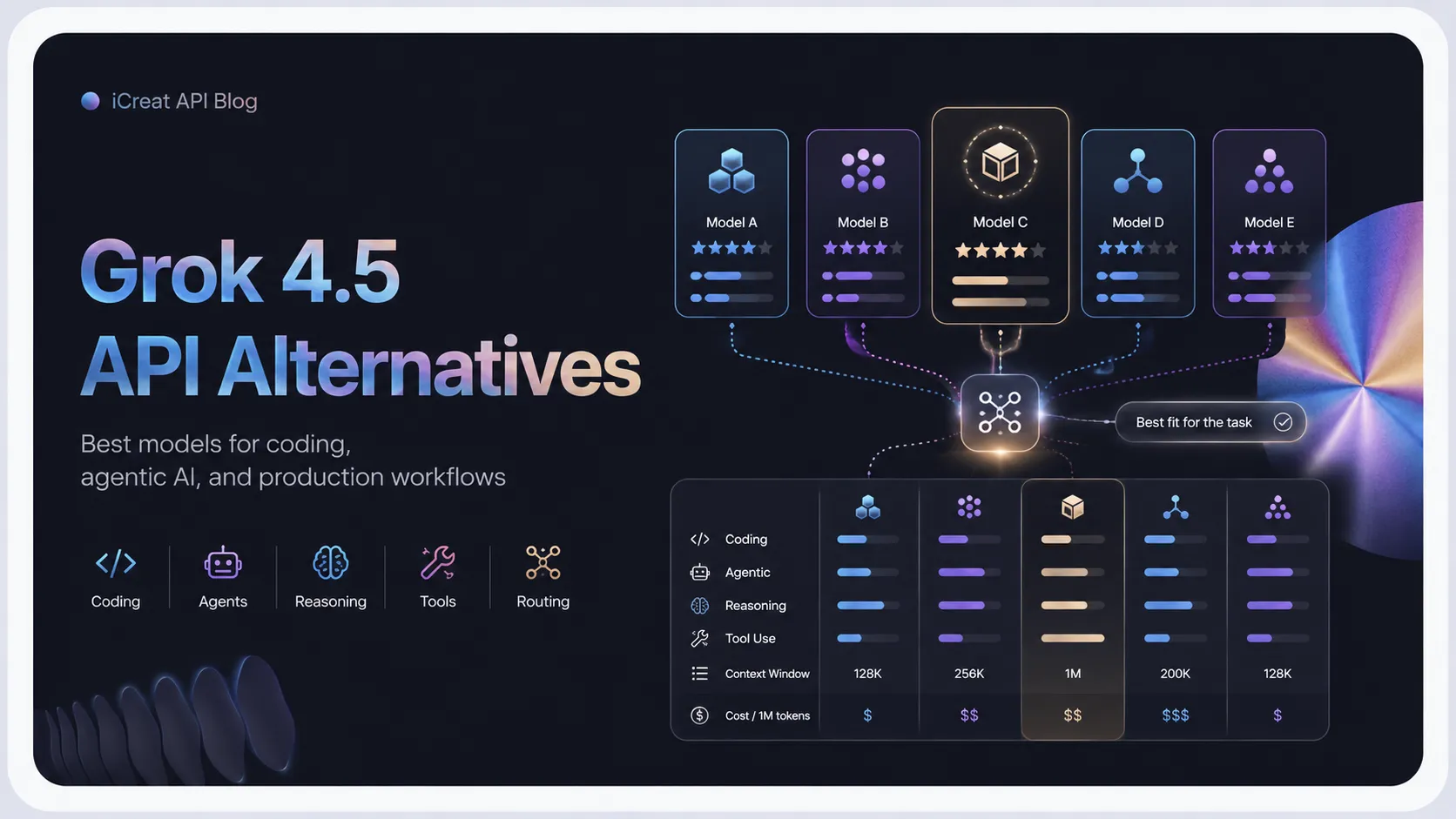
At the same time, Grok 4.5 is not the only model developers should consider. If you are evaluating models for production, you may also want to compare GPT, Claude, Gemini, DeepSeek, and other LLMs based on price, latency, model behavior, API compatibility, and your specific workload.
This is especially true if your goal is not simply to use Grok 4.5, but to build a reliable product with the best available model for each task.
What If You Need Grok-Like Workflows but Want Other API-Ready Models?
iCreat API does not currently provide Grok 4.5. However, if you are researching Grok 4.5 because you need coding, reasoning, agentic workflows, or knowledge work automation, iCreat API provides access to other LLM models from OpenAI, Anthropic, Google, DeepSeek, and more through one unified API.
This is useful for developers who do not want to integrate multiple providers separately. Instead of managing separate accounts, billing systems, API formats, and model endpoints, you can compare multiple model families from one place.
For example, developers looking at Grok 4.5 may also consider the following models on iCreat API:
| If You Are Interested in Grok 4.5 For... | Models to Consider on iCreat API |
|---|---|
| Coding agents |
gpt-5.3-codex, gpt-5.5,
claude-opus-4.8, claude-sonnet-4.6
|
| Advanced reasoning |
gpt-5.5, claude-opus-4.8,
gemini-3.1-pro-preview
|
| Balanced coding and general tasks |
gpt-5.4, claude-sonnet-4.6,
gemini-3.1-pro-preview
|
| Cost-sensitive LLM calls |
gpt-5.4-mini, gpt-5.4-nano,
gemini-3.5-flash, deepseek-v4-flash
|
| Fast model comparison | OpenAI, Anthropic, Google, and DeepSeek models through one API |
The right model depends on your workload. A coding assistant may need a stronger reasoning model. A large-scale classification pipeline may need a cheaper and faster model. A business automation product may need a balanced model that handles structured output, long instructions, and reliable formatting.
Grok 4.5 Pricing vs Other LLM API Options
Grok 4.5's base price is competitive at $2 per million input tokens and $6 per million output tokens. But developers should compare it against the specific models they can actually use in their production stack.
Here are selected LLM prices currently listed for models available through iCreat API:
| Model | Provider | Input Price | Output Price | Good Fit |
|---|---|---|---|---|
gpt-5.5 |
OpenAI | $5.00 / 1M tokens | $30.00 / 1M tokens | High-quality reasoning and complex tasks |
gpt-5.3-codex |
OpenAI | $1.75 / 1M tokens | $14.00 / 1M tokens | Coding-oriented workloads |
gpt-5.4 |
OpenAI | $2.50 / 1M tokens | $15.00 / 1M tokens | General-purpose LLM applications |
gpt-5.4-mini |
OpenAI | $0.75 / 1M tokens | $4.50 / 1M tokens | Lower-cost production tasks |
gpt-5.4-nano |
OpenAI | $0.20 / 1M tokens | $1.25 / 1M tokens | High-volume, cost-sensitive calls |
claude-opus-4.8 |
Anthropic | $5.00 / 1M tokens | $25.00 / 1M tokens | Advanced reasoning and agentic tasks |
claude-sonnet-4.6 |
Anthropic | $3.00 / 1M tokens | $15.00 / 1M tokens | Balanced coding and reasoning |
claude-haiku-4.5 |
Anthropic | $1.00 / 1M tokens | $5.00 / 1M tokens | Faster, lower-cost Claude workloads |
gemini-3.1-pro-preview |
$2.00 / 1M tokens | $12.00 / 1M tokens | Reasoning and general AI workflows | |
gemini-3.5-flash |
$1.50 / 1M tokens | $9.00 / 1M tokens | Fast general-purpose workloads | |
gemini-2.0-flash-lite-001 |
$0.08 / 1M tokens | $0.30 / 1M tokens | Very low-cost lightweight tasks | |
deepseek-v4-flash |
DeepSeek | $0.17 / 1M tokens | $0.34 / 1M tokens | Budget-sensitive experimentation |
deepseek-v4-pro |
DeepSeek | $1.80 / 1M tokens | $3.70 / 1M tokens | Lower-cost reasoning and coding tests |
For developers, this comparison shows why a multi-model API platform can be useful. Grok 4.5 may be attractive for a certain type of coding and agentic workload, but production systems often need more than one model. A common setup might use a stronger model for difficult reasoning, a cheaper model for routing or classification, and a faster model for high-volume background tasks.
How to Choose a Grok 4.5 Alternative
If you are searching for Grok 4.5 because you want a strong coding model, start by
testing models such as gpt-5.3-codex, gpt-5.5,
claude-opus-4.8, and claude-sonnet-4.6. These are better
candidates for software engineering tasks than lightweight models designed mainly
for speed or cost.
If you are building an agent that needs to handle long instructions, tool use,
planning, and multi-step reasoning, compare higher-end models such as
gpt-5.5, claude-opus-4.8, and
gemini-3.1-pro-preview. The best choice will depend on how each model
behaves in your actual workflow, not only on public benchmark results.
If cost is the main concern, lower-cost models such as gpt-5.4-mini,
gpt-5.4-nano, gemini-2.0-flash-lite-001,
deepseek-v4-flash, and deepseek-v4-pro may be better
starting points. These models may not replace a frontier coding model for complex
tasks, but they can be useful for classification, extraction, routing,
summarization, and large-scale automation.
The safest approach is to test multiple models on the same task set. Use your own prompts, your own expected outputs, and your own cost constraints. Public benchmarks are useful, but your production workload is the benchmark that matters most.
Build With Multiple LLM Models Through iCreat API
Grok 4.5 is an important release for developers interested in coding agents, engineering automation, and knowledge work. It offers competitive pricing, strong benchmark results in several coding-related tasks, API access through the SpaceXAI console, and deep integration with Cursor workflows. (SpaceXAI)
But if your goal is to build with API-ready LLMs today, you may want to compare more than one model. iCreat API gives developers access to OpenAI, Anthropic, Google, DeepSeek, and other model providers through one API, one account, and unified billing.
You can explore available models on the iCreat API Models page, review integration details in the Docs, compare current model pricing on the Pricing page, and sign up to start testing model output with a small recharge.
For teams comparing Grok 4.5 with other LLMs, the practical question is not only "Which model is the newest?" The better question is: Which model gives the best result for your real task, at the right cost, through an API stack you can actually ship with?
iCreat API is built for that kind of comparison.