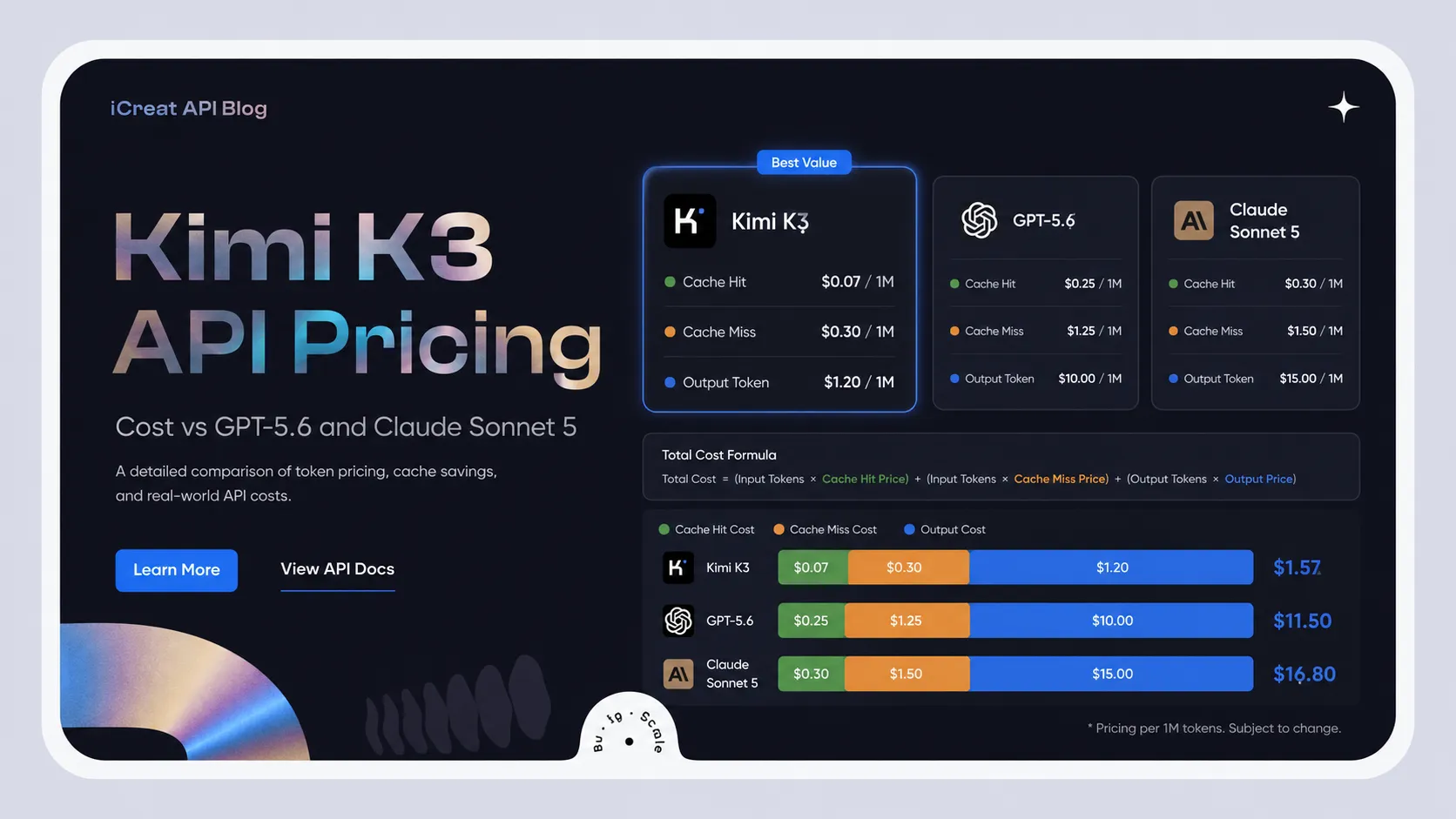



When Kimi K3 was announced, it quickly became one of the most discussed AI models among developers. With a 2.8 trillion parameter architecture, a 1 million token context window, native vision capabilities, and an open model strategy, Kimi K3 represents a major step forward for large-scale AI systems.
But for developers building real applications, the biggest question is not simply:
Which AI model has the highest benchmark score?
The more practical question is:
Which AI model should I use for my specific workflow?
The AI model market in 2026 has become much more complicated. Developers now have access to powerful models from different providers, including open models like Kimi K3 and proprietary models such as GPT-5.6 and Claude Sonnet 5. Each model has different strengths.
Some models are better at long reasoning tasks. Some perform better in coding environments. Others are stronger for writing, analysis, or agent workflows.
This means choosing an AI model is no longer about finding a single winner. It is about understanding which model fits your application.
In this guide, we compare Kimi K3 vs GPT-5.6 vs Claude Sonnet 5 across capabilities, developer workflows, and production considerations. We will also explain why modern AI applications increasingly need access to multiple models instead of depending on only one.
Kimi K3, GPT-5.6, and Claude Sonnet 5 Represent Different AI Strategies
Before comparing individual capabilities, it is important to understand that these models are built with different goals.
Kimi K3 focuses on scaling open intelligence and long-horizon agent workflows.
GPT-5.6 focuses on advanced reasoning, coding reliability, and production-ready AI applications.
Claude Sonnet 5 focuses on strong general intelligence, knowledge work, and complex reasoning tasks.
The best choice depends on what you are building.
Kimi K3: A Large Open Model Designed for Long-Horizon Intelligence
Kimi K3 is Moonshot AI’s latest large-scale model. According to its official release, Kimi K3 is a 2.8 trillion parameter model built with Kimi Delta Attention (KDA) and Attention Residuals (AttnRes). It is described as the first open 3T-class model, with native vision capabilities and a 1 million token context window.
The model is designed around tasks that require sustained reasoning over long periods, including:
- Software engineering
- Autonomous coding workflows
- Knowledge research
- Complex document analysis
- Agent-based tasks
Kimi K3’s strongest positioning is not simply raw model size. Its advantage comes from combining a very large architecture with long-context capability and agent-oriented workflows.
For example, the model demonstrates strong performance in coding-related tasks where an AI system needs to understand large repositories, work through multiple steps, and maintain context across a long session.
For developers interested in open models, Kimi K3 represents an important milestone because it expands access to frontier-level AI capabilities beyond closed providers.
However, model capability is only one part of production AI development. Developers also need to consider:
- API availability
- infrastructure requirements
- latency
- operational cost
- integration complexity
A powerful model does not automatically become the best production choice for every application.
GPT-5.6: Strong Reasoning and Production-Ready AI Development
GPT-5.6 represents the direction of highly optimized proprietary AI systems.
For developers, the value of GPT models is not only benchmark performance. The larger advantage comes from a mature ecosystem designed around building applications.
Typical use cases include:
- Complex reasoning
- Code generation
- Structured outputs
- Tool calling
- AI agents
- Business automation
When developers build production systems, reliability often matters as much as intelligence.
A model may generate impressive answers in testing, but production applications require predictable behavior, stable APIs, and compatibility with existing development workflows.
For teams building customer-facing applications, GPT-5.6 is often considered when consistency and advanced reasoning are important.
Developers can access GPT models through unified API platforms such as iCreat AI Models, without managing multiple provider integrations separately.
Claude Sonnet 5: Strong Performance for Knowledge Work and Complex Tasks
Claude Sonnet 5 is another leading proprietary model designed for advanced reasoning and professional workflows.
Claude models are widely used for tasks involving:
- Long-form writing
- Research assistance
- Document analysis
- Coding support
- Business workflows
For many teams, Claude’s strength comes from handling complex instructions and maintaining coherent responses across long interactions.
This makes Claude models suitable for applications where the AI needs to understand context, analyze information, and produce high-quality written output.
For example:
- Research assistants
- Content workflows
- Enterprise knowledge systems
- AI-powered productivity tools
Like GPT models, Claude Sonnet 5 is most valuable when developers can easily integrate it into existing applications.
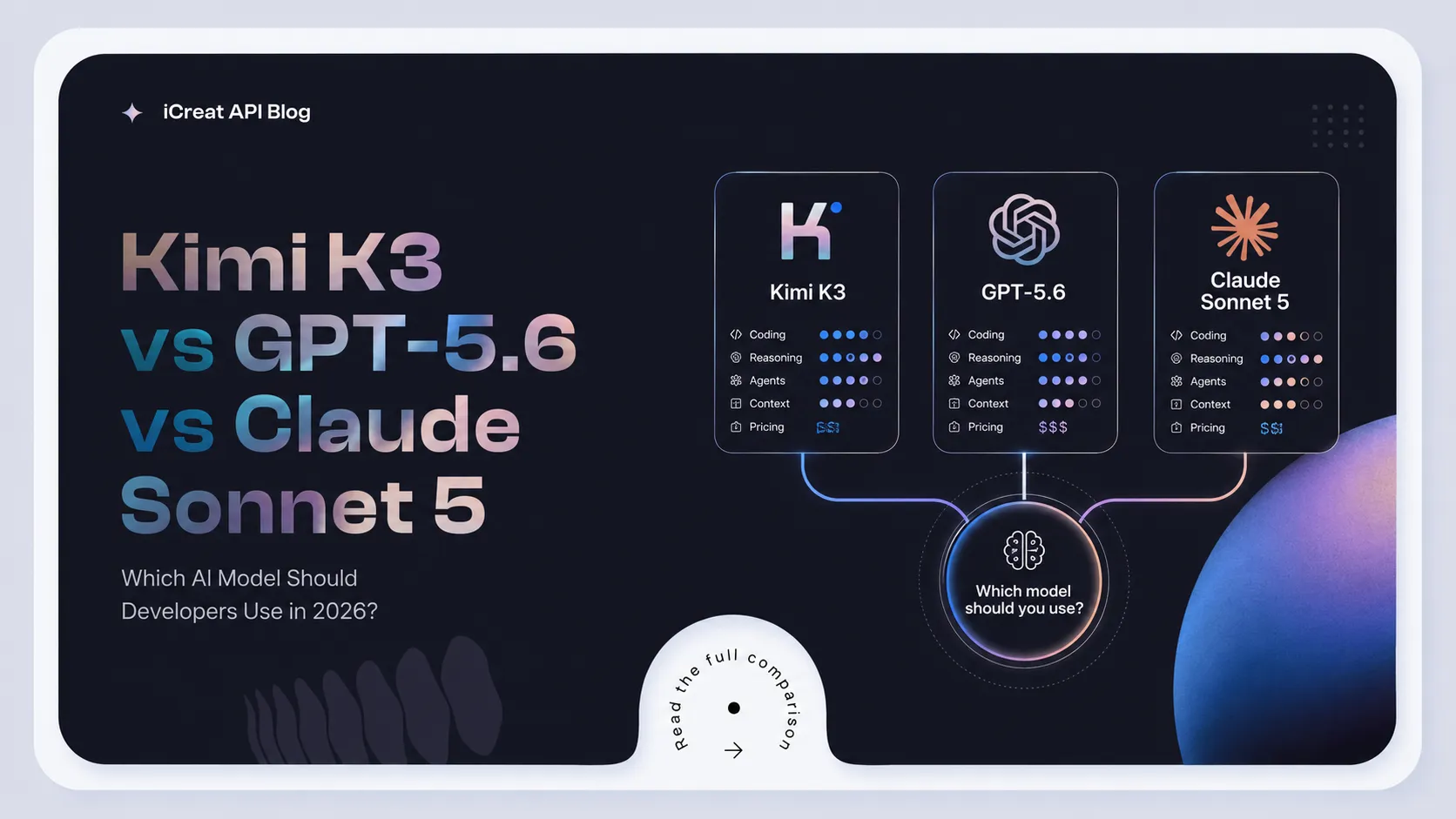
Kimi K3 vs GPT-5.6 vs Claude Sonnet 5: Capability Comparison
There is no universal winner among these models. Each one has different strengths.
| Category | Kimi K3 | GPT-5.6 | Claude Sonnet 5 |
|---|---|---|---|
| Model type | Open model | Proprietary model | Proprietary model |
| Main strength | Long-context agents and open ecosystem | Reasoning and production reliability | Knowledge work and complex analysis |
| Context capability | 1M token context | Advanced context handling | Advanced context handling |
| Coding | Strong | Strong | Strong |
| Agent workflows | Strong | Strong | Strong |
| Open ecosystem | High | Limited | Limited |
| Production ecosystem | Developing | Mature | Mature |
The important takeaway is that benchmark rankings alone do not determine the best model.
A developer building an AI application needs to consider the complete workflow.
Why Benchmark Scores Are Not Enough When Choosing an AI Model
AI benchmarks are useful because they provide measurable comparisons.
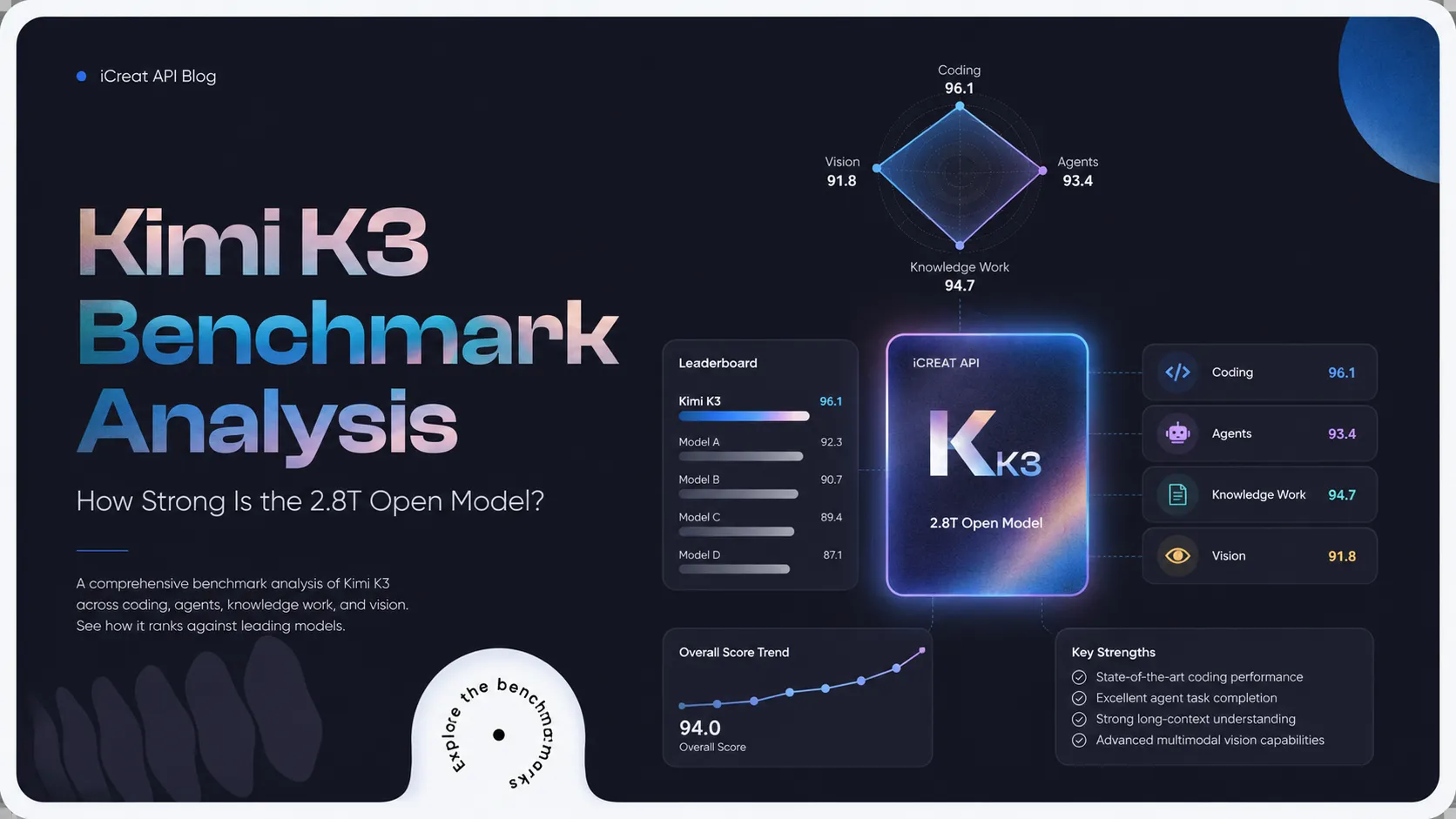
Kimi K3, for example, reports strong results across coding, agent, reasoning, and multimodal evaluations. Its official benchmark results show competitive performance against leading proprietary models across multiple categories.
However, benchmark scores do not answer every production question.
A real application needs to answer:
- How fast does the model respond?
- How predictable is the output?
- How much does each request cost?
- Can the team switch models when requirements change?
- Can developers integrate the model easily?
A model that ranks first on one benchmark may not always be the best option for a specific business workflow.
For example:
A coding assistant may prioritize programming ability.
A customer support system may prioritize reliability and cost.
A content platform may need strong writing plus image and video generation.
Different products require different models.
The Future of AI Development Is Multi-Model, Not Single-Model
A common mistake among developers is choosing one AI model and building everything around it.
This approach worked when the market had only a few major models.
Today, AI applications are becoming more specialized.
A single application may need:
- A reasoning model for complex decisions
- A language model for communication
- An embedding model for search
- An image model for visual generation
- A video model for creative production
For example:
An AI marketing platform might use:
- GPT-5.6 for strategy generation
- Claude Sonnet 5 for long-form copywriting
- image models for creative assets
- video models for advertisements
The question is no longer:
"Which AI model should we use?"
It becomes:
"How can we access the right models efficiently?"
How Developers Can Access Multiple AI Models Through One API
Managing multiple AI providers creates additional engineering challenges.
Each provider may have:
- Different authentication systems
- Different API formats
- Different billing systems
- Different SDK requirements
For development teams, this increases maintenance costs.
This is where unified AI API platforms become valuable.
iCreat AI provides a single API layer for accessing multiple AI capabilities, including large language models, image generation, video generation, embeddings, and other multimodal services.
Instead of maintaining separate integrations, developers can work through one consistent workflow.
One API for Multiple AI Models
With a unified API approach, developers can:
- Compare different models
- Switch models based on performance or cost
- Reduce integration complexity
- Build flexible AI applications
This approach is especially useful as new models continue to launch.
A developer may prefer one model today and another model six months later. A flexible API architecture makes those changes easier.
OpenAI-Compatible API Integration
Compatibility is another important factor.
Developers often already use OpenAI-style API structures in their applications.
Platforms supporting OpenAI-compatible interfaces reduce migration effort and allow teams to experiment with different models without rebuilding their entire stack.
Learn more about API integration through iCreat API Docs.
Unified Billing and Pay-As-You-Go Access
Managing multiple AI providers also creates billing complexity.
A unified platform allows developers to:
- Manage usage in one place
- Track costs more easily
- Pay based on actual usage
For teams testing different AI workflows, this makes experimentation simpler.
You can explore available models and pricing through iCreat Pricing.
Choosing the Right AI Model in 2026
The best AI model depends on your goal.
Choose Kimi K3 if you need:
- Open model access
- Long-context workflows
- Advanced agent experimentation
- Large-scale coding tasks
Choose GPT-5.6 if you need:
- Advanced reasoning
- Reliable production workflows
- Strong developer ecosystem
Choose Claude Sonnet 5 if you need:
- Knowledge work
- Writing quality
- Complex document understanding
Use multiple models if you need:
- Flexible AI applications
- Different models for different tasks
- Lower dependency on one provider
FAQ
Final Thoughts: The Best AI Model Is the One That Fits Your Workflow
Kimi K3 shows how quickly the AI landscape is changing. Large open models are becoming increasingly competitive, while proprietary models continue improving in reliability and ecosystem support.
For developers, the future is unlikely to be about choosing one permanent winner.
The winning strategy is flexibility.
The ability to access different models, compare performance, control costs, and switch workflows will become increasingly important.
With a unified API platform, developers can build applications that adapt as AI models continue to evolve.
Start building with flexible AI model access through Sign up for iCreat.