



Introduction
The AI model market has changed.
A few years ago, choosing an AI model was relatively simple: developers typically selected the most capable general-purpose model available and built their application around it.
Today, that approach is becoming less practical.
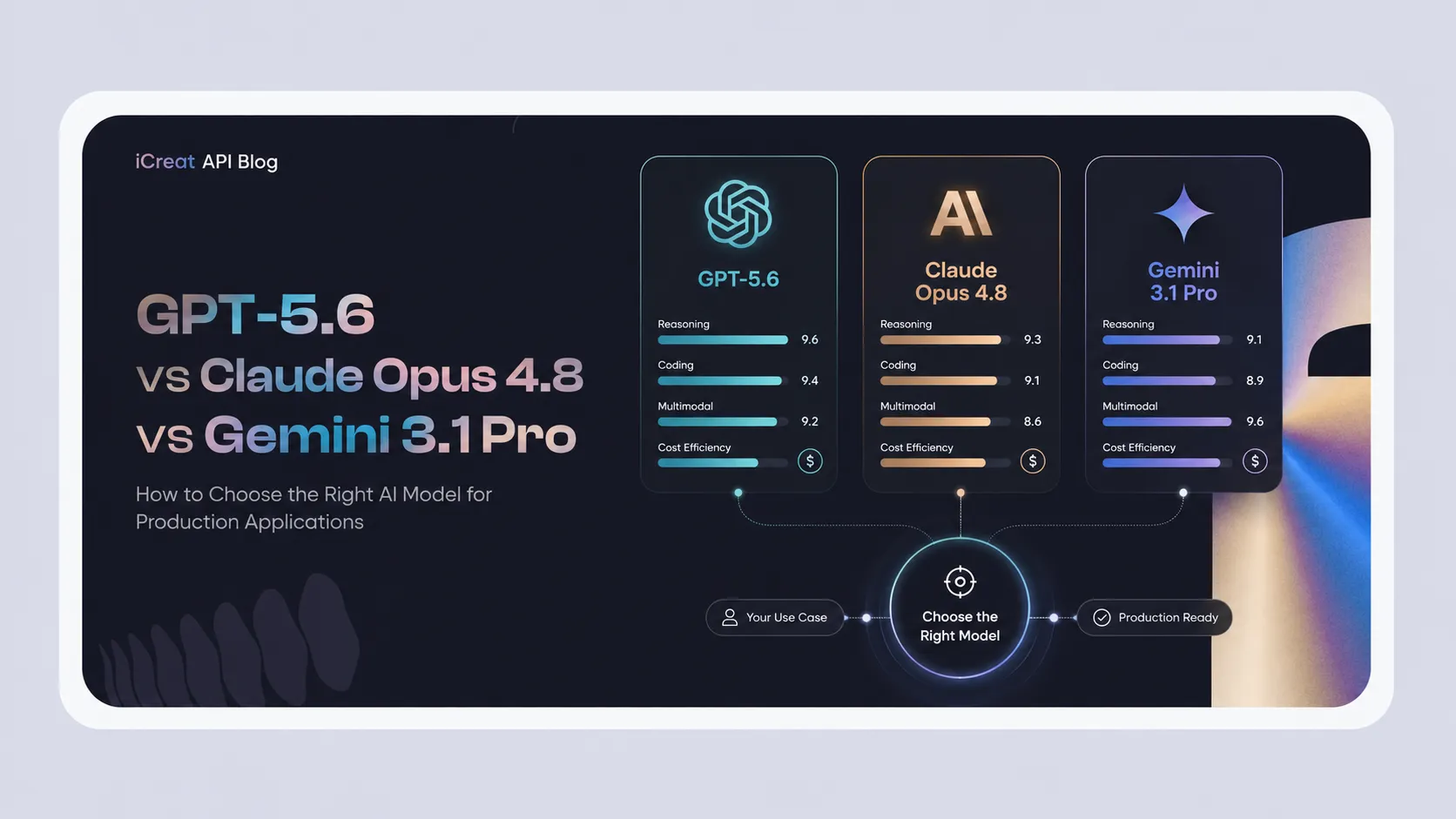
Frontier models such as GPT-5.6, Claude Opus 4.8, and Gemini 3.1 Pro are all highly capable, but they are optimized for different types of work. The strongest model in one scenario may not be the best choice in another.
For a company building an AI product, the real question is no longer:
The better question is:
A modern AI SaaS product may contain multiple AI functions:
- A customer support assistant answering thousands of daily questions.
- A document analysis system processing enterprise knowledge.
- An AI coding assistant helping developers write and debug software.
- An autonomous agent completing multi-step business workflows.
Each function has different requirements.
A customer support chatbot may prioritize:
- Low cost.
- Fast responses.
- High-volume scalability.
An AI research assistant may prioritize:
- Reasoning depth.
- Accuracy.
- Long-context understanding.
An AI coding agent may prioritize:
- Planning ability.
- Tool usage.
- Reliable multi-step execution.
This is why model selection should start with application architecture, not model popularity.
GPT-5.6, Claude Opus 4.8, and Gemini 3.1 Pro each represent different approaches to AI development:
- GPT-5.6 focuses on advanced reasoning, coding, and agent workflows.
- Claude Opus 4.8 focuses on complex reasoning and professional knowledge work.
- Gemini 3.1 Pro focuses on multimodal capabilities and large-context applications.
For developers building AI products, understanding these differences helps create better systems with the right balance of intelligence and cost.
The Best AI Model Depends on Your Application Architecture
A common mistake when selecting AI models is evaluating them as if they are interchangeable.
They are not.
An AI model is not simply a smarter or weaker version of another model. Different models are optimized around different types of interactions.
The first question developers should ask is:
There are three common roles.
1. AI as an Assistant: Optimize for Speed and Cost Efficiency
In many applications, AI works as an assistant.
Examples:
- Customer support chatbot.
- Writing assistant.
- Search assistant.
- Internal productivity tool.
The AI helps users complete tasks, but each individual request usually has relatively low business value.
The priorities are usually:
- Fast response time.
- Predictable cost.
- Good enough accuracy.
- Ability to handle large request volumes.
For these applications, using the most powerful model for every request may not be the best business decision.
For example:
A customer support platform handling one million monthly conversations does not necessarily need the highest-cost reasoning model for every customer question.
A balanced approach may use:
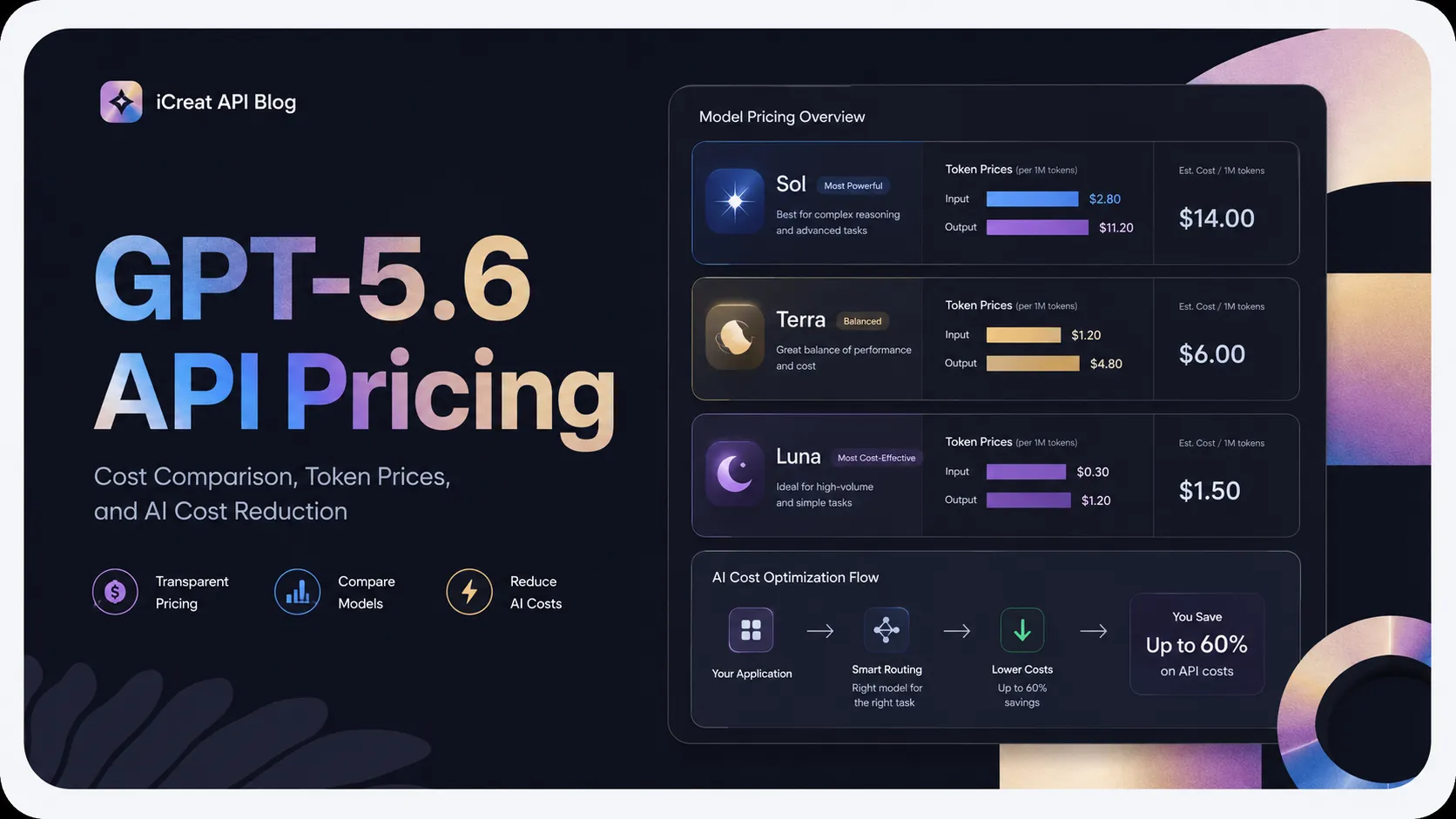
- GPT-5.6 Terra for normal conversations.
- GPT-5.6 Luna for high-volume requests.
- More powerful models only for complex cases.
The goal is not maximum intelligence.
The goal is maximum product efficiency.
2. AI as a Decision Maker: Reasoning Quality Becomes Critical
Some applications do not simply generate responses.
They influence decisions.
Examples:
- Financial analysis tools.
- Enterprise research assistants.
- Legal document systems.
- Business intelligence platforms.
In these scenarios, incorrect outputs can create higher costs.
The key requirement becomes:
A stronger reasoning model may cost more, but the additional accuracy can create more business value.
For these applications, developers often prioritize:
- Logical consistency.
- Multi-step reasoning.
- Understanding complex instructions.
- Reducing incorrect conclusions.
Models such as GPT-5.6 Sol and Claude Opus 4.8 are designed for these higher-value reasoning workloads.
3. AI as an Autonomous Worker: Model Reliability Matters Most
The next generation of AI applications is moving beyond chat interfaces.
Instead of answering one question, AI agents need to complete tasks.
An agent workflow may require:
- Understanding the user's goal.
- Breaking the goal into smaller tasks.
- Calling external tools.
- Evaluating results.
- Adjusting the approach.
- Completing the final output.
This is fundamentally different from generating a single response.
A model that performs well in a simple conversation may not always perform equally well in an autonomous workflow.
Agent applications require:
- Strong reasoning.
- Planning ability.
- Tool calling.
- Context management.
- Error handling.
This is one area where models such as GPT-5.6 become particularly valuable.
Reasoning Capability: Why Intelligence Matters Differently Across Workloads
When developers compare AI models, they often look at benchmark scores.
However, benchmarks do not always represent real production requirements.
The more important question is:
Consider two tasks.
Simple task:
User:
"Summarize this document."
Workflow:
Input -> Understanding -> Output
Agent task:
User:
"Analyze our competitors, identify market opportunities, and create a product strategy."
Workflow:
Understand objective
↓
Break down tasks
↓
Collect information
↓
Evaluate sources
↓
Generate insights
↓
Create recommendation
The second workflow requires much stronger reasoning.
Every additional step introduces opportunities for mistakes.
This is why reasoning capability matters differently depending on the application.
GPT-5.6: Best for Reasoning, Coding, and Agent Workflows
GPT-5.6 is designed for developers building applications that require advanced reasoning and software engineering capabilities.
The GPT-5.6 family includes:
| Model | Best Fit |
|---|---|
| GPT-5.6 Sol | Maximum reasoning capability |
| GPT-5.6 Terra | Balanced production applications |
| GPT-5.6 Luna | Cost-efficient high-volume usage |
GPT-5.6 for Coding Applications
Coding AI is becoming one of the most important AI application categories.
However, coding ability is not only about generating code.
Production coding assistants need to handle:
- Existing codebases.
- Architecture decisions.
- Debugging.
- Testing.
- Refactoring.
- Technical trade-offs.
A useful coding model needs to understand the broader software system, not just complete individual code snippets.
GPT-5.6 is suitable for:
- AI coding assistants.
- Software engineering agents.
- Developer productivity tools.
GPT-5.6 for Agent Applications
Agentic AI requires more than language generation.
Agents need to reason about:
- What action to take.
- When to use tools.
- How to recover from failure.
- How to complete long workflows.
GPT-5.6 is designed for applications where AI needs to behave more like a software operator rather than a chatbot.
Claude Opus 4.8: Best for Complex Reasoning and Knowledge Work
Claude Opus 4.8 represents another approach to frontier AI.
Rather than focusing only on automation and agents, Claude models are widely considered strong options for complex knowledge workflows.
Typical use cases include:
- Research analysis.
- Long-form writing.
- Professional document review.
- Strategic reasoning.
Where Claude Opus 4.8 Fits Best
Claude Opus 4.8 is especially useful when the application depends on:
- Careful analysis.
- Clear explanations.
- Understanding complex information.
- High-quality generated content.
For example:
An enterprise research assistant analyzing hundreds of pages of business documents may value reasoning quality and response structure more than raw speed.
Gemini 3.1 Pro: Best for Multimodal and Long-Context Applications
Modern AI applications increasingly process more than text.
They need to understand:
- Documents.
- Images.
- Business data.
- Visual information.
- Large knowledge collections.
This is where Gemini 3.1 Pro becomes competitive.
Why Context Length Alone Is Not Enough
A common misunderstanding is that a larger context window automatically creates better results.
However, the real challenge is not only storing information.
It is:
For example:
An enterprise assistant may receive thousands of pages of documentation.
The challenge is not putting those documents into context.
The challenge is finding the relevant information and producing a useful answer.
Gemini 3.1 Pro is designed for workloads where large-scale information processing and multimodal understanding are important.
GPT-5.6 vs Claude Opus 4.8 vs Gemini 3.1 Pro: Capability Comparison
Comparing frontier models requires looking beyond general intelligence.
For production applications, developers usually evaluate models across several dimensions:
- Reasoning reliability.
- Coding ability.
- Agent performance.
- Context understanding.
- Multimodal capability.
- Operating cost.
A model that leads in one category may not be the best choice for another.
| Capability | GPT-5.6 | Claude Opus 4.8 | Gemini 3.1 Pro |
|---|---|---|---|
| Advanced reasoning | Strong for complex problem solving and multi-step workflows | Strong for deep analysis and knowledge tasks | Strong for information-heavy reasoning |
| Coding | Strong for software engineering and agentic coding workflows | Strong for coding assistance and developer workflows | Capable for general coding tasks |
| AI agents | Strong focus on tool use and autonomous workflows | Strong reasoning foundation for agents | Strong for multimodal agent scenarios |
| Long-context tasks | Strong | Strong | Strong |
| Multimodal input | Strong | Strong | Strong focus |
| Enterprise workflows | Strong | Strong | Strong |
However, this table only shows capability differences.
The more important question is:
GPT-5.6 vs Claude Opus 4.8: Reasoning vs Workflow Execution
GPT-5.6 and Claude Opus 4.8 are often compared because both target advanced AI applications.
However, their practical positioning can be different.
GPT-5.6: Designed Around AI Systems
GPT-5.6 is particularly suitable for applications where AI needs to interact with software environments.
Examples:
- Coding agents.
- Automated workflows.
- Tool-based applications.
- AI operators.
The focus is not only generating a high-quality answer.
It is enabling AI systems to perform tasks.
Claude Opus 4.8: Designed Around Complex Knowledge Tasks
Claude Opus 4.8 is particularly suitable when the primary challenge is understanding and reasoning over information.
Examples:
- Research.
- Analysis.
- Professional writing.
- Complex document workflows.
The model choice depends on what role AI plays.
If AI is acting like a software worker, GPT-5.6 may be a strong fit.
If AI is acting like an expert analyst, Claude Opus 4.8 may be a strong fit.
GPT-5.6 vs Gemini 3.1 Pro: Reasoning vs Information Processing
GPT-5.6 and Gemini 3.1 Pro overlap in many areas, but they often appeal to different application requirements.
GPT-5.6
Strong fit for:
- Reasoning-heavy tasks.
- Coding.
- Agent workflows.
- Complex decision-making.
Gemini 3.1 Pro
Strong fit for:
- Multimodal applications.
- Large information processing.
- Document-heavy workflows.
For example:
A coding agent analyzing and modifying a software repository may prioritize GPT-5.6.
A business intelligence application analyzing thousands of documents, images, and structured data may benefit from Gemini's multimodal capabilities.
Cost Is Not Just a Model Feature - It Is a Product Strategy
One of the biggest mistakes startups make when selecting AI models is treating cost as an afterthought.
The typical process looks like this:
- Choose the most powerful model.
- Build the product.
- Discover AI costs are too high.
- Attempt to optimize later.
This approach creates problems because AI costs are directly connected to product economics.
A better approach is:
- Understand the application's workload.
- Estimate request volume.
- Determine accuracy requirements.
- Select the appropriate intelligence level.
- Optimize model usage.
Model Selection Should Consider Total AI Operating Cost
The actual cost of AI infrastructure is not only the token price.
A more complete calculation includes:
Model Cost
The direct API usage cost:
- Input tokens.
- Output tokens.
- Image processing.
- Tool usage.
Engineering Cost
Every additional provider creates technical overhead.
Examples:
- Different APIs.
- Different SDKs.
- Different authentication.
- Different error handling.
Maintenance Cost
AI models evolve quickly.
A team using several providers independently needs to continuously maintain:
- Model updates.
- Integration changes.
- Performance monitoring.
Switching Cost
A company that depends heavily on one provider may face difficulty adapting when:
- Prices change.
- New models launch.
- Better alternatives appear.
This is why many AI companies are moving toward multi-model infrastructure.
GPT-5.6, Claude, and Gemini Pricing Comparison
For production applications, model capability must be balanced with cost.
Below is a representative comparison of frontier models available through iCreat API:
| Model | Input Price | Output Price | Best Use Case |
|---|---|---|---|
| GPT-5.6 Sol | $0.5 / 1M tokens | $4 / 1M tokens | Advanced reasoning and agents |
| Claude Opus 4.8 | $5 / 1M tokens | $25 / 1M tokens | Complex knowledge workflows |
| Claude Sonnet 4.6 | $3 / 1M tokens | $15 / 1M tokens | Coding and productivity |
| Gemini 3.1 Pro Preview | $2 / 1M tokens | $12 / 1M tokens | Multimodal and long context |
| DeepSeek V4 Pro | $1.8 / 1M tokens | $3.7 / 1M tokens | Cost-efficient workloads |
The important point is not that the cheapest model always wins.
A better strategy is matching cost to business value.
How Different AI Products Should Choose Models
AI Coding Assistant
A coding product usually values:
- Code understanding.
- Debugging accuracy.
- Repository-level reasoning.
- Developer workflow integration.
Recommended approach:
Primary models:
- GPT-5.6.
- Claude Sonnet 4.6.
- Claude Opus 4.8.
Cost optimization:
Use lower-cost models for:
- Simple explanations.
- Documentation generation.
- Routine coding questions.
Reserve premium models for:
- Complex debugging.
- Architecture decisions.
- Large refactoring tasks.
AI Customer Support Platform
Customer support has very different economics.
A support platform may handle:
- Thousands of conversations daily.
- Repetitive questions.
- Knowledge retrieval.
The priority is usually:
- Response consistency.
- Speed.
- Cost efficiency.
A practical architecture:
- GPT-5.6 Terra for general conversations.
- GPT-5.6 Luna for high-volume requests.
- Premium models for difficult escalations.
The goal is not maximizing intelligence for every interaction.
The goal is delivering reliable customer experiences at sustainable cost.
AI Research or Enterprise Knowledge Platform
Research applications often have higher requirements.
They need:
- Document understanding.
- Complex reasoning.
- Accurate synthesis.
A possible approach:
- Gemini 3.1 Pro for large information processing.
- GPT-5.6 Sol for complex reasoning.
- Claude Opus 4.8 for analysis-heavy tasks.
Why Multi-Model API Platforms Are Becoming the Default AI Architecture
The future of AI development is likely not based on one permanent model winner.
The reason is simple:
Different AI workloads have different optimization goals.
A production AI system may need:
- Maximum reasoning for one workflow.
- Low cost for another workflow.
- Multimodal capability for another workflow.
This is similar to cloud infrastructure.
Companies do not choose one server configuration for every workload.
They select different resources based on requirements.
AI models are moving in the same direction.
How iCreat API Helps Developers Build Flexible AI Applications
iCreat API provides access to multiple frontier models through one OpenAI-compatible API workflow.
Instead of creating separate integrations for each provider, developers can manage different models through one platform.
This provides several advantages:
One API Integration
Developers can connect to multiple AI models without maintaining separate API architectures.
Flexible Model Switching
Teams can adjust model selection based on:
- Cost changes.
- New model releases.
- Application requirements.
Unified Billing
Instead of managing multiple provider accounts and payment systems, teams can manage AI usage through one platform.
Production Features
iCreat API supports:
- Streaming responses.
- Function calling.
- Tool calling.
- Structured output.
- JSON mode.
- Vision.
- Image input.
These capabilities enable developers to build:
- AI agents.
- Multimodal applications.
- Enterprise assistants.
- Automated workflows.
Building a Model Strategy with iCreat API
A strong AI product strategy does not start with:
It starts with:
Examples:
AI Coding SaaS
Architecture:
- GPT-5.6 for advanced coding tasks.
- Claude models for additional coding workflows.
- Cost-efficient models for simple requests.
Enterprise AI Assistant
Architecture:
- Gemini for large knowledge processing.
- GPT-5.6 for reasoning.
- Claude for analysis-heavy workflows.
Consumer AI Application
Architecture:
- GPT-5.6 Luna/Terra for high-volume interactions.
- Premium models only when additional intelligence creates user value.
FAQ
Final Thoughts: AI Model Selection Is Becoming an Engineering Strategy
GPT-5.6, Claude Opus 4.8, and Gemini 3.1 Pro are all powerful models, but they solve different problems.
The future of AI development is not about finding one model that wins every category.
It is about building systems that can choose the right model for the right task.
For developers and SaaS companies, the strongest AI infrastructure combines:
- Model flexibility.
- Cost control.
- Production-ready APIs.
- The ability to adapt as new models emerge.
iCreat API enables developers to access GPT-5.6, Claude, Gemini, DeepSeek, and other frontier models through one OpenAI-compatible API, helping teams build scalable AI products without being locked into a single model provider.