



Introduction
Kimi K3 entered the market with specifications that are difficult to ignore: 2.8 trillion total parameters, a 1-million-token context window, native multimodal capabilities, and benchmark results close to the strongest proprietary models.
Its API price has attracted just as much attention.
The official Kimi K3 API charges:
- $0.30 per million cache-hit input tokens
- $3.00 per million cache-miss input tokens
- $15.00 per million output tokens
At first glance, that seems straightforward. But token prices alone do not tell you what an application will actually cost.
A coding agent that repeatedly reuses the same repository may achieve a high cache-hit rate. A customer support chatbot handling unrelated conversations may reuse very little context. A research tool may consume millions of input tokens but generate relatively short answers. Another application may produce long reports where output tokens become the largest expense.
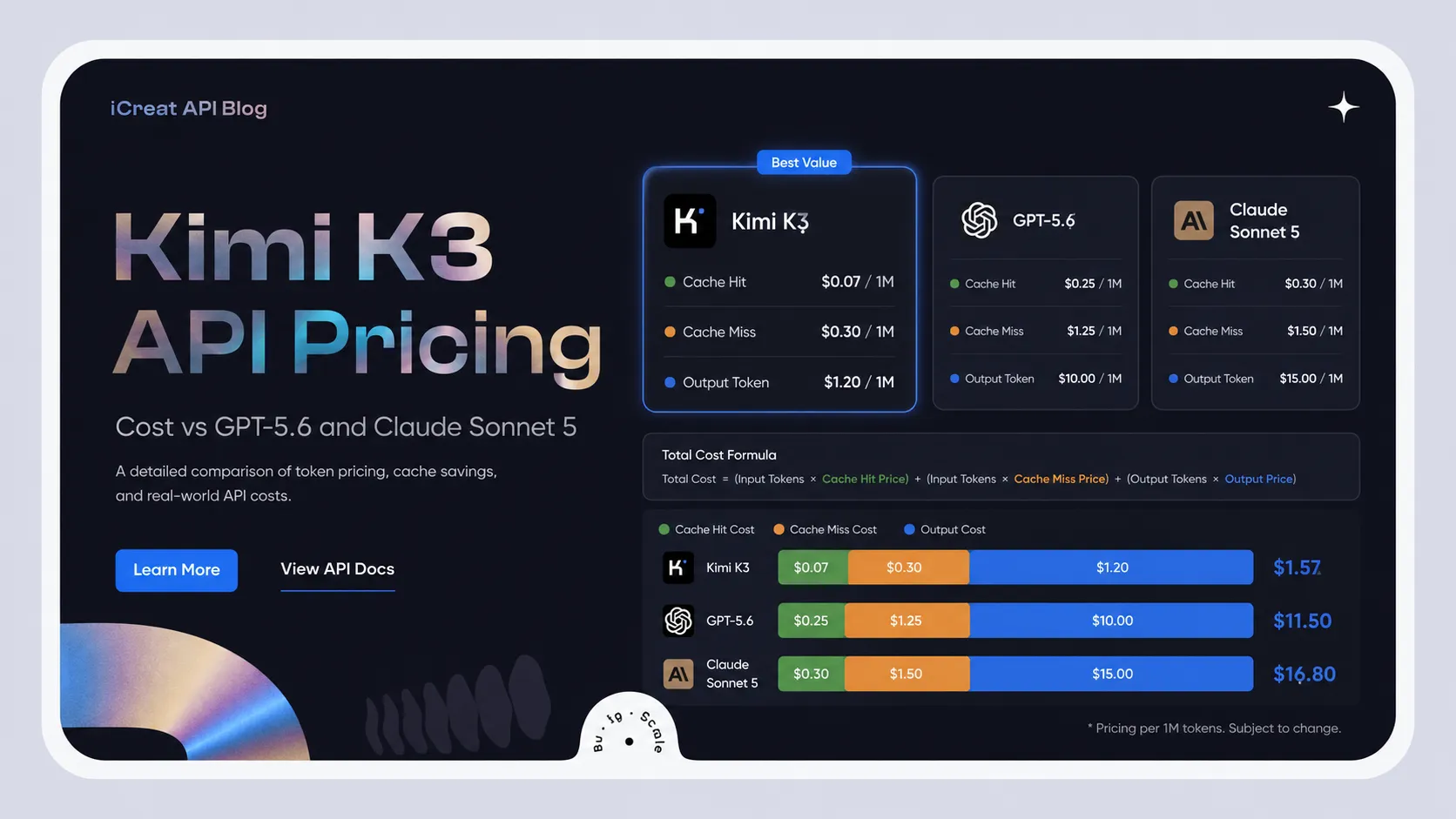
This guide explains the complete Kimi K3 API pricing structure, calculates realistic workload costs, and compares K3 with GPT-5.6 and Claude Sonnet 5.
It also explains how to access Kimi K3 through iCreat, and identifies lower-cost models developers can use when K3’s capability or price does not match the workload.
Kimi K3 API Pricing at a Glance
Moonshot AI lists the following official prices for the kimi-k3 model:
| Token category | Price per 1M tokens |
|---|---|
| Cache-hit input | $0.30 |
| Cache-miss input | $3.00 |
| Output | $15.00 |
Kimi states that its official API achieves a cache-hit rate above 90% in coding workloads through its Mooncake inference architecture. That is a platform-level result for coding workloads, not a guaranteed rate for every application. Actual cache performance depends on how prompts, files, system instructions, and conversation history are structured.
The full pricing information is available in the official Kimi K3 release.
Kimi K3 is also available through iCreat at the same listed rates, alongside Claude, GPT, Gemini, and DeepSeek models under one account. Access options are covered later in this guide.
What Do Cache-Hit and Cache-Miss Input Mean?
Every API request contains input tokens. These may include:
- The system prompt
- The user’s message
- Conversation history
- Source documents
- Code repositories
- Tool results
- Examples and instructions
When the model processes new input for the first time, those tokens are normally billed at the cache-miss rate.
If the same reusable prefix has already been processed and remains available in the cache, the provider may charge the lower cache-hit price instead.
For Kimi K3, the difference is substantial:
| Input type | Price |
|---|---|
| Cache miss | $3.00 per 1M tokens |
| Cache hit | $0.30 per 1M tokens |
A cache hit therefore costs 90% less than an uncached input token.
This can matter more than the headline input price.
Consider an agent that receives a 500,000-token codebase at the beginning of every turn. Without caching, ten turns could repeatedly bill five million input tokens. With an effective cache, the first request may use the higher rate while much of the repeated repository context is billed at the lower rate.
However, developers should not assume that all long prompts will automatically achieve Kimi’s reported 90% cache-hit rate.
The percentage depends on whether requests preserve the same reusable prefix. Frequent changes to the system prompt, file order, repository snapshot, or message structure can reduce cache reuse.
How to Calculate Kimi K3 API Cost
A simplified Kimi K3 cost formula is:
Total cost = uncached input cost + cached input cost + output cost
For usage measured in millions of tokens:
Kimi K3 cost = (cache-miss input × $3) + (cache-hit input × $0.30) + (output × $15)
Suppose an application uses:
- 4 million cache-miss input tokens
- 16 million cache-hit input tokens
- 3 million output tokens
The monthly cost would be:
- Uncached input: 4 × $3 = $12
- Cached input: 16 × $0.30 = $4.80
- Output: 3 × $15 = $45
- Total: $61.80
Despite processing 20 million input tokens, output accounts for most of the bill.
This pattern is common among frontier models. Developers focus on reducing prompt size, but long generated responses may have a larger financial impact.
Kimi K3 Is Much More Expensive Than Kimi K2.6
Kimi K2.6 was priced at:
- $0.16 per million cache-hit input tokens
- $0.95 per million cache-miss input tokens
- $4.00 per million output tokens
Kimi K3 increases those rates to $0.30, $3.00, and $15.00 respectively.
That represents approximately:
| Token type | K2.6 | K3 | Increase |
|---|---|---|---|
| Cache-hit input | $0.16 | $0.30 | 87.5% |
| Cache-miss input | $0.95 | $3.00 | 216% |
| Output | $4.00 | $15.00 | 275% |
The price increase reflects a major change in product positioning.
K2.6 competed more directly as a cost-efficient model. K3 is priced like a frontier model intended to compete with premium Claude and GPT options.
This does not automatically make K3 poor value. A model that completes a task in fewer retries, avoids failed tool calls, or handles a workflow that a cheaper model cannot finish may still reduce total application cost.
But teams migrating from K2.6 should not expect a similar token budget.
The output rate has risen from $4 to $15 per million tokens. For applications that generate long code files, reports, research documents, or agent logs, this change can materially affect monthly spending.
Kimi K3 vs Claude Sonnet 5 vs GPT-5.6 Pricing
The following table compares official first-party API rates as of August 18, 2026.
| Model | Standard input | Cached input | Output |
|---|---|---|---|
| Kimi K3 | $3.00 | $0.30 | $15.00 |
| Claude Sonnet 5 introductory price | $2.00 | $0.20 | $10.00 |
| Claude Sonnet 5 standard price | $3.00 | $0.30 | $15.00 |
| GPT-5.6 Sol | $5.00 | $0.50 | $30.00 |
| GPT-5.6 Terra | $2.50 | $0.25 | $15.00 |
| GPT-5.6 Luna | $1.00 | $0.10 | $6.00 |
Claude Sonnet 5 has introductory pricing of $2 per million input tokens and $10 per million output tokens through August 31, 2026. On September 1, its standard price changes to $3 input and $15 output. Its cache-hit price changes from $0.20 to $0.30 per million tokens.
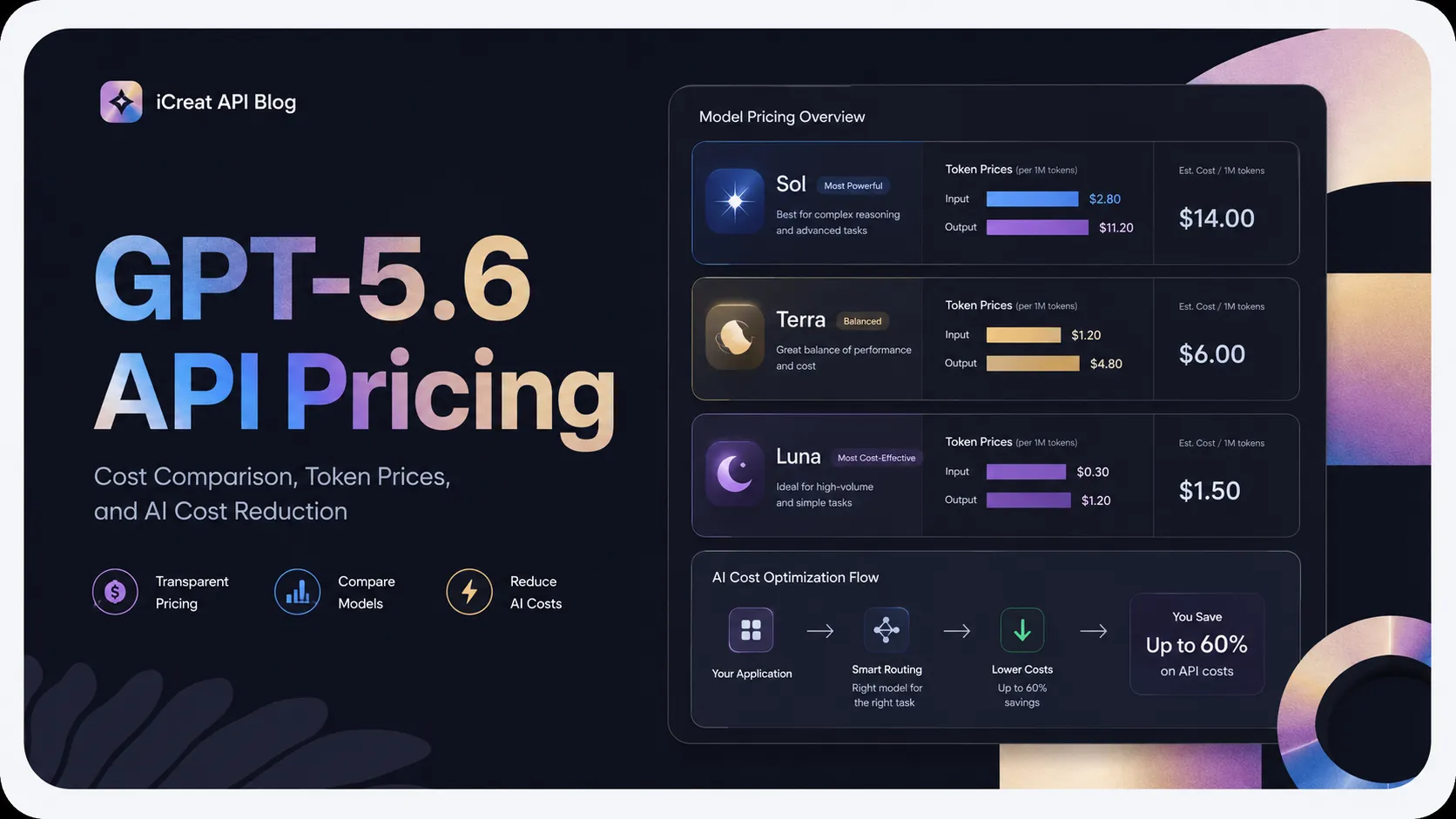
OpenAI divides GPT-5.6 into three tiers. Sol is the flagship model, Terra is the balanced tier, and Luna is the fastest and most affordable. OpenAI charges $5/$30 for Sol, $2.50/$15 for Terra, and $1/$6 for Luna. Cache reads receive a 90% discount, while new cache writes are charged at 1.25 times the normal input rate.
At standard pricing, Kimi K3 and Claude Sonnet 5 have the same base token rates. GPT-5.6 Terra is slightly cheaper on input but has the same output rate. GPT-5.6 Luna is considerably cheaper, while GPT-5.6 Sol is the most expensive option in the comparison.
The price table still does not reveal which model is the most economical in practice. That depends on workload shape and success rate.
Scenario 1: Customer Support or Chat Application
Assume a monthly workload uses:
- 10 million uncached input tokens
- 2 million output tokens
- No meaningful cache reuse
Estimated monthly costs would be:
| Model | Monthly cost |
|---|---|
| Kimi K3 | $60 |
| Claude Sonnet 5, introductory | $40 |
| Claude Sonnet 5, standard | $60 |
| GPT-5.6 Sol | $110 |
| GPT-5.6 Terra | $55 |
| GPT-5.6 Luna | $22 |
For a normal chat application with limited context reuse, Kimi K3 costs the same as Claude Sonnet 5 at its future standard rate. It is slightly more expensive than GPT-5.6 Terra and almost three times the cost of GPT-5.6 Luna.
The cheapest model is not automatically the correct model.
A basic customer support system may not need K3’s long-horizon agent capabilities or 1-million-token context. A smaller model can be more economical when requests are short, responses are predictable, and the application does not require advanced autonomous work.
K3 becomes easier to justify when the request is difficult enough that cheaper models require repeated attempts, escalation, or human correction.
Scenario 2: Coding Agent With 90% Cache Reuse
Coding agents often reuse large amounts of repository context. This is one of the workloads where prompt caching can materially change the result.
Assume a monthly coding workload uses:
- 100 million input tokens
- 90 million input tokens served from cache
- 10 million uncached input tokens
- 20 million output tokens
Estimated costs are:
| Model | Monthly cost |
|---|---|
| Kimi K3 | $357 |
| Claude Sonnet 5, introductory | $238 |
| Claude Sonnet 5, standard | $357 |
| GPT-5.6 Sol | $695 |
| GPT-5.6 Terra | $347.50 |
| GPT-5.6 Luna | $139 |
Kimi K3 and standard-priced Claude Sonnet 5 produce the same estimate because their input, cached-input, and output rates are identical.
GPT-5.6 Terra is only $9.50 cheaper in this scenario. GPT-5.6 Sol costs almost twice as much, while Luna is far cheaper.
But coding-agent economics cannot be judged by tokens alone.
Suppose Luna completes only 60% of difficult repository tasks while K3 completes 80%. The lower token bill may be offset by more retries, longer sessions, and greater human review.
The useful metric is not simply cost per token.
It is:
Teams evaluating Kimi K3 should run the same repository tasks across multiple models and measure:
- Completion rate
- Number of model turns
- Total input and output tokens
- Tool-call count
- Time to completion
- Human correction time
- Failed or reverted changes
A model that costs twice as much per token may still be less expensive per successful pull request.
Scenario 3: Long-Document Research
Now consider a research workflow that processes long reports, contracts, papers, or financial documents.
Assume it uses:
- 50 million uncached input tokens
- 5 million output tokens
- No cache reuse
Estimated cost:
| Model | Monthly cost |
|---|---|
| Kimi K3 | $225 |
| Claude Sonnet 5, introductory | $150 |
| Claude Sonnet 5, standard | $225 |
| GPT-5.6 Sol | $400 |
| GPT-5.6 Terra | $200 |
| GPT-5.6 Luna | $80 |
Kimi K3 is competitively priced relative to other frontier options, but it is not the lowest-cost choice.
The decision depends on how the workflow uses the long context.
A model may support a 1-million-token window but still perform better when information is retrieved in smaller, relevant sections. Sending the full document corpus on every request may be more expensive and less accurate than using retrieval, document segmentation, or a staged research process.
Long context is a capability ceiling, not a requirement to fill the entire window.
Output Tokens Are the Main Cost Risk
Kimi K3’s $15 output price is five times its uncached input price and 50 times its cached input price.
That makes generated content the most important cost variable in many applications.
For example, one million cached input tokens plus one million output tokens costs:
- Cached input: $0.30
- Output: $15.00
- Total: $15.30
More than 98% of that cost comes from the output.
Developers can reduce output cost by:
- Setting clear length limits
- Requesting structured rather than repetitive explanations
- Avoiding unnecessary reasoning logs in user-visible output
- Breaking large tasks into stages only when those stages improve success
- Using smaller models for summaries, formatting, or classification
- Reserving frontier models for decisions that require their additional capability
The goal should not be to make every response as short as possible. Cutting necessary output can reduce quality.
The goal is to prevent the model from generating tokens that do not contribute to the result.
Does Kimi K3’s 1M Context Make It Cheaper?
Not by itself.
A large context window can reduce the need to split documents or build complex retrieval workflows. It can also help an agent maintain continuity across long sessions.
But every token still has a cost.
A 1-million-token uncached input request costs approximately $3 before the model produces any output. If the response contains 50,000 output tokens, the output adds another $0.75.
One such request is not necessarily expensive. Repeating it thousands of times is.
Caching can lower repeated input cost, but teams should still decide whether the entire context needs to be present on every turn.
A better architecture may combine:
- Retrieval for selecting relevant evidence
- Cached context for stable instructions and repositories
- A frontier model for difficult reasoning
- A smaller model for routing and lightweight tasks
Kimi K3’s context window creates architectural flexibility. It does not remove the need for cost control.
Is Self-Hosting Kimi K3 Cheaper Than the API?
For most teams, no.
Kimi K3 has 2.8 trillion total parameters and activates 16 of 896 experts. Moonshot recommends deployment on supernode configurations with 64 or more accelerators because inference efficiency depends on a large, high-bandwidth communication domain.
The open-weight release is important for researchers, infrastructure providers, and organizations that require deployment control.
It does not mean an ordinary development team can run K3 economically on a few local GPUs.
Self-hosting requires more than fitting weights into memory. Teams must account for:
- Accelerators
- High-bandwidth interconnects
- Replication and failover
- Inference software
- Quantization
- Monitoring
- Engineering labor
- Peak and idle capacity
- Model updates
- Security and access control
The API will remain the practical option for most startups and application developers.
Self-hosting becomes more reasonable when an organization has unusually high and predictable demand, strict data-control requirements, or existing large-scale inference infrastructure.
When Is Kimi K3 Worth the Price?
Kimi K3 is most financially defensible when its specific strengths improve task completion.
Potential fits include:
- Long-running coding agents
- Repository-scale software tasks
- Browser research
- Spreadsheet and office automation
- Multimodal document work
- Long-context knowledge systems
- Research workflows requiring many tools and steps
It may be less economical for:
- Basic chat
- Classification
- Short summaries
- Simple extraction
- High-volume routing
- Template-based customer support
- Tasks that smaller models already complete reliably
Using a frontier model for every request is rarely the most efficient architecture.
A better system routes simple work to lower-cost models and reserves K3-class capability for tasks that justify it.
How to Access Kimi K3 Through iCreat
Kimi K3 is available through iCreat, alongside models from Anthropic, OpenAI, Google, and DeepSeek.
iCreat lists Kimi K3 at the same rates as the official API:
| Token category | iCreat price per 1M tokens |
|---|---|
| Input | $3.00 |
| Cache read | $0.30 |
| Output | $15.00 |
Because the token rates match the official price, the reason to call K3 through iCreat is not a discount. It is consolidation.
With one iCreat account, a team can:
- Call Kimi K3 and models such as Claude Sonnet 5, GPT-5.6, Gemini, and DeepSeek through the same OpenAI-compatible API
- Run the workload comparisons described in this guide by changing only the model identifier
- Route simple requests to cheaper models while reserving K3 for difficult tasks
- Manage everything with one balance and unified billing, pay as you go, with no subscription or minimum commitment
For teams that want to measure K3 against alternatives before committing a monthly budget, this setup removes most of the integration overhead.
Visit the Kimi K3 model page on iCreat for current rates, or create an iCreat account and top up to start calling K3 today.
Lower-Cost Models Available Through iCreat
Kimi K3 can be called through iCreat at the rates shown above.
However, users researching Kimi K3 pricing are often trying to solve a broader problem:
iCreat also provides access to several lower-priced models that can be tested for those workloads through one API.
Claude Sonnet 5
Claude Sonnet 5 on iCreat is a strong alternative for coding, tool use, knowledge work, and multi-step agents.
At the time of writing, iCreat prices Claude Sonnet 5 at:
| Token category | iCreat price per 1M tokens |
|---|---|
| Input | $0.40 |
| Cache read | $0.04 |
| Cache creation | $0.50 |
| Output | $2.00 |
Using the same customer-support scenario of 10 million input tokens and 2 million output tokens, the estimated iCreat cost is $8, compared with $60 for Kimi K3.
For the long-document scenario of 50 million input tokens and 5 million output tokens, the estimate is $30, compared with $225 for K3.
Under the simplified coding-agent scenario with 90% cache reuse, the estimate is $47.60, compared with $357 for K3.
In each example, Kimi K3 costs approximately 7.5 times as much based on the listed token rates.
This does not prove Claude Sonnet 5 will outperform K3 on every task. It shows that teams have a large cost margin in which they can test quality, add retries, or use a stronger model only for selected steps.
GPT-5.6
Developers who prioritize difficult reasoning, precise execution, coding, and professional workflows can also evaluate GPT-5.6 through iCreat.
GPT-5.6 provides multiple capability tiers, making it possible to route different tasks according to difficulty rather than sending every request to the most expensive model.
Other Cost-Control Options
The iCreat model library also includes models such as DeepSeek V4 Pro, DeepSeek V4 Flash, Gemini 3.1 Pro Preview, and lighter GPT variants.
This supports a more practical production architecture:
- Use a fast model for classification and routing.
- Use a cost-efficient reasoning model for standard tasks.
- Escalate only difficult requests to a frontier model.
- Use separate image or video models when the workflow needs generation beyond text.
Developers can use the iCreat API documentation to integrate models through a consistent, OpenAI-compatible API structure.
Why a Unified API Can Lower Costs Beyond Token Pricing
Token prices are visible. Integration and maintenance costs are less visible.
Connecting directly to several providers may require separate:
- Accounts
- API keys
- SDKs
- Request formats
- Error-handling logic
- Usage dashboards
- Billing systems
- Rate-limit strategies
The cost becomes more noticeable when a team wants to compare models or switch providers.
A unified API layer allows developers to change the model identifier while preserving more of the surrounding application logic.
That makes it easier to run real workload tests instead of making a permanent decision from a benchmark table.
Through iCreat, teams can manage multiple text, image, video, and multimodal models with one account and unified billing. Pricing is pay as you go, with no subscription or minimum commitment.
Review current rates on the iCreat pricing page.
How to Choose Based on Budget
For a small prototype, optimize for speed of testing rather than theoretical perfection. Use a lower-cost model and move to a frontier model only when the initial option fails measurable requirements.
For a high-volume application, build routing from the beginning. Even a small reduction in output length or frontier-model usage can have a large effect at scale.
For a coding agent, measure cost per completed issue rather than cost per million tokens. Include retries, tool calls, latency, and human correction.
For long-context research, test both direct long-context input and retrieval-based workflows. The larger window may simplify development, but retrieval may reduce both cost and distraction.
For teams that specifically need Kimi K3, use its official API or call it through iCreat, and measure the real cache-hit rate before projecting monthly cost.
For teams that need comparable coding or knowledge-work capability at a lower token price, test currently available alternatives such as Claude Sonnet 5 and GPT-5.6 through iCreat.
FAQ
Final Verdict
Kimi K3 is priced as a frontier model, not as a budget open model.
Its official $3 input and $15 output rates place it alongside the standard price of Claude Sonnet 5 and close to GPT-5.6 Terra. Its cache-hit price is competitive, especially for coding agents that reuse large repositories or stable context.
The most important cost risk is output. At $15 per million tokens, verbose agent traces, long reports, and repeated code generation can quickly dominate the bill.
K3 may justify that price when its long-horizon coding, research, multimodal, or agent capabilities improve successful task completion. It is harder to justify for simple, high-volume work that smaller models can already perform.
The best buying decision is therefore not based on the lowest token rate or the highest benchmark score.
It is based on measured cost per successful result.
Kimi K3 is available through iCreat at official-equivalent rates. Developers can call K3 and compare it against models such as Claude Sonnet 5, GPT-5.6, Gemini, and DeepSeek through one OpenAI-compatible API.
Create an iCreat account to test Kimi K3 and other models with unified billing and pay only for actual usage.