



Most fashion creative production teams treat revision loops as a creative problem. They are usually an input problem.
A reshoot gets ordered, a campaign gets re-edited, an AI generation gets re-prompted for the fourteenth time — and the team looks for someone to blame. The photographer missed the brief. The retoucher over-polished. The AI tool did not understand the brand. In practice, the root cause is almost always upstream. To reduce revision loops in fashion creative production, the lever is not better tools or sharper creative direction. It is better inputs — the layered set of brief, references, samples, specs, styling, and detail captures that decide whether a shoot ships or re-shoots. This guide walks through the six input layers, how to audit them before production starts, and the failures that tend to surface two weeks later as another revision request.
Why Most Fashion Revision Loops Start Before Production Begins
The intuition that revision loops are an execution problem is strong because the loop becomes visible only at execution. A shoot wraps, the brand sees the results, the results do not match what was in someone's head, and the loop begins. The conclusion the team draws is that the execution failed.
That conclusion is usually wrong. By the time a shoot wraps, the inputs have already decided the outcome. If the brief was vague, the photographer filled the gap with their own interpretation. If the reference images were inconsistent, the lighting ended up inconsistent. If the product samples were pre-production prototypes, the campaign now shows garments that do not match what shoppers will receive.
Rex Jones's framing on LinkedIn — Every Reshoot Started With a Missing Brief — captures the underlying pattern bluntly: a reshoot is, in his words, a communication problem with a camera attached to it. The communication failed before the camera rolled.
This is why revision loops compound. Each loop adds another round of interpretation — the brand re-explains what it meant, the production team re-interprets what it heard, and the next round of deliverables inherits another layer of drift. Rebuilder AI's analysis of why fashion production takes so long makes the underlying cost structure explicit: repeated revisions increase communication overhead between brands and production partners, with each request requiring fresh explanation and reinterpretation.
The implication is uncomfortable for teams that want to fix revision loops by being more creative. The fix is not more creativity. The fix is more discipline at the input layer — before anyone picks up a camera or writes a prompt.
What "Better Inputs" Actually Means in Fashion Creative Production
Inputs, in this guide, are the layered set of materials and decisions that exist before production starts. They are not a single artifact. Treating them as a single artifact — usually "the brief" — is what causes teams to fix one layer and watch revision loops continue because the other five layers were never addressed.
A useful definition: an input is anything the production team will use as ground truth during execution. If it is treated as ground truth and it is wrong, the deliverable will be wrong.
The six input layers fashion creative production depends on:
- Creative brief — the written document naming objectives, audience, deliverables, and technical specs.
- Reference images — visual anchors for mood, composition, lighting, and finish.
- Product samples — the actual garments or products being shot.
- Shot list and spec sheet — the per-deliverable breakdown of aspect ratios, resolution, platforms, and counts.
- Styling direction — the documented decisions on color, texture, silhouette, wardrobe, and props.
- Detail captures — close-ups of the elements shoppers use to verify product truth (logos, prints, hardware, fabric, back views).
A team that fixes only the brief will still reshoot because the reference images were low-resolution. A team that fixes only the reference images will still reshoot because the samples were prototypes. A team that fixes only the samples will still reshoot because there is no shot list, so deliverables are missing.
The discipline is layered. Each input layer has its own failure mode, its own audit rule, and its own downstream consequence. The next section unpacks them.
The Six Input Layers Every Fashion Shoot Needs
Each input layer has one job, one failure mode, and one audit rule. The framework treats them as separate because mixing them is what produces the "we fixed the brief, why are we still reshooting?" pattern.
Layer 1 — Creative Brief
The brief is the written document that names what the team is making, for whom, and to what end. It is not a moodboard, a chat thread, or a verbal direction in a kickoff call.
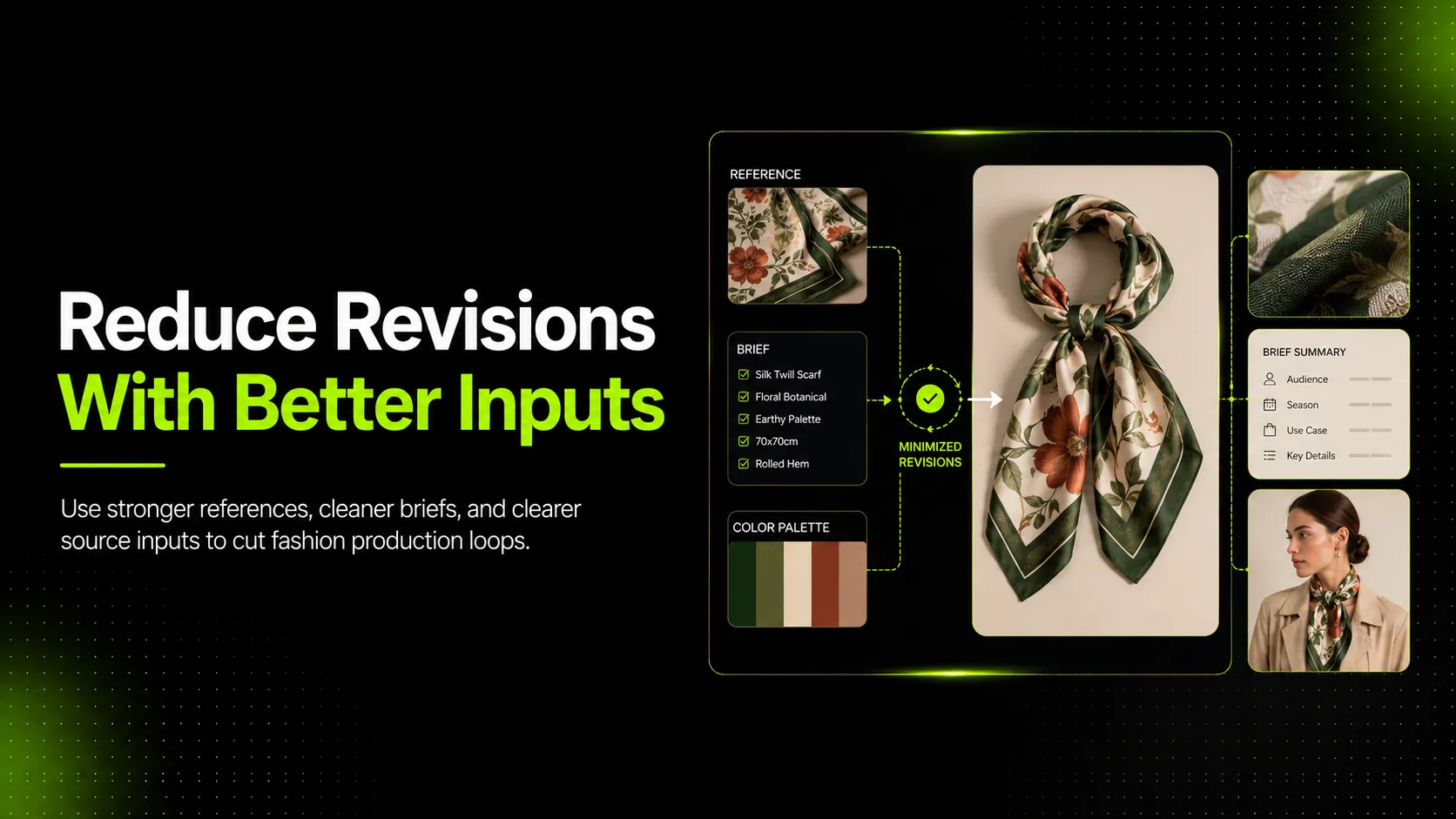
A real brief covers objectives (what business outcome this campaign serves), audience (who the visual is for), deliverables (what specifically will be produced), and technical specs (aspect ratios, resolution, platforms, counts).
The failure mode: the brief exists only in someone's head, or exists as a deck of references without written objectives. The production team then fills the gap with their own interpretation, and the brand spends the first revision loop explaining what it meant.
The audit rule: if the brief cannot be read aloud in under two minutes and answer "what are we making, for whom, and to what end", it is not a brief.
Layer 2 — Reference Images
Reference images are the visual anchors — mood, composition, lighting, finish. They are not a substitute for the brief. They are how the brief's verbal direction gets translated into a visual target.
A strong reference set is high-resolution, consistent in lighting and color temperature, and not over-retouched. A weak set is low-resolution, mixed-source, AI-faked to the point of unrealistic fabric, or — the most common failure — pulled from campaigns with budgets many times what this production has.
The failure mode: the references are beautiful but unreachable. The team chases a finish it cannot produce, and the brand rejects the deliverable for looking "cheaper than the reference" even though the reference was never achievable at this budget.
The audit rule: every reference image should be achievable at this production's budget and equipment level. If it is not, either remove it or upgrade the budget.
Layer 3 — Product Samples
Product samples are the actual garments or products being shot. They are not interchangeable with reference images, and they are not interchangeable with each other.
The critical rule: samples must match what shoppers will receive. A pre-production prototype, a sample size that will not be sold, or a garment with construction differences from the production run will produce campaign visuals that mislead shoppers. The campaign may look right; the returns will say otherwise.
For a dress with print and fabric texture, this is the layer where drape, fit, and pattern accuracy get locked in. A prototype dress with a slightly different print run becomes a campaign visual that does not match what a shopper receives — and the mismatch surfaces as a return, not as a creative note.
The failure mode: the brand ships a sample that does not match the production garment. The campaign goes live. A shopper receives a product whose print, fit, or fabric does not match the photo. The return gets logged as a quality complaint when the underlying problem was an input mismatch.
The audit rule: every sample photographed must be checked against the production spec — same fabric, same construction, same hardware, same label. If they differ, the sample cannot be used for publishable assets.
Layer 4 — Shot List and Spec Sheet
The shot list is the per-deliverable breakdown of what specifically will be produced. It includes aspect ratios, resolution, platforms (marketplace, Shopify, social, ad), and counts per SKU.
This layer is where revision loops hide. Without a shot list, the team shoots what feels right on the day, and the missing deliverables are discovered weeks later when the ecommerce team tries to populate a product page.
The failure mode: the shoot wraps with eighty percent of the deliverables, and the missing twenty percent forces either a reshoot or a compromise — using the wrong aspect ratio for the marketplace, cropping a hero image for a social vertical, padding the PDP with reused angles.
The audit rule: every deliverable on the channel plan has a corresponding row in the shot list. If a channel requirement exists, the shot list names how it will be filled.
Layer 5 — Styling Direction
Styling direction is the documented set of decisions on color palette, texture combinations, silhouette, wardrobe selection, and props. It is an input layer, not an aesthetic preference to be discovered on set.
For fashion campaigns, styling direction is often the difference between a coherent visual set and a random collection of looks. For accessories — a sneaker, a handbag — styling context (what wardrobe the accessory sits with, what scene it lives in) decides whether the product reads as premium or generic.
The failure mode: styling is improvised on set, the resulting visuals feel inconsistent across SKUs, and the brand asks for re-edits to "make them feel more cohesive" — a request that is impossible to fulfill in post when the underlying styling decisions were never made.
The audit rule: styling direction is documented before the shoot, not negotiated on the day.
Layer 6 — Detail Captures
Detail captures are the close-ups of the elements shoppers use to verify product truth — logos, prints, hardware, zippers, fabric weave, collar construction, back views. They are inputs to the product detail page, the marketplace listing, and increasingly to AI-assisted workflows where detail images feed the generation model directly.
For a t-shirt with logo and collar detail, this is the layer where logo placement, collar construction, and fabric weave get locked in. Skip it and the team loses the ability to verify product accuracy later — the review becomes guesswork.
For AI-assisted production, detail captures are not optional. AI models inherit input flaws directly; a missing detail capture means the model invents the detail, and the invented detail becomes a revision loop when the brand asks why the logo looks wrong.
If your team needs to standardize on a workflow that requires a detail image and a back view as mandatory inputs before any generation starts, iCreat AI's AI Fashion Detail Image Generator is built around exactly that discipline — close-ups of fabric, logos, hardware, and back views as a first-class input category, not an afterthought.
The failure mode: detail captures are skipped to save time on set, then surface as missing PDP images, marketplace rejections, or AI generations with invented details that have to be reworked.
The audit rule: every product category has a documented list of required detail captures. Apparel: fabric, logo, collar, back view. Accessories: hardware, material, logo placement, construction. Packaging: label text, cap detail, back-label view. The list is checked before the shoot wraps.
How to Audit Inputs Before Production Starts
Input auditing is a pre-production gate, not a post-production review. The point is to find the weak input before the shoot, not after.
A simple audit asks one question per layer: is this input strong enough to serve as ground truth during production? If yes, the layer passes. If no, the layer must be fixed before production starts — or the production date must move.
The table below maps the most common weak-input patterns to the revision loop they typically cause.
| Weak input | Likely revision loop |
|---|---|
| No written brief, only verbal direction | "This isn't what we discussed" — entire direction gets re-litigated |
| Brief exists but missing technical specs | Deliverables are wrong format, resolution, or aspect ratio |
| Reference images low-resolution | Team cannot match finish; brand calls result "cheap-looking" |
| Reference images mixed-source, inconsistent lighting | Visual set looks incoherent across SKUs |
| Reference images pulled from campaigns with 10x budget | Brand rejects deliverable for being beneath the reference |
| Product samples are pre-production prototypes | Campaign visuals do not match shippable product; returns follow |
| No shot list | Missing deliverables discovered late, forcing reshoots |
| Shot list missing platform-specific requirements | Wrong aspect ratios for marketplace, social, or ad placements |
| Styling direction improvised on set | Visual set feels inconsistent; brand requests impossible re-edits |
| Detail captures skipped | Missing PDP images, marketplace rejections, or AI generations with invented details |
| Detail captures low-resolution or poorly lit | Team cannot verify product accuracy; review becomes guesswork |
The audit rule: every layer must be answerable with "yes, this is strong enough to be ground truth" before the production date is locked. A single "no" should move the date, not the deadline.
Browzwear's analysis of how structured metadata simplifies fashion workflows makes a related point from the production-management side: structured inputs — tags, statuses, metadata — reduce friction across the workflow. The same principle applies at the input layer. Explicit structure beats implicit knowledge.
Common Input Failures and What They Cost Downstream
Input failures are predictable. Recognizing the pattern early is cheaper than paying for the loop.
Failure 1: The brief is a moodboard. A deck of reference images with no written objectives circulates as "the brief." The production team interprets the references; the brand reinterprets the result. *Cost*: one full revision cycle, usually discovered at first delivery. *Fix*: write the brief. Two minutes read aloud. Objectives, audience, deliverables, specs.
Failure 2: References are aspirational, not achievable. The brand pulls references from luxury campaigns with budgets many times its own. The team chases a finish it cannot produce. *Cost*: the deliverable is rejected for being "beneath the reference," and the reshoot chases a still-unreachable target. *Fix*: audit every reference against actual production budget and equipment. Remove unachievable references or upgrade the production.
Failure 3: References are AI-faked. AI-generated references show fabric, fit, and lighting that no real production can match. The brand falls in love with the AI finish. *Cost*: every real deliverable disappoints because the reference was never real to begin with. *Fix*: separate AI exploration references (clearly labeled as such) from production references. Production references must be real photography.
Failure 4: Samples do not match shippable product. A pre-production sample is photographed. The production garment differs in fabric, fit, or construction. *Cost*: campaign visuals mislead shoppers. Returns and reviews follow. *Fix*: every sample is checked against the production spec before the shoot.
Failure 5: No shot list, or shot list missing channel specs. The shoot wraps. Days later, the ecommerce team realizes the marketplace listings need a square 1:1 image, the social ads need a 9:16 vertical, and the Shopify hero needs a 16:9 wide. None was shot. *Cost*: either a reshoot or a compromise crop that hurts performance. *Fix*: channel requirements drive the shot list, not the other way around.
Failure 6: Detail captures skipped to save time. The shoot is running long. Detail captures get cut. A jacket's zipper, hardware, and lining never get captured. *Cost*: missing PDP images surface weeks later. For AI-assisted production, missing detail captures mean the model invents details, and the invented details become a revision loop when the brand asks why the hardware is wrong. *Fix*: detail captures are non-negotiable per category. If the shoot is running long, cut something else.
TEG's analysis of the hidden costs of fashion production frames this category bluntly: hidden costs — sample revisions, pattern changes, mismatched inputs — compound silently across the production timeline. Input discipline is the cheapest place to intervene; reshoots are the most expensive.
A Starter Checklist for Input-First Fashion Production
A short pre-production checklist. If any layer cannot be checked, the production date is not ready.
Layer 1 — Creative brief:
- [ ] Written document exists (not a moodboard, not a chat thread)
- [ ] Objectives named (what business outcome this serves)
- [ ] Audience named (who the visual is for)
- [ ] Deliverables named (what specifically will be produced)
- [ ] Technical specs included (aspect ratios, resolution, platforms, counts)
- [ ] Brief can be read aloud in under two minutes and answers "what, for whom, to what end"
Layer 2 — Reference images:
- [ ] High-resolution
- [ ] Consistent lighting and color temperature
- [ ] Not AI-faked to the point of unrealistic fabric or fit
- [ ] Achievable at this production's budget and equipment
- [ ] Separated from AI exploration references (clearly labeled)
Layer 3 — Product samples:
- [ ] Match production spec (fabric, construction, hardware, label)
- [ ] Not pre-production prototypes (or, if prototypes, clearly flagged)
- [ ] Available in the sizes and colorways being shot
Layer 4 — Shot list and spec sheet:
- [ ] Every deliverable on the channel plan has a corresponding row
- [ ] Aspect ratios per channel specified (marketplace, Shopify, social, ad)
- [ ] Resolution requirements per deliverable specified
- [ ] Counts per SKU specified
Layer 5 — Styling direction:
- [ ] Color palette documented
- [ ] Texture combinations documented
- [ ] Silhouette and wardrobe selection documented
- [ ] Props and scene context documented (especially for accessories)
Layer 6 — Detail captures:
- [ ] Category-specific detail list documented (apparel: fabric, logo, collar, back view; accessories: hardware, material, logo placement, construction; packaging: label text, cap detail, back-label view)
- [ ] Detail captures checked against category list before shoot wraps
- [ ] Detail images high-resolution and well-lit
- [ ] For AI-assisted workflows: detail image and back view submitted as mandatory inputs
This is a gate, not a guideline. If the checklist cannot be completed, the production is not ready to start.
FAQ: Reducing Revision Loops with Better Inputs
How many input layers does a small team actually need? All six, but the depth varies by team size. A founder-operator shooting their own products still needs a written brief, even if it is two paragraphs. Reference images, samples, and a shot list are unavoidable. Styling direction and detail captures can be lighter for a single-SKU shoot than for a campaign, but skipping them entirely is what produces revision loops.
Does AI-assisted production change the input requirements? Yes — it makes them stricter. AI models inherit input flaws directly. A low-resolution reference that a human photographer might compensate for becomes a low-resolution output that the AI cannot improve. A missing detail capture becomes an invented detail. AI does not relax input discipline; it raises the stakes on it.
What about agencies — do they own the input layer, or does the client? Both, in practice. The client owns the business objectives and the product samples. The agency owns the translation of those objectives into a brief, a shot list, and styling direction. Ambiguity about who owns which layer is itself an input failure.
How do I push back on a client who wants to skip the brief step? Frame the brief as the cheapest insurance the client will ever buy. A two-paragraph brief costs thirty minutes. A reshoot costs weeks. Most experienced clients know this; the ones who do not can be convinced by the cost framing more reliably than by the workflow framing.
How do I handle a retainer client where inputs are stable? The audit shrinks but does not disappear. Brief and styling direction may be inherited from a master document. References may be a refresh rather than a rebuild. Samples, shot list, and detail captures remain mandatory for every new SKU.
Can input discipline eliminate revision loops entirely? No. Some revision is intrinsic to creative work — the brand sees the result and decides it wants a different direction. The goal of input discipline is not zero loops. It is to eliminate the loops caused by input weakness, so the only loops that remain are genuine creative decisions, not communication failures.
What about quality control on the output side? Output quality control matters, but it is downstream of input quality. Tekmon's analysis of quality control in apparel production frames the underlying pattern well: customer-driven quality loops reduce returns and strengthen brand loyalty. The same logic applies at the input layer — input quality loops reduce revision loops and strengthen downstream trust.
When You Want a Workflow Built Around Inputs
The six-layer input framework is operational, not necessarily technical. The same workflow, the same team, the same tools — different discipline at the input layer.
If your team wants a tool that enforces input discipline at the workflow level rather than relying on individual memory, iCreat AI's AI Product Photography is built around the input-first model: a main reference image as required input, a detail image as a first-class category, and a back view where the product demands it. The workflow refuses to start until the inputs exist, which is the discipline this guide is arguing for.
The revision loop is the symptom. The input layer is the cause. Fix the cause, and most of the symptoms disappear on their own.