



Two years ago, the question teams asked about AI tools was "which model is best?" Today, that question still matters, but it no longer explains why some tools feel reliably useful in daily production while others remain interesting experiments. The difference is increasingly not in the underlying model. It is in everything surrounding the model: how prompts are organized, how data moves between steps, how failures are handled, how governance rules are enforced, and whether the tool fits into an existing workflow or forces the team to reorganize around it.
This shift is not subtle. It is showing up in product launches, platform updates, and the kinds of features that teams now evaluate before adopting a new AI tool. Claude Desktop's recent expansion into AWS, Google Cloud, and Microsoft Foundry deployments was not marketed as a model upgrade. It was marketed as deployment flexibility, local storage, identity integration, and keeping reasoning within chosen cloud boundaries. The value proposition had moved from "our model is smarter" to "our model runs where you need it, under your controls." That is an infrastructure story, not a model story.
For ecommerce and creative teams producing visual content at scale, this category formation matters because it changes how you should evaluate tools, plan workflows, and decide where to invest production time. This article covers why individual model launches no longer explain product value well enough, what the hidden layer between capability and usability actually consists of, how routing and governance are becoming product features, why creative workflows specifically need infrastructure thinking, and what makes AI creative infrastructure a real category rather than just a marketing frame.
Key Takeaways
- Product value in AI tools is shifting from model capability to infrastructure: orchestration, routing, governance, context continuity, and deployment controls.
- The "hidden layer" between an AI model and business usable output includes prompt management, data flow control, fallback behavior, version tracking, and output validation.
- Recent signals from Claude Desktop enterprise deployments, OpenRouter's governance and residency features, Google's agent coordination protocols, and agent-focused versioning tools like Oak show infrastructure becoming first-class product design.
- For ecommerce visual production, infrastructure value shows up in whether a tool can produce consistent campaign assets across SKUs, handle reference-image-driven generation at scale, and integrate with upstream and downstream creative steps.
- iCreat AI's AI Product Photography is built around this infrastructure-aware approach: reference inputs, guided prompts, model selection within a commercial workflow, and outputs designed for ecommerce placements rather than generic generation.
Why Individual Model Launches No Longer Explain Product Value Well Enough
When a new AI image model launches, the coverage focuses on benchmark scores, sample outputs, and feature comparisons. These matter, but they describe what the model can do in isolation. They do not describe what happens when that model is embedded in a real production workflow with real constraints: a team that needs 200 product variants by Friday, a brand guideline document that every output must match, a compliance review before anything goes live, and three other tools that sit upstream and downstream of this one.
The gap between model capability and production usefulness is where infrastructure lives. A model that produces stunning images in a demo may produce inconsistent results when fed reference images from a real product shoot. A model that handles single-image generation well may break down when asked to produce 50 variations of the same product across different backgrounds and aspect ratios. A model that works perfectly in the vendor's interface may become unreliable when called through an API inside a larger automation pipeline.
This is not a criticism of any specific model. It is a structural observation about where friction accumulates. The model is the engine, but the transmission, steering, brakes, and dashboard are what determine whether the vehicle actually gets you to work on time. Teams are learning this through experience: they adopted a tool because the model looked impressive, then discovered that the hard problems were not image quality but prompt versioning, output organization, handoff to the next tool, and understanding why Tuesday's batch looked different from Monday's.
The market is responding. Look at what gets announced now alongside or instead of pure model improvements:
- Deployment options that let users choose their cloud environment and identity provider
- Routing controls that let users specify which regions handle their requests and which models serve which workload types
- Governance frameworks that treat compliance as architecture rather than a post-hoc checklist
- Coordination protocols that let multiple AI agents or tools work together without human mediation at every step
- Version control systems redesigned specifically for AI workflow artifacts
None of these are model capabilities. All of them are infrastructure. And all of them are becoming reasons teams choose one tool over another.
How Routing, Governance, and Deployment Are Becoming Product Features
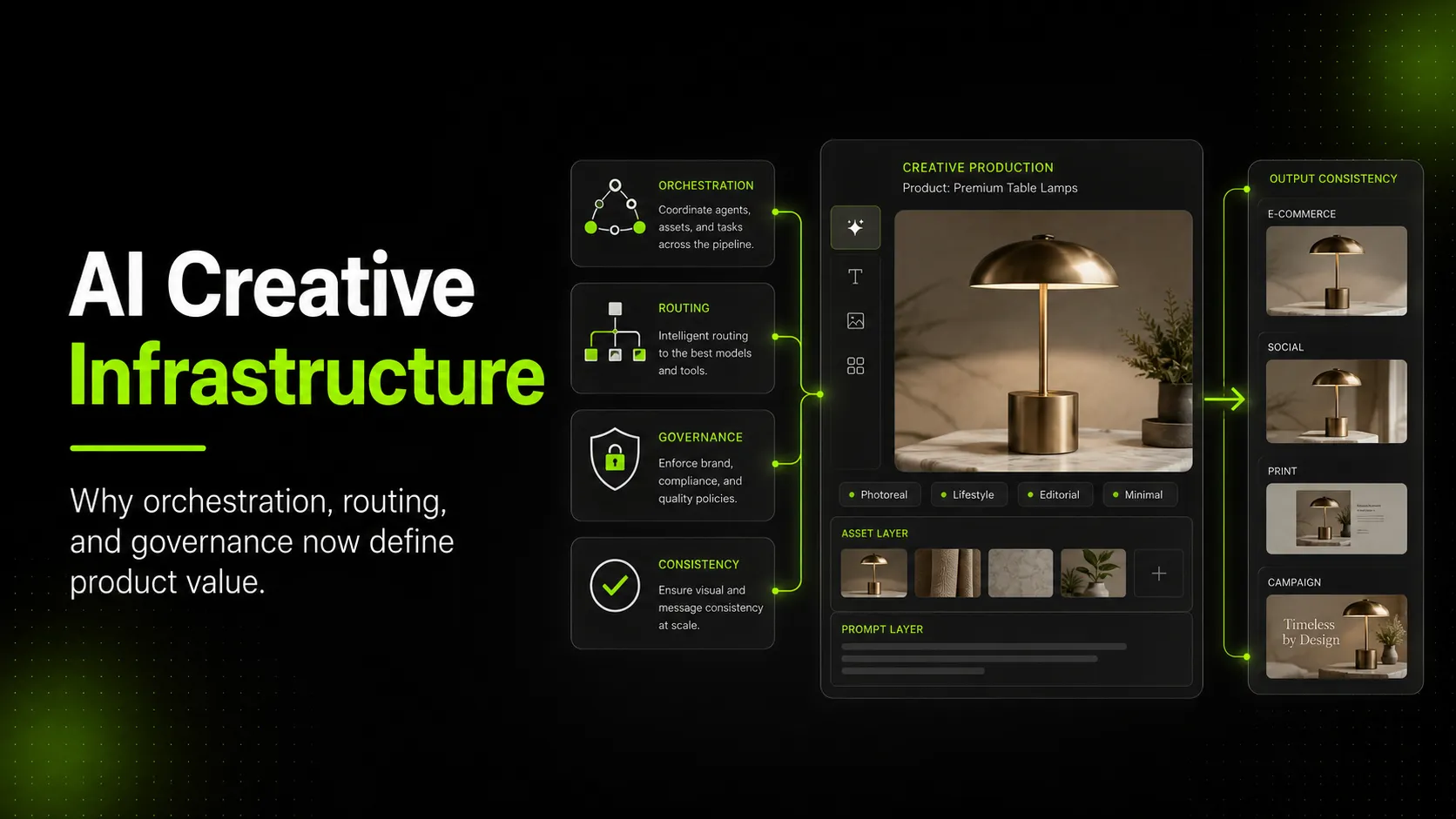
The clearest signal that infrastructure is becoming a product category is that infrastructure-specific features are now being shipped, marketed, and evaluated as core product differentiators. Five recent developments illustrate this pattern.
Deployment as a Feature
Claude Desktop's support for AWS, Google Cloud, and Microsoft Foundry deployments represents a meaningful shift in how AI products position themselves. The announcement did not lead with "our model is now X% smarter." It led with deployment flexibility: run Claude on your preferred cloud, use your existing identity provider, keep conversation history in your storage, and maintain the security posture your organization already enforces. For enterprises, these deployment characteristics often matter more than marginal benchmark improvements. The message is clear: the model is necessary but not sufficient. The deployment context is where adoption decisions get made.
Routing as Governance
OpenRouter's governance framework frames routing architecture as a governance layer. The argument is straightforward: deciding which model serves which request type, which region processes which workload, and which fallback path activates when something fails — these are not operational afterthoughts. They are architectural decisions that should be made upfront, encoded into the system, and auditable afterward. When routing rules are explicit and machine-enforceable, governance becomes reliable. When routing is ad hoc and decided case-by-case by whoever is running the pipeline that day, governance becomes wishful thinking.
Data Residency as a User Control
OpenRouter's data residency controls take the routing-as-governance idea further by giving API users direct control over which geographic regions their requests route through. This addresses a real compliance concern: organizations operating under GDPR, HIPAA, or internal data-handling policies cannot afford to send requests through arbitrary endpoints. Making residency a user-configurable option rather than a hidden implementation detail turns compliance from a risk into a feature.
Agent Coordination as Infrastructure
Google's Agent Development Kit (ADK) and the A2A (Agent-to-Agent) protocol demonstrate that multi-agent systems require coordination infrastructure that goes far beyond prompt engineering. When multiple AI agents need to collaborate — one handling research, another generating visuals, a third reviewing output against guidelines — the protocol that connects them, defines their roles, and manages their handoffs is itself a product. The agents are the workers; the coordination protocol is the factory floor.
Version Control Redesigned for AI Workflows
Oak, positioned as a Git replacement designed specifically for agents and structured AI workflows, signals that traditional version control systems do not naturally capture the artifacts that matter in AI production: prompt versions, model configurations, tool parameters, execution logs, and output lineage. When a team needs to understand why this week's campaign visuals differ from last week's, the relevant version history includes not just file changes but the entire context that produced those files. Building purpose-made versioning for AI workflows is evidence that practitioners feel the absence of this infrastructure acutely enough to fund and build solutions for it.
Taken together, these five signals point in the same direction: the people building and buying AI tools are spending increasing attention on everything except the raw model capability. That attention is creating a product category.
Why This Matters for Creative and Ecommerce Workflows
Infrastructure arguments can feel abstract until you map them onto a concrete production problem. For ecommerce and creative teams, the infrastructure category formation shows up in specific, daily pain points.
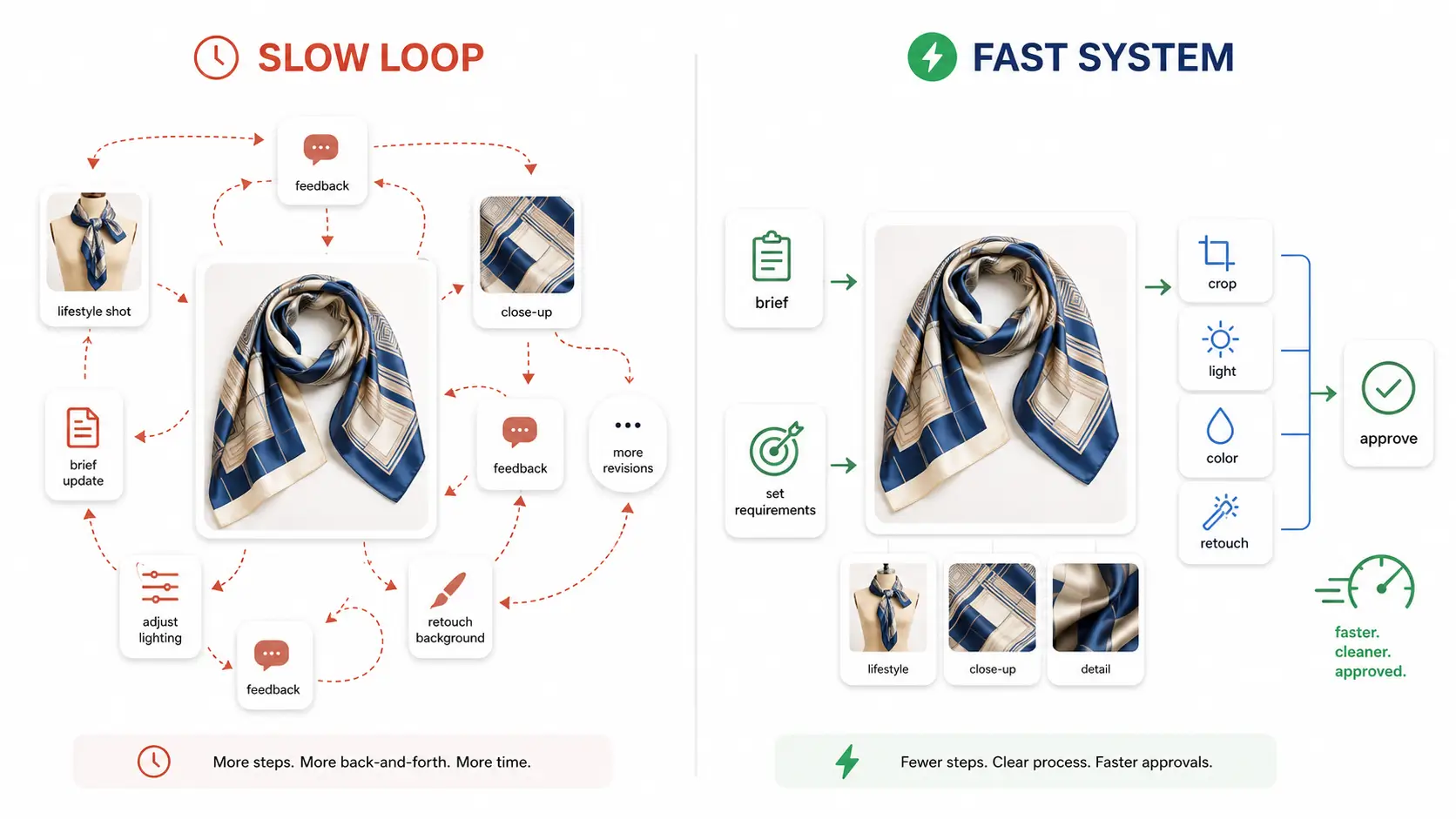
Consistency at scale. A fashion brand preparing a seasonal sale needs email headers, promo banners, social cuts in four aspect ratios, on-site carousel images, and ad creatives for three platforms — all featuring 20–50 products, all matching the same campaign mood, all accurate to the actual items being sold. Producing this volume with consistent quality requires more than a good image model. It requires a system that can ingest reference images, apply consistent prompt logic across hundreds of generations, validate outputs against product truth standards, organize results by placement, and deliver them in formats that each channel expects. That system is infrastructure.
Workflow continuity. Most creative teams already use multiple tools: a background remover, an upscaler, an image generator, possibly a video generator, and a DAM or file-sharing system for organization. The value of any single tool depends on how cleanly it connects to the others. A background remover that outputs clean PNGs at 4K is more valuable than one that compresses the output and strips metadata that the downstream generator needs. An image generator that accepts reference images and preserves detail is more valuable than one that treats every input as a style suggestion. Integration quality is infrastructure quality.
Speed under pressure. Flash drops, limited-time offers, and reactive campaign adjustments do not allow teams to manually shepherd each image through a multi-tool pipeline. The faster the turnaround, the more the infrastructure has to handle the mechanics: queuing, routing, error recovery, format conversion, and quality gating. When a team can go from product photo to published campaign visual in under an hour, it is not because someone worked faster. It is because the infrastructure handled the overhead.
Trust and accountability. When an AI-generated campaign visual reaches a customer, the brand is accountable for what that image shows. If the product color is wrong, if the discount implied by the visual does not exist on the landing page, or if the image implies features the product does not have, the brand takes the hit — not the AI tool vendor. Infrastructure that enforces validation checkpoints, maintains output lineage, and supports review-before-publish workflows is not bureaucratic overhead. It is risk reduction.
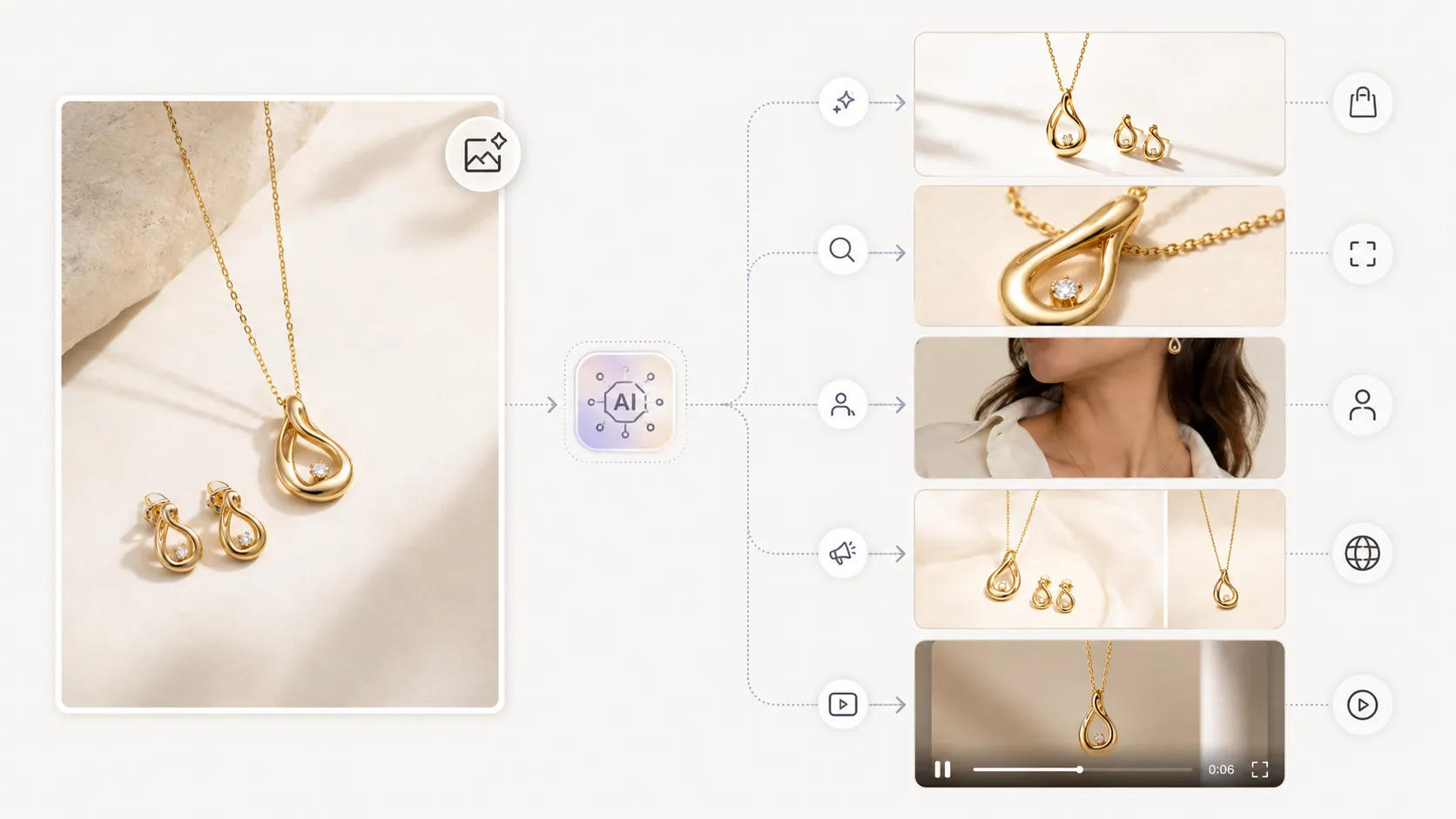
iCreat AI's approach to AI Product Photography reflects this infrastructure orientation. The workflow is designed around reference-image-driven generation (not open-ended text-to-image), model selection suited to the output need (GPT-Image-1 for standard generation, Nano Banana Pro for advanced detail work), output formats and resolutions matched to ecommerce placements, and integration with supporting tools like AI Image Replacer for variation work and AI Product Video for motion content. Each of these choices is an infrastructure decision: it is about how the tool fits into a production system, not just about what the model can render in isolation.
What Makes AI Creative Infrastructure a Real Category Now
Categories form when a cluster of products starts sharing common characteristics, addressing common problems, and being evaluated on common criteria independent of the underlying technology. AI creative infrastructure is crossing that threshold for several reasons.
Shared vocabulary is emerging. Terms like "routing," "governance," "residency," "fallback," "lineage," "handoff," and "orchestration" are appearing in product documentation, engineering blogs, and buyer conversations with consistent meanings. When both vendors and buyers use the same words to describe the same problems, a category exists whether anyone has formally named it or not.
Buyer evaluation criteria are shifting. Teams evaluating AI tools increasingly ask questions that have nothing to do with benchmark scores: "Where does my data live?" "What happens when it breaks?" "How do I audit what happened last month?" "Does this integrate with what I already use?" These are infrastructure questions. The fact that they are now standard parts of evaluation means infrastructure is a decision dimension on par with model quality.
Specialized tools are emerging for infra problems. Oak for AI workflow versioning, OpenRouter for governed routing, Google ADK for agent coordination — these are not general-purpose AI tools. They are tools whose entire reason for existence is to solve an infrastructure problem that general-purpose tools created but did not address. The existence of specialized infrastructure tools is perhaps the strongest category signal of all.
Platform vendors are infra-izing their offerings. When Anthropic, Google, and others start leading product announcements with deployment, governance, and coordination features rather than pure model improvements, it signals that even the largest players see infrastructure as where competitive differentiation is moving. Platforms do not reposition their messaging lightly. This is a collective reading of where customer demand is concentrating.
Workflow complexity has outgrown single-tool solutions. As teams connect more AI tools into longer pipelines, the pain points accumulate at the connections: data format mismatches, missing metadata, unclear error responsibility, no unified logging, no way to replay a production run. These pains are real, recurring, and expensive. Markets form around real recurring expensive problems.
A category does not need a formal name or an industry analyst report to be real. It needs shared problems, shared vocabulary, specialized solutions, and shifted buyer criteria. AI creative infrastructure has all four. The name may settle into something else — "AI operations platform," "creative stack," "model orchestration layer" — but the underlying phenomenon is already driving product decisions, investment patterns, and workflow designs.
Conclusion: Infrastructure Is Where Repeatable Value Compounds
The models will keep getting better. That is almost certain. What is less certain — and far more important for teams choosing tools today — is whether the infrastructure around those models will keep pace with the complexity of real production workloads.
For creative and ecommerce teams, the practical implication is straightforward: when evaluating AI tools, look past the demo images and benchmark numbers. Ask how the tool handles your actual workflow. Ask where your data goes. Ask what happens when something breaks. Ask how you would trace a problem backward if a stakeholder raises a concern three weeks after publication. Ask whether the tool plays well with the other tools you already use.
The tools that give good answers to these infrastructure questions are the ones that will still be useful six months from now, when the next model launch makes today's benchmarks obsolete and the only lasting advantage is how well the tool fits into the system you actually operate.
If you are building or scaling an ecommerce visual production workflow and want a tool designed for infrastructure-aware creative production, try iCreat AI's AI Product Photography to see how reference-image-driven generation, model selection, and ecommerce-ready outputs can fit into your existing pipeline.
Log in to iCreat AI when you're ready to build governed, repeatable visual production workflows: https://icreat.ai/ai-tools/login.