



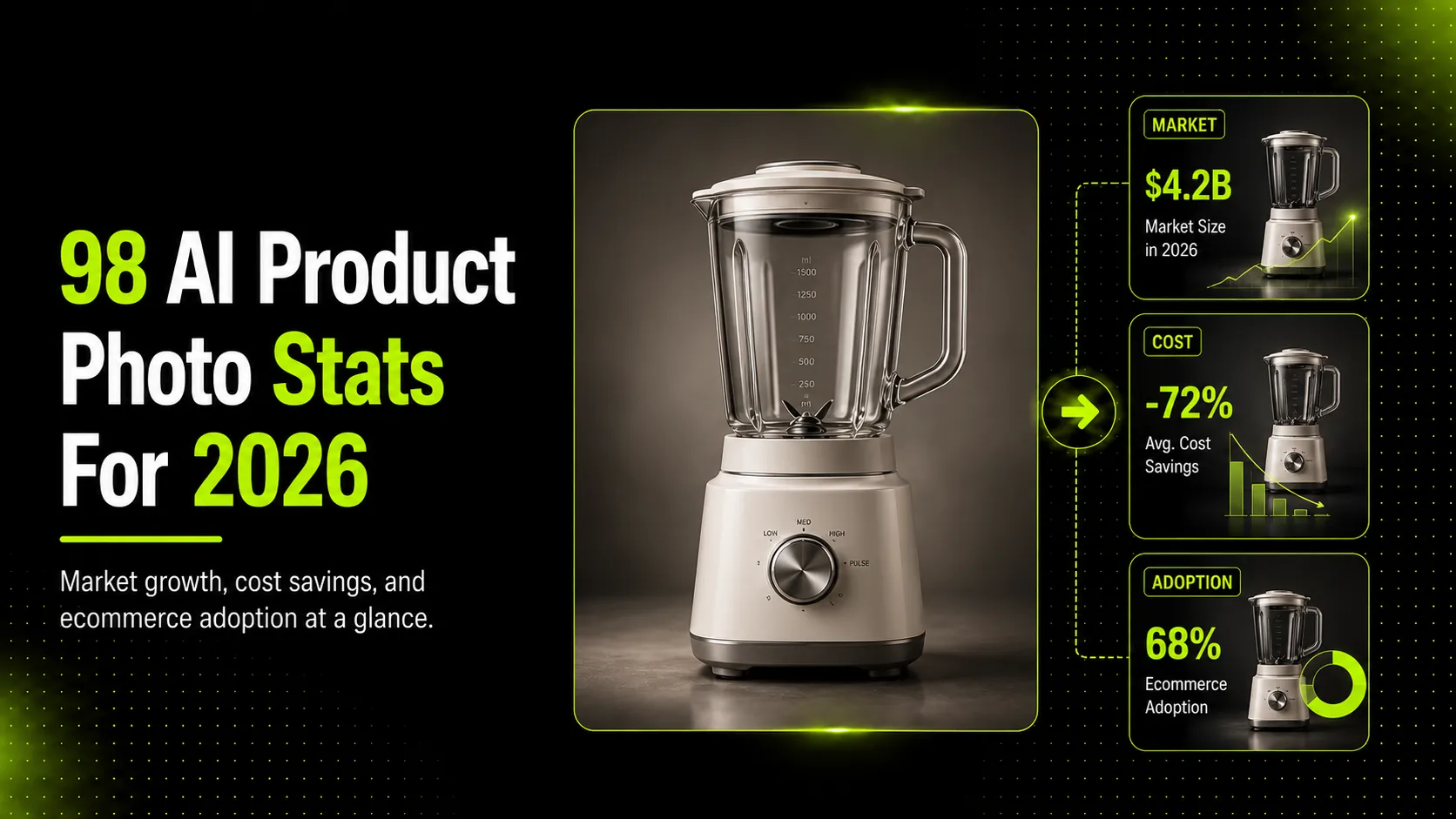
Curious about the state of AI Product Photograph in 2026? Then look no further. We’ve curated, vetted, and categorized a list of up-to-date stats below.
Top AI Product Photograph statistics
- The global AI image generation market is valued at $12.4 billion in 2026, showing how quickly automated visual creation has moved from experimental design work into mainstream commerce production. (Statista)
- The AI product photography market is projected to reach $5 billion by 2035, with a projected compound annual growth rate of 24.5%. (Statista)
- Global ecommerce sales are forecast to reach $6.4 trillion in 2026, giving product imagery a larger role in how brands compete for digital shelf visibility. (Shopify)
- AI image editing has become one of the fastest-growing software categories, with AI image editing tool traffic and software listings rising 441% year over year. (HubSpot)
- Ecommerce brands increased adoption of AI photography tools by 55% in early 2026 as teams looked for faster ways to create catalog, marketplace, and ad creatives. (Shopify)
- Fashion ecommerce retailers are projected to reach 89% adoption of AI virtual models by late 2026. (Statista)
- AI-generated product images can cost $2 to $3 per image, compared with $25 to $500 for traditional product photography. (Shopify)
- AI product photography workflows can be 85% to 97% cheaper than traditional studio shoots that require photographers, models, lighting, props, and post-production. (Shopify)
Platform & shopper visual behavior statistics
- Product images are essential on Amazon, and every product detail page requires at least one compliant main image. (Amazon Seller Central)
- Amazon recommends that sellers upload at least six additional images and one video to help customers evaluate products effectively. (Amazon Seller Central)
- Shopify reports that global ecommerce sales are expected to reach $6.4 trillion in 2026, increasing the volume of product pages competing through images and visual storytelling. (Shopify)
- Statista identifies online shopping as a global retail category shaped by product discovery, marketplace comparison, mobile browsing, and visual merchandising behavior. (Statista)
- Everyday shoppers increasingly accept AI-enhanced product visuals, with 83% unable to distinguish between an AI lifestyle product photo and a real lifestyle photo. (HubSpot)
- Human accuracy in identifying AI-generated imagery has dropped to 38%, showing how realistic AI product and lifestyle visuals have become. (HubSpot)
- A majority of buyers, 67%, still want brands to be transparent when AI is used in product visual creation. (HubSpot)
- Digital teams testing AI imagery report satisfaction rates as high as 94%, indicating that AI-generated ecommerce visuals can meet practical merchandising and campaign needs. (HubSpot)
CTR & listing conversion statistics
- Fashion ecommerce brands using AI-generated on-model images have reported conversion lifts of up to 60%. (Statista)
- AI-optimized product images can lift click-through rates by 47% on shopping ad surfaces such as Google Shopping. (HubSpot)
- Businesses using AI-generated images in marketing campaigns report an average ROI of 310%. (HubSpot)
- Product listing creation time can fall by 73% when ecommerce teams replace manual photo production with AI-generated product visuals. (Shopify)
- Context-aware background generation can reduce manual editing time by 67% for product pages, marketplace assets, and campaign creatives. (Shopify)
- Wyzowl reports that YouTube remains the most effective video marketing platform, with 69% of video marketers calling it effective. (Wyzowl)
- Instagram is rated effective by 56% of video marketers, making it a high-priority channel for AI-generated product visuals, reels, and shoppable content. (Wyzowl)
- Facebook is rated effective by 55% of video marketers, keeping product visuals important for social commerce and retargeting creative. (Wyzowl)
Listing content & ranking performance statistics
- Amazon requires the main image to show the actual product for sale, making image accuracy a direct compliance factor for marketplace listings. (Amazon Seller Central)
- Amazon requires product images to accurately represent the product and match the product title. (Amazon Seller Central)
- Amazon main images must not include text, logos, borders, color blocks, watermarks, or other graphics over the product or background. (Amazon Seller Central)
- Amazon main images must use a pure white background for most product categories. (Amazon Seller Central)
- Amazon requires products in the main image to fill at least 85% of the image frame. (Amazon Seller Central)
- Amazon supports JPEG, TIFF, PNG, and non-animated GIF files for product images. (Amazon Seller Central)
- Amazon image zoom requires high-resolution product photos, with 1,000 pixels or larger recommended for zoom functionality. (Amazon Seller Central)
- BrightEdge reports that AI agent requests reached 88% of human organic search activity in 2026, making structured product content and visual clarity increasingly important for AI-led discovery. (BrightEdge)
Shop traffic & image referral statistics
- BrightEdge projects that AI agent activity will surpass human-driven search by the end of 2026. (BrightEdge)
- BrightEdge reports that AI agents are actively shaping which companies customers choose to engage with and buy from. (BrightEdge)
- AI-driven shopping referrals have grown sharply as ecommerce discovery shifts toward multimodal search, conversational search, and visual product matching. (EMARKETER)
- Ecommerce sales are forecast to reach $6.4 trillion worldwide in 2026, increasing competition for image-led traffic across marketplaces, search engines, and social platforms. (Shopify)
- YouTube is used by 82% of businesses that upload video marketing content, making product video and AI-generated motion assets key traffic drivers. (Wyzowl)
- LinkedIn is used by 70% of video marketers, creating B2B opportunities for AI-generated product demos, launch videos, and visual explainers. (Wyzowl)
- Instagram is used by 69% of video marketers, reinforcing the value of AI-generated lifestyle product images and short-form product visuals. (Wyzowl)
- Facebook is used by 66% of video marketers, keeping ecommerce image and video creative central to paid and organic shop traffic. (Wyzowl)
Search term & buyer demographic statistics
- Statista reports that ecommerce continues to grow across regions, age groups, and retail categories, expanding the audience exposed to AI-generated product photos. (Statista)
- Shopify forecasts global ecommerce sales of $6.4 trillion in 2026, reflecting broad consumer reliance on digital product discovery. (Shopify)
- EMARKETER tracks AI-driven buying behavior as one of the defining digital market trends for 2026 and beyond. (EMARKETER)
- BrightEdge reports that AI agents are becoming a major discovery layer for online customers, changing how shoppers search for and compare products. (BrightEdge)
- Fashion ecommerce is one of the strongest adoption categories for AI product photos, with virtual model usage projected to reach 89% by late 2026. (Statista)
- Buyer expectations around AI disclosure are significant, with 67% wanting brands to be transparent about AI use in product visual creation. (HubSpot)
- Shopper difficulty in detecting AI imagery is high, with 83% unable to tell AI lifestyle product photos from real ones. (HubSpot)
- Human ability to identify AI-generated images has fallen to 38%, increasing the importance of ethical visual policies and accurate product representation. (HubSpot)
Photography service & pricing statistics
- Traditional product photography can cost $25 to $500 per image depending on shot complexity, product type, studio requirements, and editing needs. (Shopify)
- AI-generated product photos average $2 to $3 per image, creating a major cost advantage for sellers with large SKU catalogs. (Shopify)
- AI product photography can reduce production costs by 85% to 97% compared with traditional photography workflows. (Shopify)
- Product photography pricing is affected by photographer experience, equipment costs, type of shot, and turnaround time. (Shopify)
- Full ecommerce photo workflows often include setup, styling, lighting, shooting, retouching, resizing, and file delivery, all of which add cost to traditional production. (Shopify)
- AI photography tools reduce the need for repeated studio rentals by allowing brands to generate new backgrounds, formats, and seasonal variants digitally. (Shopify)
- Context-aware background generation reduces manual editing time by 67%, lowering the hidden post-production cost of ecommerce imagery. (Shopify)
- Listing creation time can fall by 73% when AI-generated photos replace or augment traditional photo production. (Shopify)
Image technical optimization statistics
- Amazon requires product images to be clear, sharp, and non-pixelated. (Amazon Seller Central)
- Amazon recommends images of at least 1,000 pixels on the longest side to support zoom. (Amazon Seller Central)
- Amazon allows product images up to 10,000 pixels on the longest side. (Amazon Seller Central)
- Amazon recommends JPEG as the preferred product image format. (Amazon Seller Central)
- Amazon accepts TIFF, PNG, and non-animated GIF image files in addition to JPEG. (Amazon Seller Central)
- Amazon requires main product images to avoid watermarks, logos, borders, and text overlays. (Amazon Seller Central)
- Amazon requires the product to fill at least 85% of the main image frame, helping maintain visibility in search results and mobile grids. (Amazon Seller Central)
- Amazon recommends uploading at least six additional images and one video, which gives brands more room to show scale, features, use cases, and product details. (Amazon Seller Central)
Local retail product photo statistics
- Shopify reports that ecommerce sales are forecast to reach $6.4 trillion in 2026, expanding digital opportunities for local retailers that invest in stronger product visuals. (Shopify)
- Local retailers using ecommerce platforms must compete visually with national brands, making consistent product photography a core merchandising asset. (Shopify)
- Product photography pricing depends on turnaround time, which makes AI product photos especially useful for local retailers that need fast seasonal updates. (Shopify)
- AI product photo tools can reduce image costs from traditional ranges of $25 to $500 per image to roughly $2 to $3 per image. (Shopify)
- AI product photography can reduce image production costs by 85% to 97%, helping small retailers create professional-looking catalogs without full studio budgets. (Shopify)
- Mobile-first ecommerce growth increases the need for local retailers to use clear product photos that remain readable on smaller screens. (Statista)
- Amazon requires at least one compliant main image per product, a useful benchmark for local retailers selling through marketplaces as well as their own stores. (Amazon Seller Central)
- Amazon recommends six additional product images and one video, giving local retailers a practical visual content benchmark for marketplace-ready product pages. (Amazon Seller Central)
Short video & 3D visual content statistics
- YouTube is used by 82% of businesses that publish video marketing content. (Wyzowl)
- LinkedIn is used by 70% of video marketers. (Wyzowl)
- Instagram is used by 69% of video marketers. (Wyzowl)
- Facebook is used by 66% of video marketers. (Wyzowl)
- Webinars are used by 56% of video marketers. (Wyzowl)
- TikTok is used by 40% of video marketers, keeping short product videos relevant for ecommerce discovery. (Wyzowl)
- YouTube is rated effective by 69% of video marketers. (Wyzowl)
- Instagram is rated effective by 56% of video marketers. (Wyzowl)
Mobile shopping image statistics
- Amazon requires product main images to fill at least 85% of the frame, a standard that improves visibility in compact mobile search results. (Amazon Seller Central)
- Amazon recommends at least 1,000 pixels on the longest side so shoppers can use zoom to inspect details on mobile and desktop. (Amazon Seller Central)
- Amazon recommends at least six additional images and one video, giving mobile shoppers more ways to evaluate a product without visiting a physical store. (Amazon Seller Central)
- Shopify forecasts global ecommerce sales of $6.4 trillion in 2026, with mobile product discovery playing a major role in online buying journeys. (Shopify)
- Statista identifies mobile commerce as a major component of global online shopping behavior, increasing the importance of fast-loading, readable product images. (Statista)
- AI-generated product photos can reduce production costs to $2 to $3 per image, helping brands create more mobile-optimized variants for ads, thumbnails, and PDP galleries. (Shopify)
- Context-aware background generation can reduce manual editing time by 67%, making it easier to create mobile-first product image sets. (Shopify)
- AI-optimized product images can increase click-through rates by 47% on shopping surfaces where mobile users scan images before reading product details. (HubSpot)
- Facebook is used by 66% of video marketers, maintaining the importance of mobile-friendly product visuals in social commerce feeds. (Wyzowl)
AI tool & AI product photograph statistics
- The global AI image generation market is valued at $12.4 billion in 2026. (Statista)
- The AI product photography market is projected to reach $5 billion by 2035. (Statista)
- The AI product photography category is projected to grow at a 24.5% compound annual growth rate through 2035. (Statista)
- AI image editing tools saw 441% year-over-year growth in traffic and software listings. (HubSpot)
- Ecommerce brand adoption of AI photography tools jumped 55% in early 2026. (Shopify)
- Virtual model adoption among fashion ecommerce retailers is projected to reach 89% by late 2026. (Statista)
- AI-generated on-model photos can increase fashion ecommerce conversion rates by 60%. (Statista)
- AI-generated product images can deliver an average marketing ROI of 310%. (HubSpot)
- AI-generated product visuals can cost $2 to $3 per image, compared with traditional product photography costs of $25 to $500 per image. (Shopify)