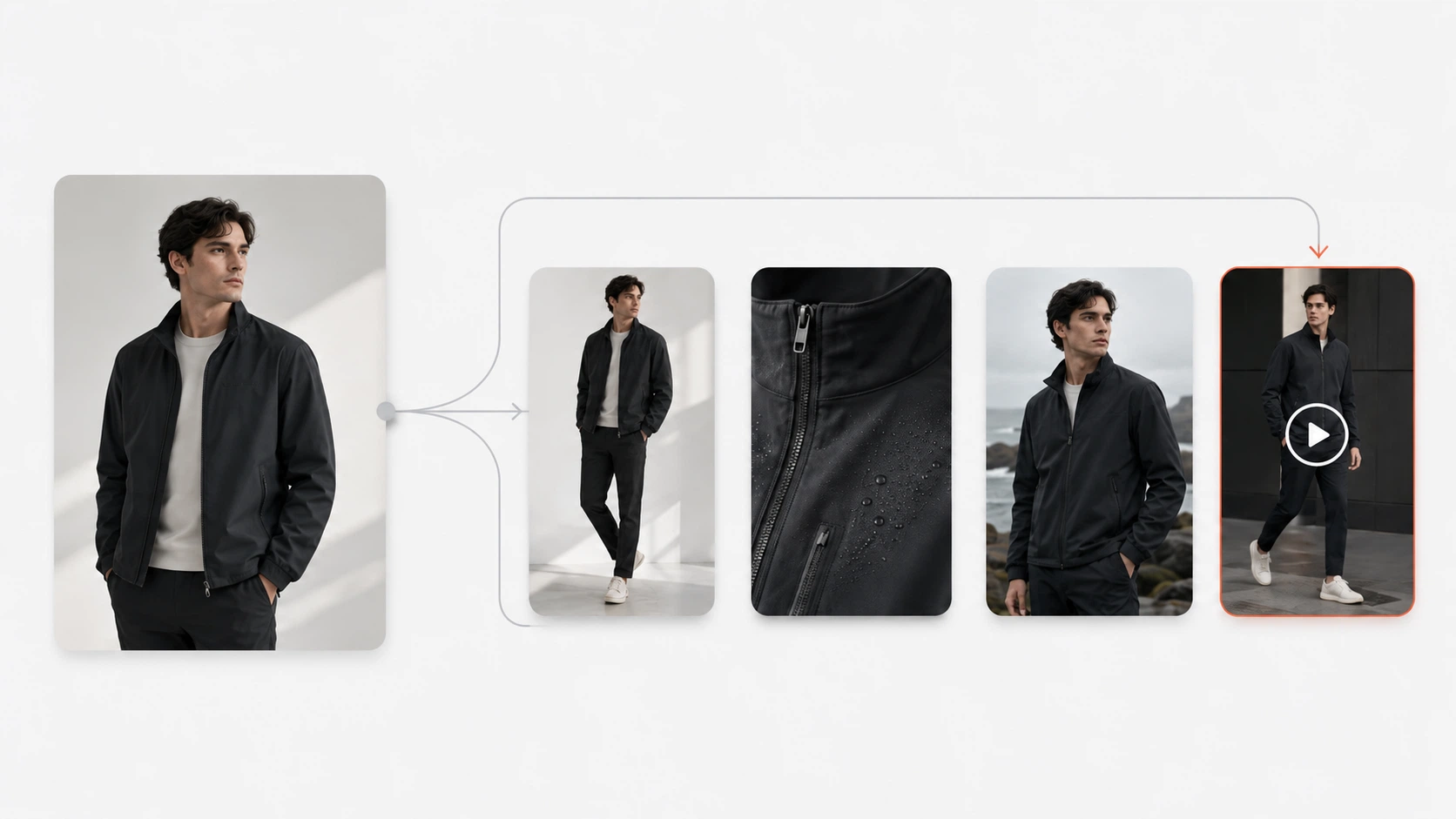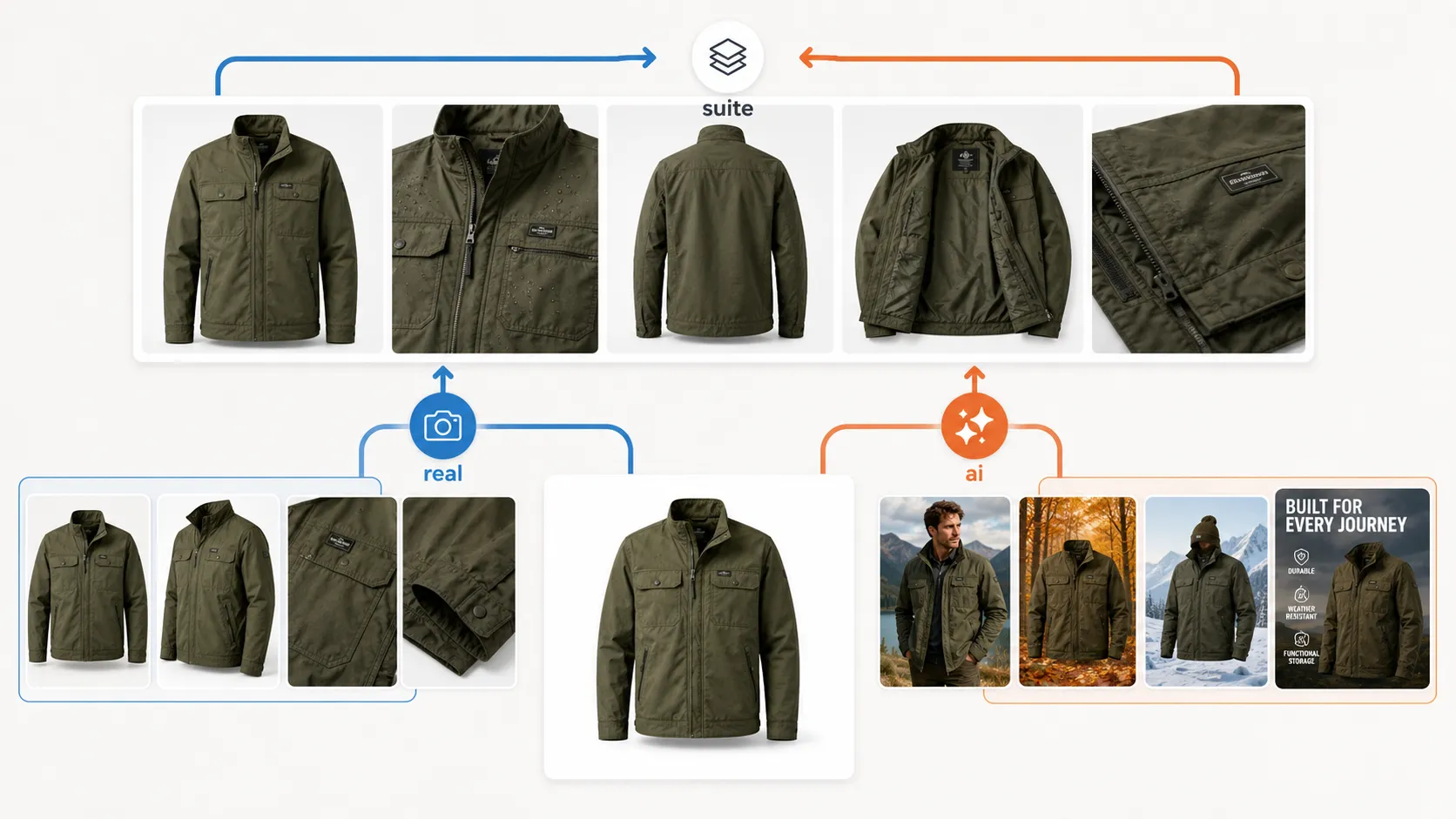




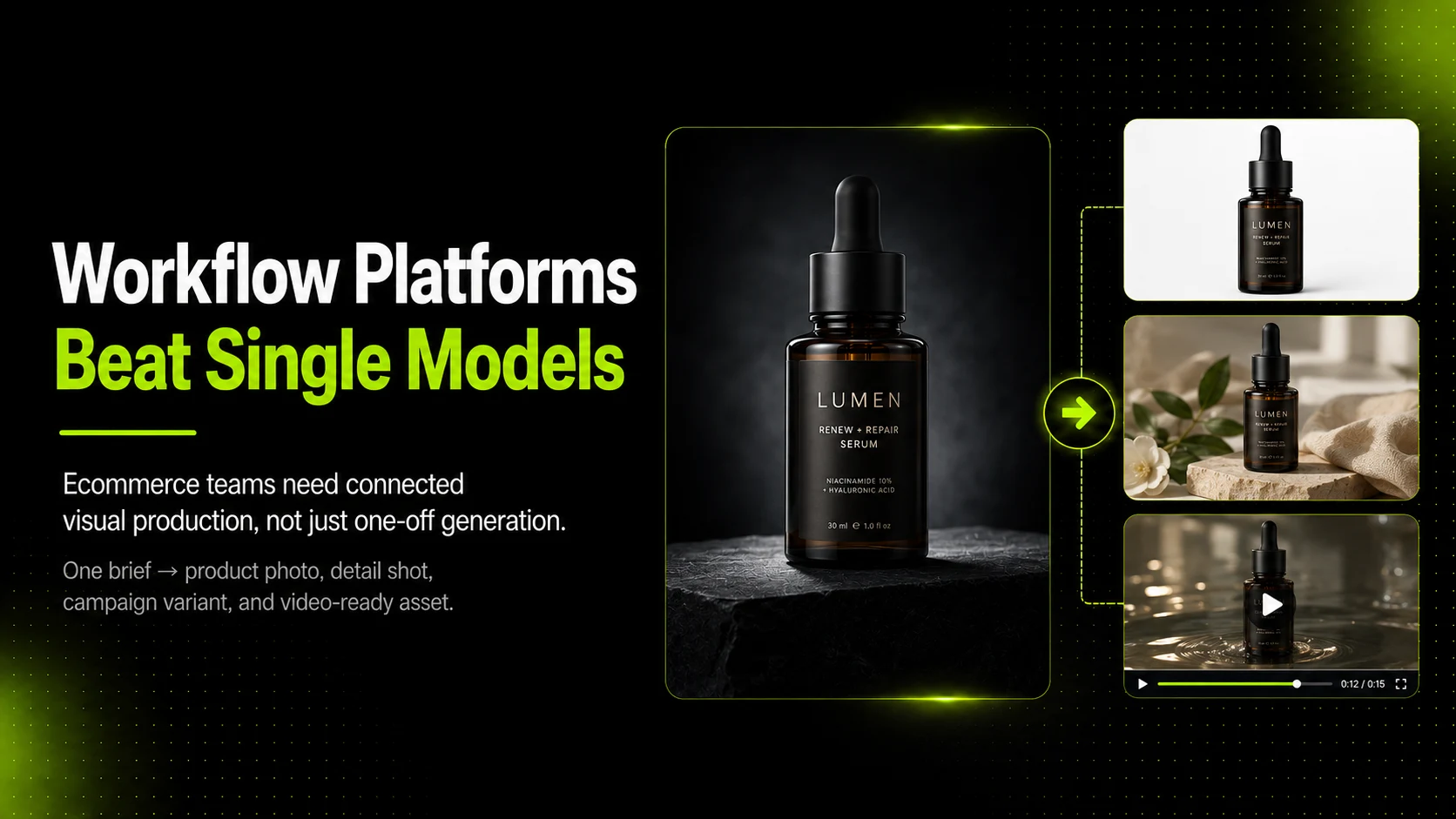
Standalone AI models are getting faster, cheaper, and more capable every month. But for ecommerce teams, that does not automatically solve the real work. Product launches still need briefs, reviews, revisions, asset variants, and channel-specific outputs. In practice, the market is moving toward AI visual workflow platforms because standalone models only handle one layer of the job: generation. The bigger value now sits in the system that connects generation, editing, variation, and delivery into one repeatable process.
For fashion ecommerce brands, this shift matters because the hardest part of visual production was never finding one decent image. It was producing enough high-quality assets, keeping them consistent, and adapting them across campaigns without rebuilding the workflow every time. That is where platforms start to matter more than individual model releases.
Key Takeaways
- Standalone models create outputs, but workflow platforms create repeatable production systems.
- The more image, video, and multimodal tools multiply, the more value shifts to orchestration rather than single-model selection.
- Ecommerce teams care about revision speed, consistency, and multi-format delivery more than constant model-hopping.
- For fashion brands, the winning stack is increasingly the one that turns one brief into a connected visual workflow.
Why the AI Landscape Feels More Powerful but Still More Fragmented
The AI market is full of launches that sound individually impressive. One week it is a faster flash model. The next week it is a better local model, a better coding workflow, or a more advanced robotics announcement. These updates matter. But they also create a common trap: teams start evaluating AI entirely through model names instead of asking what those models actually improve in a production workflow.
This gap is getting wider, not smaller. A model can be strong at image generation, another can be stronger at fast editing, and another can be better for motion or multimodal interaction. None of that automatically gives a brand a stable way to plan a product launch, generate product imagery, create campaign variants, or adapt assets across channels. The result is often a stack of disconnected tools that each do something useful but do not form a reliable system.
What Recent AI News Signals Actually Tell Us
The latest wave of product and industry news points in the same direction: product value is moving up the stack.
Apple's reported AI direction is a good example. Instead of betting on one monolithic AI system, the company is reportedly combining smaller local models with cloud routing for more complex tasks. That is a systems decision, not a model leaderboard decision. It suggests that orchestration, cost control, privacy, and task routing are becoming product differentiators.
OpenAI's robotics move points to the same conclusion from another angle. Once AI is expected to operate inside a real-world loop, intelligence alone is not enough. Systems need continuity, state, execution layers, and a way to connect multiple capabilities into one task flow. Robotics simply makes the workflow problem more visible.
Even smaller announcements reinforce the same pattern. A flash model appears inside a developer workflow surface. A release note emphasizes infrastructure reliability more than flashy end-user features. These are signs that mature AI products are increasingly competing on system behavior, not just model novelty.
Standalone Models Are Necessary but Not Sufficient
A standalone model is still valuable. Without strong generation, editing, or motion capabilities, there is nothing useful to orchestrate. But the unit of value for ecommerce teams is rarely the model output alone.
Consider how a real fashion brand works. A team might start with a product image, then need white-background detail images, lookbook-style compositions, pose variations, promotional cuts, and short-form video. If every output requires starting over in a different tool, the workflow breaks apart. The model might be good, but the system is weak.
This is why standalone models are increasingly becoming components rather than complete solutions. The question is no longer only "which model is best?" It is also:
- Which model fits this task?
- How do approved decisions carry forward to the next output?
- How does the team avoid rebuilding creative direction from scratch?
- How do outputs stay consistent across channels?
Those are platform questions.
What Workflow Platforms Do That Models Alone Cannot
The main job of a workflow platform is not to replace models. It is to make them usable inside real commercial production.
At a practical level, an AI visual workflow platform can help with four things that a standalone model usually does not solve on its own:
1. It preserves context across steps
In commercial visual work, approved decisions matter. Once a team has agreed on product framing, mood, garment presentation, or campaign direction, those decisions should carry into the next output. Standalone models often treat each prompt like a fresh request. A workflow system tries to maintain continuity.
2. It connects output types
An ecommerce team does not just need one image. It may need a hero image, detail image, alternative crop, campaign visual, and video extension. When those outputs live in one connected production path, the team spends less time translating intent between tools.
If your workflow starts with a reference image, you can create ecommerce product photos with AI and then extend that same direction into related outputs instead of rebuilding the visual logic from zero.
3. It reduces fragmentation
Most teams do not struggle because they lack AI options. They struggle because too many AI options create operational drag. Separate interfaces, different output behaviors, disconnected revisions, and inconsistent quality all make production slower. Platforms win when they reduce those switching costs.
4. It makes repeatability possible
Commercial teams need repeatable output more than isolated brilliance. One excellent image is useful. A repeatable way to produce 20 aligned assets is much more valuable. Workflow platforms help structure that repeatability at the system level.
Why This Matters Specifically for Ecommerce Visual Production
Ecommerce is where the model-versus-platform distinction becomes obvious fastest.
A shopper rarely sees only one visual. They see a product page, a social ad, a campaign email, a collection page, and possibly a short-form launch video. From the team's perspective, this means one product often turns into many outputs. The real problem is not image generation in isolation. It is how those outputs stay aligned while moving across business needs.
This is especially true for fashion brands. Product fidelity, brand consistency, and asset variety all matter at once. A clothing team may need a hero image, back-view detail, model pose variation, and a seasonal campaign adaptation. The platform layer matters because these are not four unrelated creative acts. They are one connected production problem.
You can see the same logic in supporting workflows such as adapting product visuals with AI, expanding a concept into editorial-style fashion assets, or using pose variations for product pages and campaigns. Individually, each output solves one need. Together, they describe why workflow matters more than isolated model access.
How to Evaluate AI Tools Through a Workflow Lens
If you are evaluating AI visual products, a workflow-first lens leads to better questions than a model-first lens.
Ask questions like:
- Can this system help us move from one approved visual into multiple asset types?
- Does it reduce production coordination, or just add another tool?
- Can it support both speed and consistency?
- Does it fit our commercial process, not just our curiosity about new models?
This does not mean models stop mattering. It means the model is no longer the whole story. In many cases, a team will get more durable value from a platform that coordinates changing models than from picking one model and treating it like a permanent answer.
That is particularly relevant for brands that expect the category to keep changing. New models will continue to appear. What should stay stable is the workflow the team relies on.
Conclusion
Standalone models will keep improving, and teams should pay attention to those shifts. But the long-term commercial advantage is moving toward platforms that make those capabilities usable in real production. For ecommerce brands, the biggest gains will come from systems that preserve context, connect outputs, and turn visual production into a repeatable workflow.
If your current stack still feels like a set of disconnected AI experiments, it may be time to evaluate the workflow layer instead of chasing one more model launch. A connected system for product photography, variation, and video can create more durable value than any single standalone model ever will.