



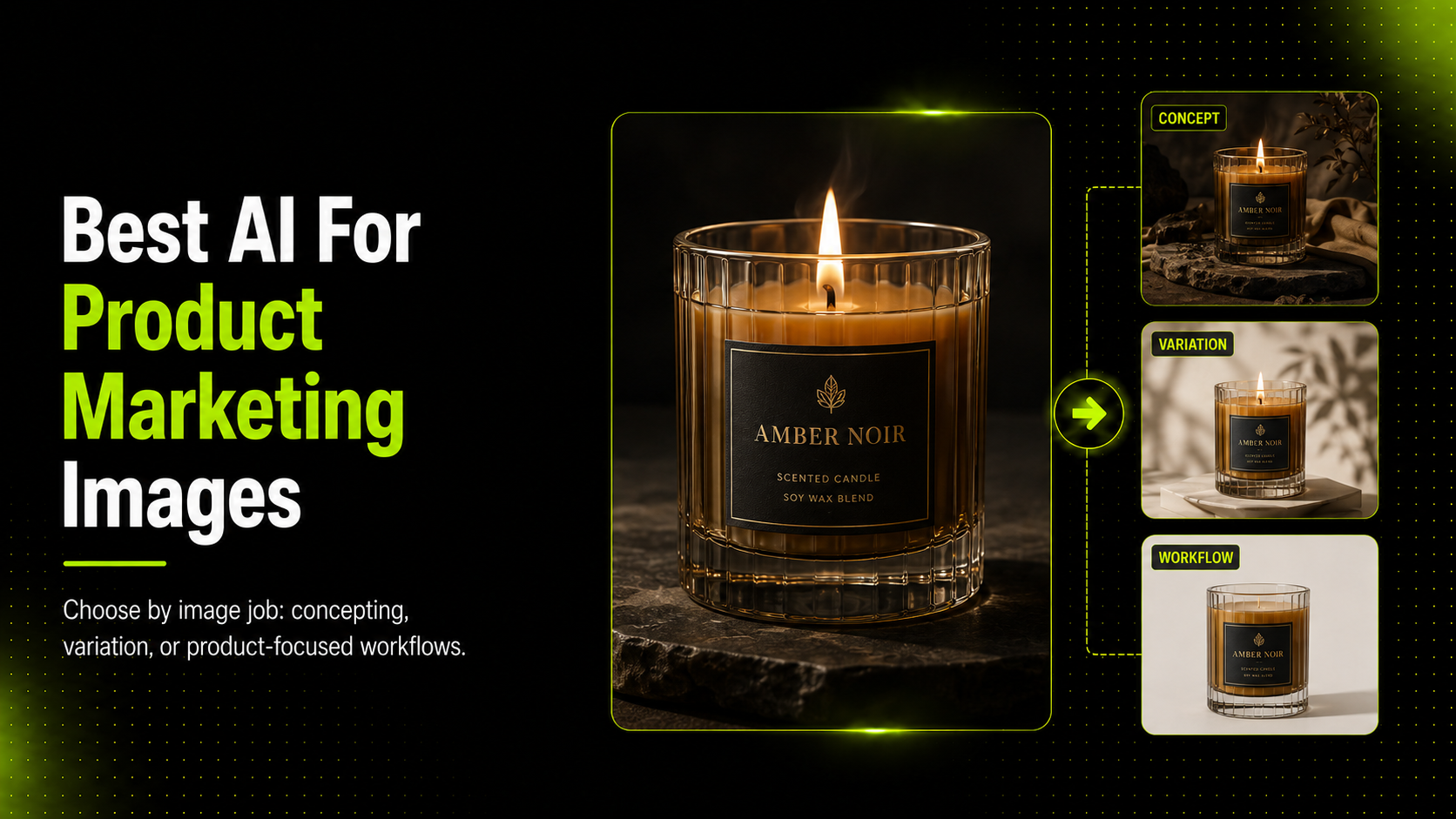
Key Takeaways
- The strongest AI for product marketing images depends on whether you need concepting, scalable variation, or controlled product-focused output.
- General image models are often strongest for exploration and moodboard-style campaign ideas.
- Product-focused AI workflows are stronger when visuals still need to stay close to real product inputs.
- The best decision is usually based on image job, not tool hype.
- Product marketing images should still be reviewed for product truth before they are reused in customer-facing ecommerce contexts.
The best AI for product marketing images depends on what job the image needs to do. If the goal is fast concepting or bold campaign experimentation, a general image model may be good enough. If the goal is repeatable product marketing visuals that still begin from real product inputs and stay usable across ecommerce workflows, a product-focused AI workflow is usually the stronger fit.
That is the decision most teams actually need to make. They are not just asking which tool makes the prettiest image. They are asking which tool helps them create more campaign assets, channel variants, and product-facing visuals without creating more review work than they save.
What Product Marketing Images Actually Need to Do
Before choosing a tool, define the job.
Product marketing images are not all doing the same work. A skincare bottle in a paid social ad needs to stop the scroll and still feel believable. A sneaker campaign image may need strong motion, color, and styling variation. A handbag launch image may need to feel premium enough for a hero banner but still recognizable enough to support the actual product story. A t-shirt visual may need to carry mood and brand tone without drifting so far from the garment that shoppers no longer trust what they are seeing.
That is why “best AI” is the wrong first question. The better question is: which kind of AI is the strongest fit for the image job?
Most product marketing image workflows fall into one of these needs:
- concepting and moodboards
- ad or campaign variations
- product-focused marketing visuals built from real inputs
- export-ready assets that may later be reused in product pages, marketplaces, or other customer-facing channels
Each one requires a different level of control.
The Main Types of AI Used for Product Marketing Images
There are three broad tool categories teams usually compare.
| AI type | Best for | Main strength | Main risk |
|---|---|---|---|
| General image models | concepting, moodboards, bold creative exploration | fast, flexible, visually impressive output | weaker product control and repeatability |
| Editing-first AI tools | cleanup, background work, asset adaptation | efficient image refinement and production support | may still need stronger product-specific workflow logic |
| Product-focused AI workflows | product marketing visuals from real source images | better control over repeatable commerce-facing assets | less open-ended than pure concept tools |
General image models are useful when a team wants to explore scenes, surfaces, lighting directions, or campaign concepts. Editing-first tools are useful when the main problem is not idea generation but cleanup, resizing, or preparing more variants from an existing image set. Product-focused workflows are strongest when the team wants more usable marketing images without abandoning the real product as the source of truth.
The better reason this decision matters is not that AI is widely discussed. It is that product marketing images sit between creativity and commerce. Teams need tools that can create variation fast enough for campaigns while still keeping the product usable when the same visual moves closer to the point of purchase. Shopify and Adobe both reinforce the same practical constraint: product images still need clarity, detail visibility, and visual control. The harder question is not whether teams use AI at all. It is which type of AI helps product marketing images without creating more quality-control work later.
Which AI Is Strongest for Different Product Marketing Jobs
Best for concepting and campaign direction
If the job is exploring direction, a general image model may be the strongest fit. For example, a skincare team may want to compare whether a launch visual should feel clinical, spa-like, or editorial. A sneaker campaign may need several mood directions before anyone commits to a final art direction. A handbag brand may want hero concepts that lean luxury, minimal, or street-style before deciding what the campaign should look like.
In these cases, flexibility matters more than exact product preservation.
Best for repeatable product-centered marketing assets
If the job is building more campaign-ready assets from product images you already trust, a product-focused workflow is usually stronger. This is where AI Product Photography becomes more practical than a general image model. The value is not just that it generates images. The value is that the workflow starts from real product references and is easier to adapt into more usable commerce-facing outputs.
For example, a t-shirt brand may want multiple cleaner marketing variations from one approved studio image. A skincare bottle may need campaign-friendly backgrounds while keeping packaging close to the real item. A sneaker team may need repeated crop and scene variations that still feel tied to the actual product.
Best for cleanup, adaptation, and export support
If the team already has strong source imagery and the problem is mostly preparation, editing-first tools can carry a lot of value. Background Remover and Image Upscaler are useful when the workflow needs cleaner edges, faster export prep, or controlled background changes rather than entirely new campaign generation.
The practical takeaway is simple: the best AI depends on whether the team is still inventing the visual direction, expanding trusted product imagery, or preparing final assets for more channels.
Where General Image Models Fall Short
This is where teams often overestimate what “best AI” means.
General models can make strong-looking product marketing visuals, but they are not always the strongest fit when the image still needs to stay tied to a real product. A skincare bottle may come back with softer shadows and stronger atmosphere, but the label spacing may drift. A handbag may look more premium, but hardware details or material feel may become less exact. A sneaker may gain campaign energy while losing sole pattern accuracy or color precision.
That tradeoff may be acceptable for early campaign exploration. It becomes riskier when those same visuals start getting reused closer to the point of purchase.
Google Merchant Center's image guidance is useful context here. Product images should accurately display the product, avoid misleading overlays, and still meet supported image requirements. That does not tell you which AI is “best,” but it does make one thing clear: once a marketing image begins to operate like a commerce image, beauty alone is not enough.
When a Product-Focused AI Workflow Is the Stronger Fit
The stronger fit is usually the workflow that gives the team enough creative variation without breaking product trust.
A product-focused AI workflow is stronger when
- the team starts from approved product images
- the goal is campaign or ad variation without rebuilding the entire shoot
- the visual may later support ecommerce-facing usage
- repeatability matters across several products or channels
A general model is stronger when
- the team is still exploring ideas
- exact product preservation is not the main requirement
- the output is a moodboard, hero concept, or rough campaign direction
A professional photoshoot is still stronger when
- hero-image trust matters most
- exact color or texture is critical
- visible labels, materials, or details are high stakes
- the image must anchor the customer's first impression of the actual product
The most practical strategy is often hybrid. Use a shoot or trusted product capture as the source of truth. Use AI to expand what that source can do.
What to Review Before Publishing Product Marketing Images
Even if the image is “just marketing,” the review standard should rise if the image may be reused near the point of purchase.
Before publishing, review:
- Product shape: does the silhouette still match the actual item?
- Color accuracy: does the item still look like the real product?
- Logo placement: are logos or visible marks still correct?
- Material or texture: does the product still look believable on close inspection?
- Cropping and framing: is the crop usable for the intended channel?
- Target channel requirements: could the image later create problems if reused in a commerce-facing surface?
- Shopper trust: if the customer saw only this visual, would it set the right expectation?
This is where a product-focused workflow becomes more commercially responsible. It does not ask AI to replace review. It asks AI to make the image set bigger and more useful while keeping the team in control of the final trust decision.
FAQ
Conclusion
The best AI for product marketing images is not the one with the loudest reputation. It is the one that fits the job your team actually needs done.
If the work is concepting, a general model may be enough. If the work is creating more usable campaign variations from real product inputs, a product-focused AI workflow is usually the stronger fit. If the work is cleanup and preparation, editing-first tools may save the most time. The strongest teams do not ask one tool to do every job. They pick the right workflow for the image, then review the result before it becomes a customer-facing asset.