



The launch of Seedance 2.5 marks a clear step forward in ByteDance’s video generation ecosystem, bringing a new generation of AI video capabilities designed for developers, API users, and production teams building real-world creative workflows. Announced at the Volcano Engine 2026 conference preview, Seedance 2.5 is positioned not as an experimental model upgrade, but as a production-oriented generation system that significantly expands what developers can build with AI video APIs.
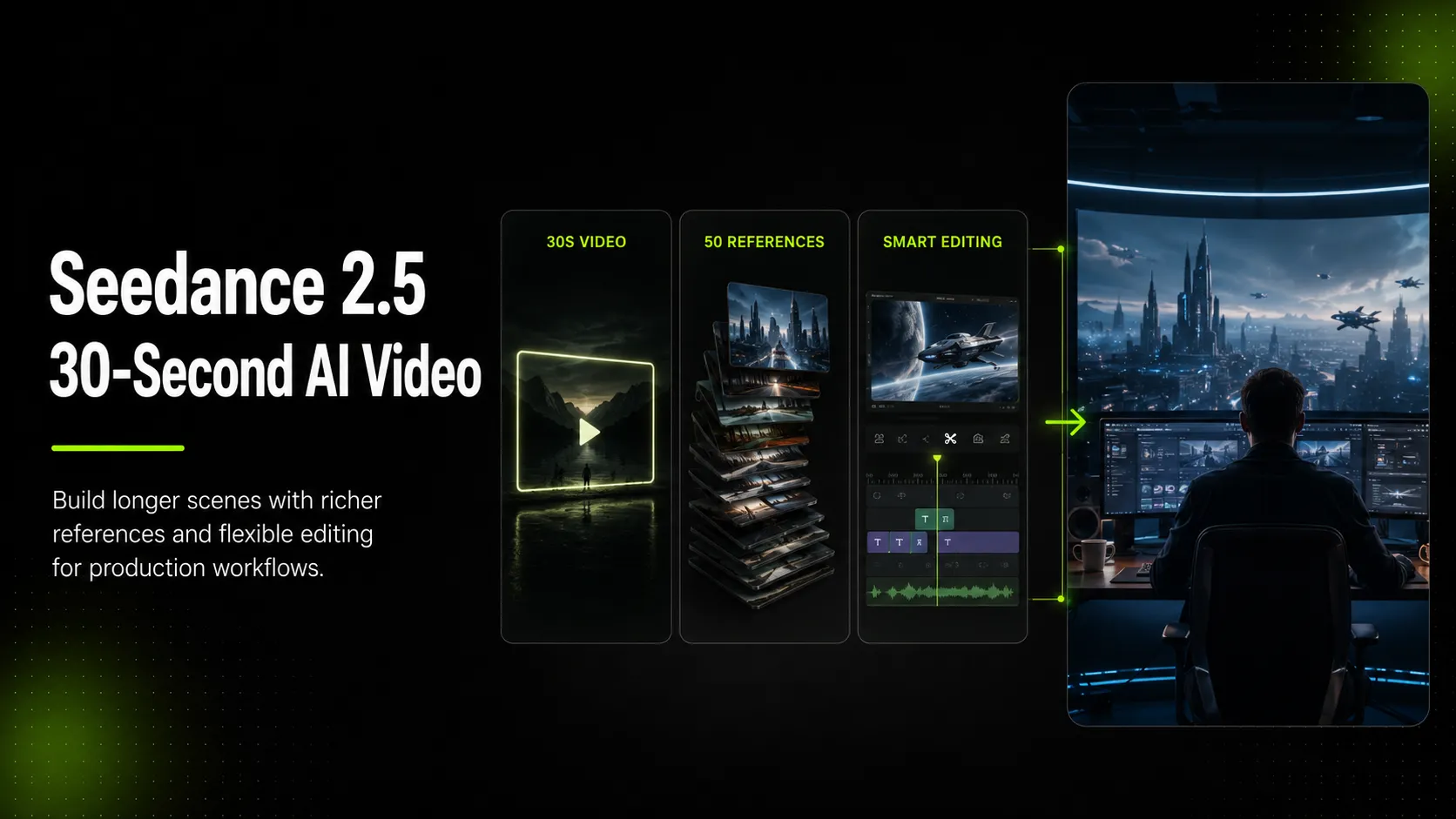
At its core, Seedance 2.5 introduces three major upgrades that define its value proposition. It extends native single-clip generation to 30 seconds, introduces a significantly expanded multi-reference system supporting up to 50 full-modal inputs, and delivers improved controllability through flexible, localized editing capabilities. Together, these upgrades move AI video from short-form generation toward structured, production-grade scene creation.
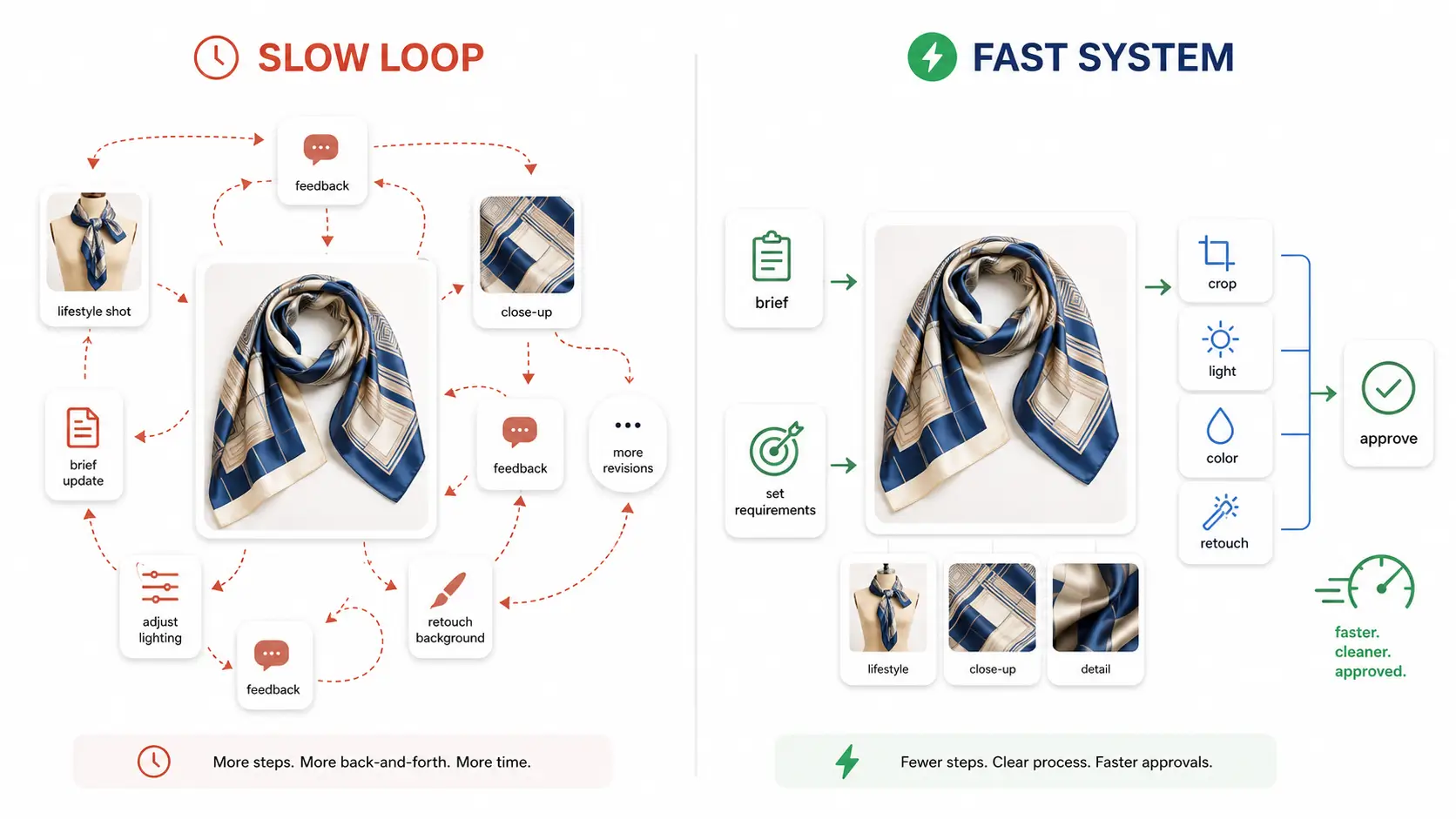
Unlike earlier iterations that primarily focused on short clips and post-generation stitching workflows, Seedance 2.5 is designed to reduce fragmentation in production pipelines. This means fewer generated segments, fewer consistency breaks, and less dependency on manual editing or compositing after generation. For developers building automated content systems, this shift directly translates into lower operational overhead and more predictable output quality.
A Clear Upgrade Path from Seedance 2.0 to 2.5
Seedance 2.5 is built on the foundation of Seedance 2.0, which already introduced multimodal generation capabilities spanning text, image, audio, and video inputs. However, in practical usage, Seedance 2.0 was still constrained by relatively short output durations and limited scene-level control. Most workflows required multiple generations stitched together, especially for narrative or commercial content.
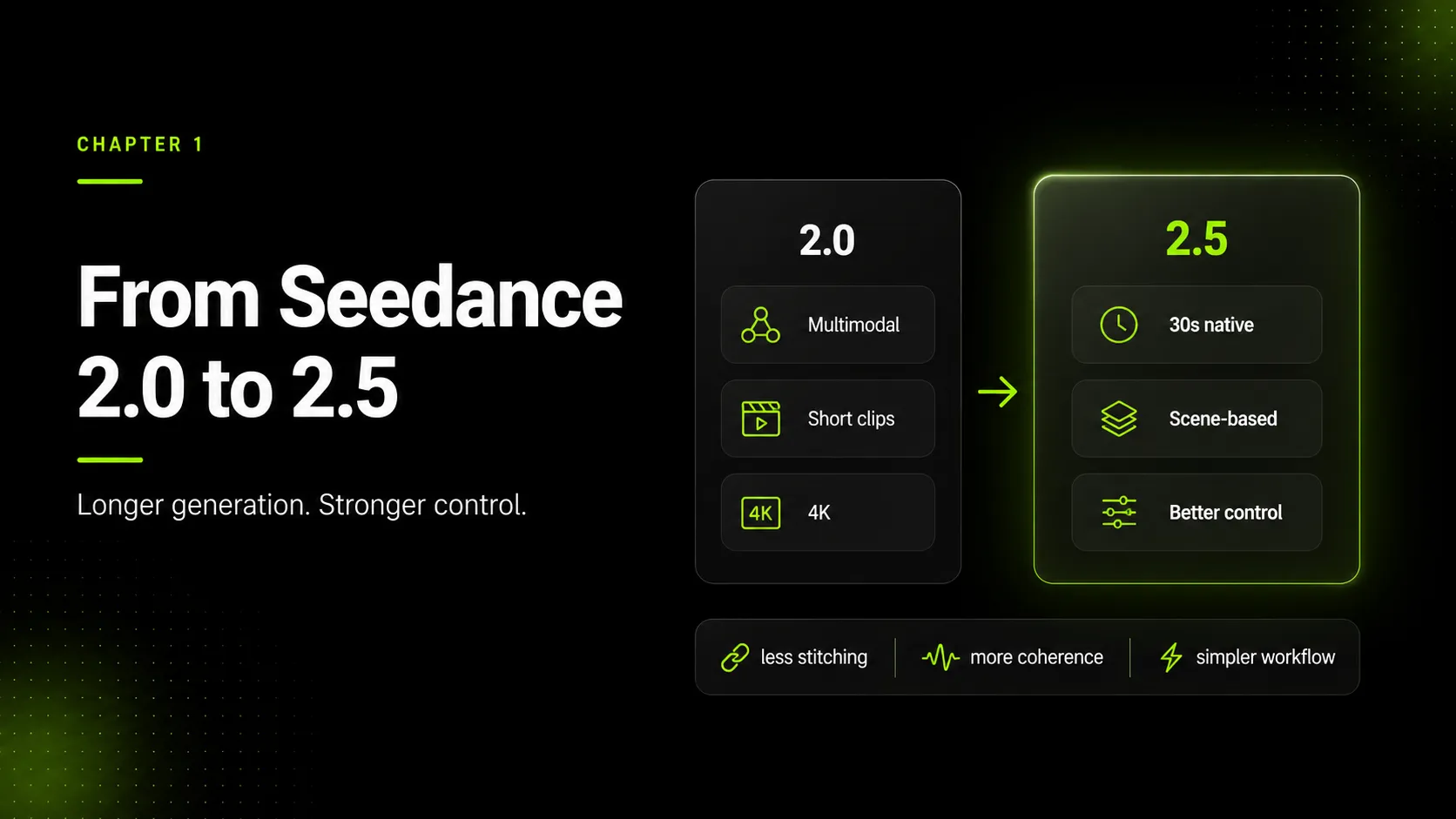
With Seedance 2.5, the system evolves into a more unified generation model. The most visible improvement is the expansion of native video output length from the 15-second range to up to 30 seconds in a single generation pass. This change is not only a numerical increase but a structural improvement in how temporal coherence is handled inside the model.
In production terms, this allows a single prompt to carry a complete narrative arc or product demonstration sequence without requiring segmentation. For developers, this reduces orchestration complexity at the API level and simplifies downstream rendering pipelines.
At the same time, Seedance 2.0 has also received an important upgrade to 4K output capability, ensuring continuity across the ecosystem while Seedance 2.5 focuses on extended generation and control improvements. This dual-track evolution allows existing integrations to remain stable while enabling new workloads to scale into longer-form video generation.
30-Second Native Video: From Clip Generation to Scene Generation
The most important feature of Seedance 2.5 is its ability to generate up to 30 seconds of continuous video in a single pass. This capability fundamentally changes how developers and creators structure prompts and workflows.
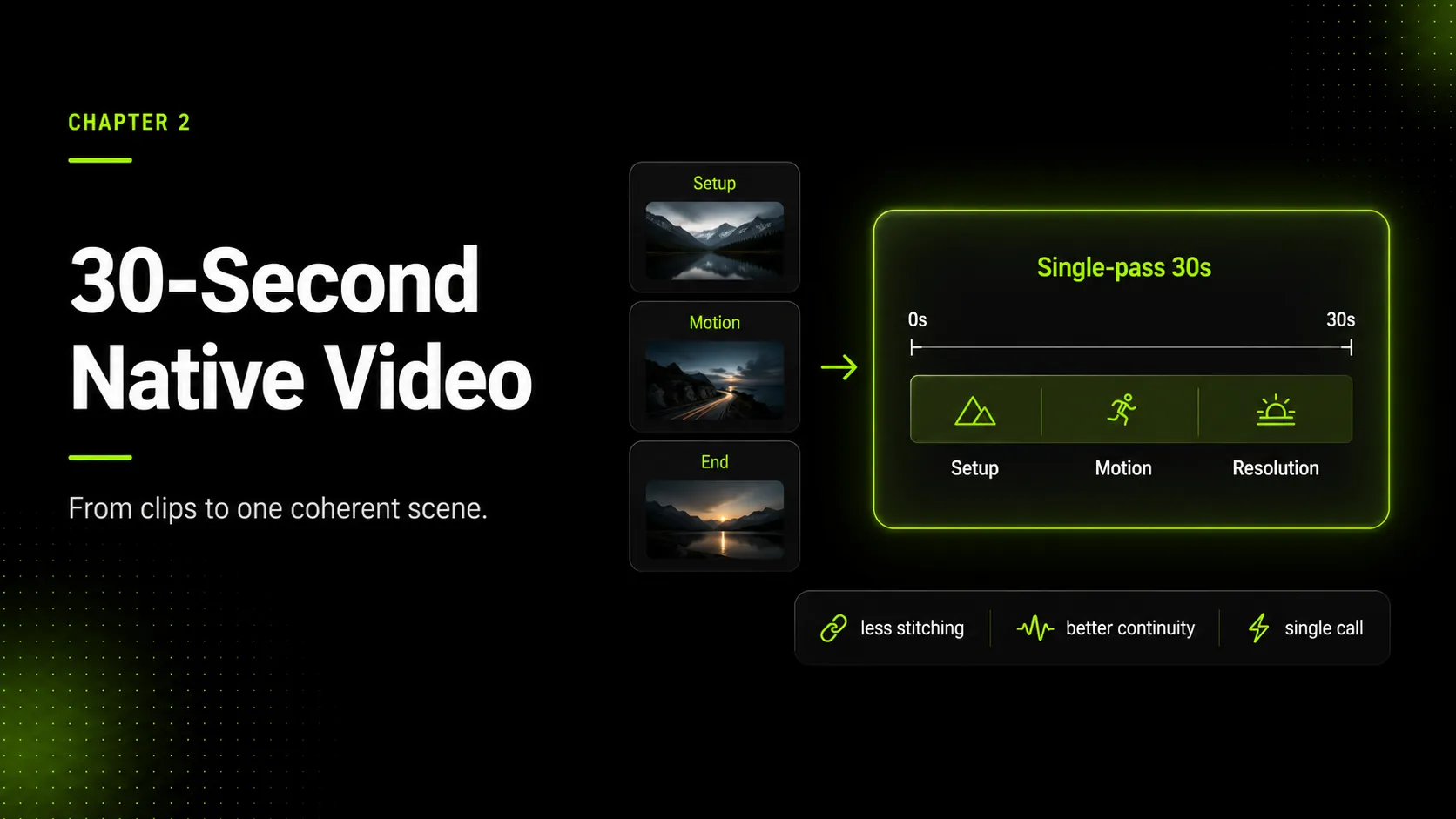
Instead of thinking in terms of multiple short clips that must be stitched together, users can now design full scene-level instructions that include setup, motion progression, and resolution within one generation cycle. This shift reduces reliance on post-processing and significantly improves consistency across characters, objects, and environments.
In practical applications, this unlocks a wide range of use cases that were previously difficult to automate. Product demonstrations can now maintain consistent framing and object identity across longer sequences. Short-form storytelling can include multi-step actions without visual drift. Advertising workflows can incorporate narrative structure rather than isolated shots.
For API users, this also reduces orchestration overhead. Instead of managing multiple generation calls and synchronization logic, developers can rely on a single generation endpoint to produce coherent extended content.
While early benchmarks are not yet publicly available, initial demonstrations suggest improved long-range consistency, particularly in maintaining character identity and object stability across extended timelines. This remains one of the most important evaluation areas as the model moves toward production-scale adoption.
50 Full-Modal References: A New Level of Creative Control
Another major upgrade in Seedance 2.5 is the expanded reference system, which now supports up to 50 full-modal reference inputs. This represents one of the largest reference capacities in current AI video systems and significantly expands the level of controllability available to users.
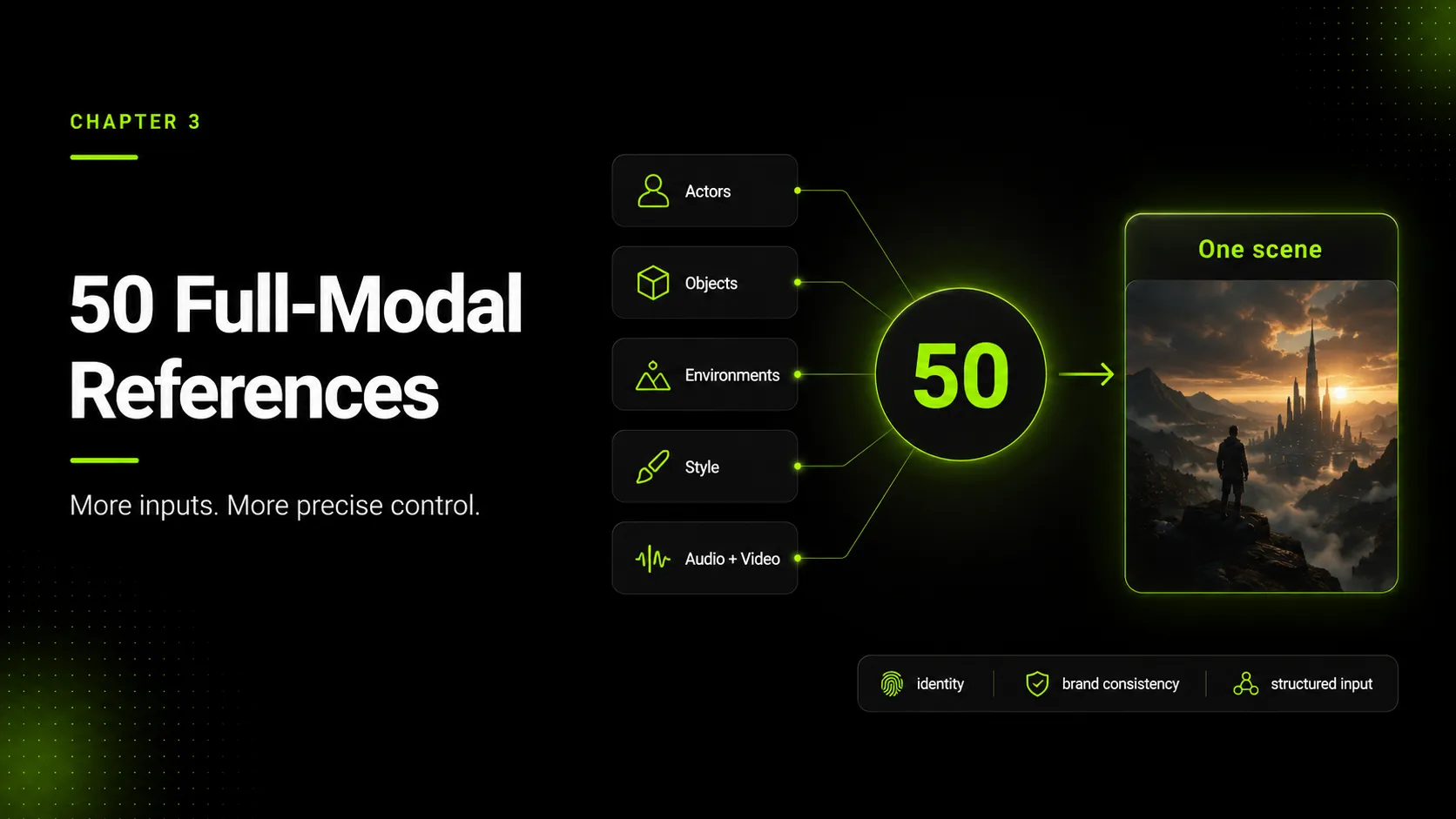
In practical terms, this means developers can provide a much richer set of inputs beyond simple prompts or single images. Entire scene configurations can be defined through multiple actors, objects, environments, and stylistic references simultaneously. The model then interprets these inputs as a structured system rather than isolated signals.
This is particularly powerful for workflows that require strict identity control or brand consistency. For example, advertising pipelines can define multiple product variants, actors, and environments within a single generation context. The model can then maintain consistency across all elements without requiring repeated conditioning or manual corrections.
Early demonstrations suggest that multi-actor scenes with more than ten distinct identities can be organized within a single generation workflow. This opens the door to applications in fashion visualization, gaming cinematics, and large-scale previsualization workflows where multi-entity coordination is essential.
For developers, this also means a shift in how inputs are structured. Instead of optimizing a single prompt, workflows can now be designed as structured reference sets, enabling more deterministic control over output behavior.
Flexible Editing: From Regeneration to Localized Modification
Seedance 2.5 also introduces a significantly improved editing system designed for production environments where iteration speed matters as much as generation quality. Instead of requiring full regeneration when changes are needed, the model supports localized editing that preserves the integrity of the original video structure.
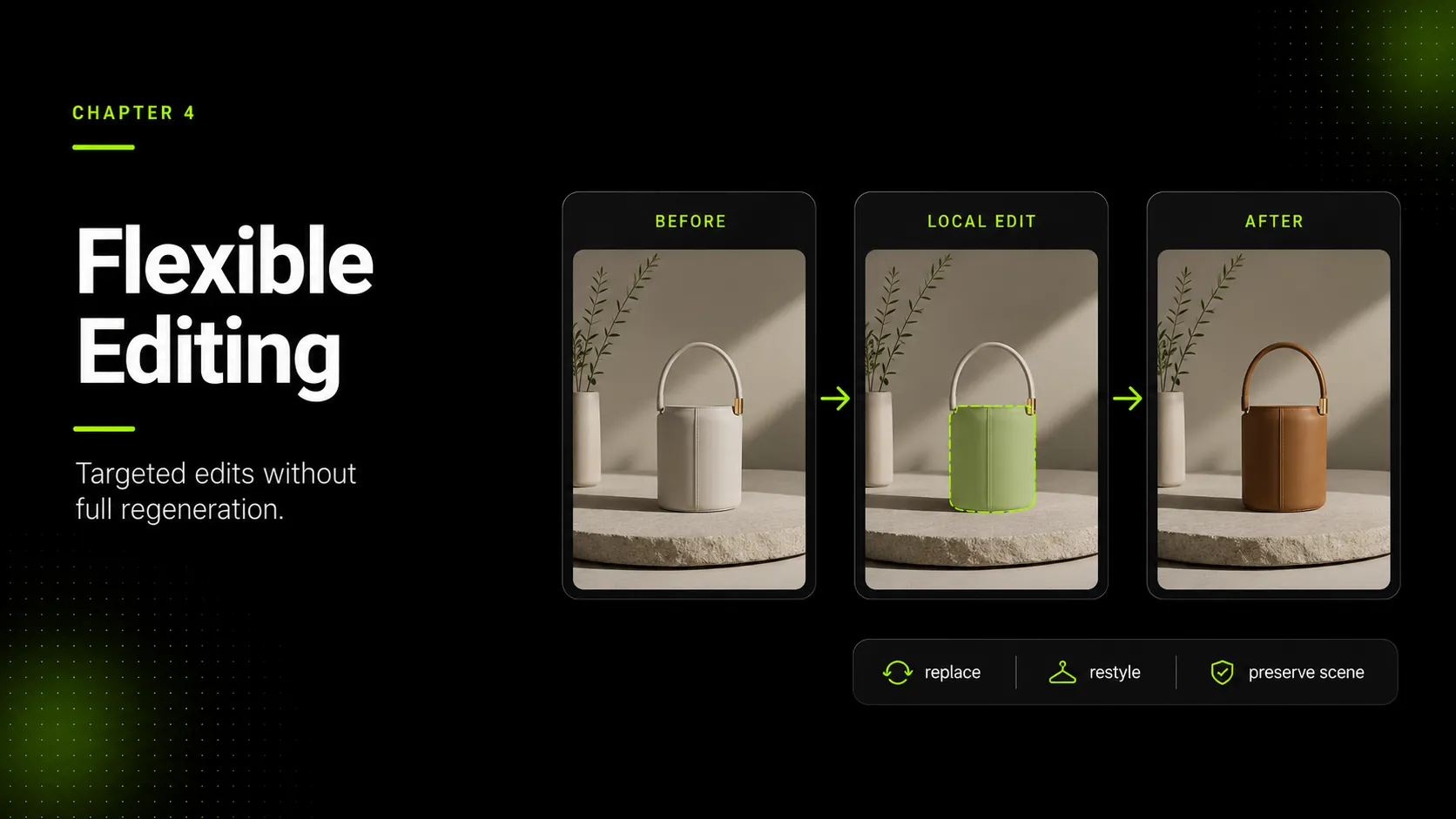
This allows users to modify specific elements within a generated video without breaking the surrounding scene. For example, a product can be replaced, a visual style can be adjusted, or a character attribute can be modified while maintaining consistency in motion, lighting, and composition.
In traditional AI video workflows, even small changes often require re-running the full generation process, which introduces both time cost and variability in results. Seedance 2.5 addresses this by introducing a more modular internal representation of scene components, enabling targeted edits with minimal disruption.
For production teams, this capability has immediate practical impact. It reduces iteration cycles, improves creative flexibility, and lowers computational cost per revision. It also brings AI video closer to traditional post-production tools, where localized adjustments are standard practice rather than full regeneration.
Expanded Capabilities for Production Workflows
Beyond its three core upgrades, Seedance 2.5 is also being positioned as a production-ready system for industrial and commercial applications. Early demonstrations highlight its ability to handle complex structured inputs, including high-detail 3D assets and multi-scene configurations.
In one example, the model reportedly processed detailed 3D mesh inputs and generated coherent cinematic outputs while preserving structural accuracy during camera movement. In another, it was used to generate structured product training materials and multilingual instructional videos automatically.
These capabilities suggest that Seedance 2.5 is not limited to creative generation but extends into structured content production pipelines. This includes use cases such as automated training data generation for embodied AI systems, synthetic edge-case scenario generation for autonomous driving research, and scalable multilingual content creation for global enterprises.
Additionally, the ecosystem surrounding Seedance continues to evolve with IP protection systems and content commercialization frameworks introduced at the same event. These initiatives indicate a broader strategy to integrate AI video generation into monetized content ecosystems, where licensing, rights management, and creator collaboration are built into the generation pipeline itself.
Key Capability Overview for Developers
The following table summarizes the most important technical capabilities of Seedance 2.5 in comparison to Seedance 2.0 for quick developer reference.
| Capability Area | Seedance 2.5 | Seedance 2.0 |
|---|---|---|
| Maximum single video length | Up to 30 seconds native generation | ~15 seconds |
| Reference inputs | Up to 50 full-modal references | Limited multimodal references |
| Editing capability | Localized, non-destructive editing | Regeneration-based editing |
| Output resolution | Not fully disclosed (ecosystem supports 4K via 2.0) | 4K supported in upgraded 2.0 |
| Workflow design | Structured scene generation | Clip-based generation |
This comparison highlights the primary positioning of Seedance 2.5: it is not simply an incremental upgrade in visual quality, but a structural expansion of generation scope and controllability.
What This Means for Developers and API Users
For developers building on top of AI video APIs, Seedance 2.5 represents a shift in how video generation workflows are designed and deployed. The most immediate impact is a reduction in multi-step generation pipelines. Instead of chaining multiple short clips, developers can now rely on longer native outputs that preserve continuity across entire scenes.
This also reduces the need for external stitching logic, post-processing alignment, and frame-level correction systems. In practice, this simplifies architecture for applications such as automated ad generation, short-form content creation, and real-time media production tools.
The expanded reference system further enables more deterministic control over output behavior. This is particularly valuable in enterprise environments where consistency is more important than variation. Brands, for example, can define structured identity sets that persist across multiple outputs without requiring repeated prompt engineering.
At the same time, localized editing capabilities improve iteration speed, which is critical for production workflows where creative feedback loops are frequent. Instead of regenerating entire scenes, developers can implement targeted adjustments, reducing both cost and latency.
Availability and Ecosystem Status
Seedance 2.5 has been previewed at the Volcano Engine 2026 conference, with broader availability expected in early July according to ecosystem partners. API access, pricing details, and production-grade benchmarks have not yet been fully disclosed.
However, early integration signals suggest that Seedance 2.5 is being positioned as part of a broader API-first ecosystem, alongside existing Seedance 2.0 endpoints and complementary models within the ByteDance creative stack. This indicates a phased rollout strategy where developers can gradually transition from 2.0-based workflows to 2.5-enhanced pipelines.
Final Takeaway: A Production-Oriented Shift in AI Video Generation
Seedance 2.5 is best understood not as a simple feature upgrade, but as a repositioning of AI video generation toward production-grade workflows. The combination of 30-second native generation, large-scale reference conditioning, and localized editing creates a system that is significantly more aligned with real-world content production needs.
For developers and API users, the most important implication is architectural: AI video generation is moving away from short, stateless outputs and toward structured, controllable, and persistent scene generation systems. This shift reduces fragmentation, improves consistency, and enables new categories of automated content workflows.
While some elements such as benchmarks, pricing, and full API availability remain pending, the direction is clear. Seedance 2.5 is designed to expand not just what AI video can generate, but how it integrates into production systems at scale.
For teams building next-generation content pipelines, this release represents a meaningful step toward replacing multi-stage video assembly with unified, prompt-driven scene generation.