



Introduction
Building AI-powered applications is no longer just about choosing the most capable model. For startups and SaaS teams, the real challenge is finding the right balance between intelligence, cost, reliability, and integration flexibility.
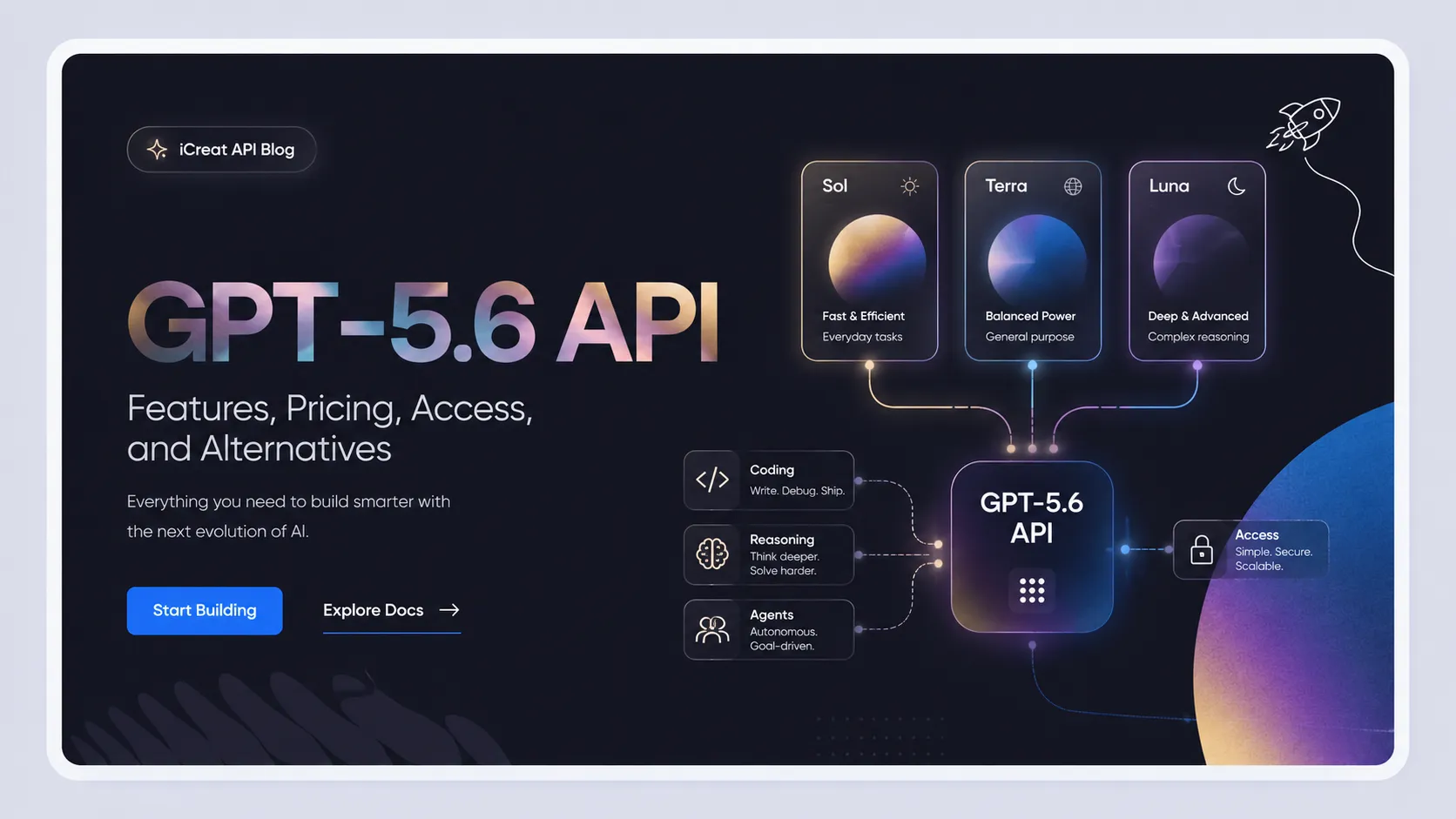
The release of GPT-5.6 introduces a new generation of OpenAI models designed for advanced reasoning, software engineering, agentic workflows, and complex professional tasks. Instead of a single model, GPT-5.6 is available as a family of models - GPT-5.6 Sol, GPT-5.6 Terra, and GPT-5.6 Luna - allowing developers to select different capability and cost levels depending on their application requirements.
However, choosing a model is only one part of building an AI product. Developers also need to consider:
- API availability and integration complexity.
- Token costs at production scale.
- The ability to switch between different AI providers.
- Whether a single workflow requires multiple specialized models.
For teams building AI applications, access to GPT-5.6 through a flexible API infrastructure can simplify development and reduce operational overhead. iCreat API provides GPT-5.6 access through an OpenAI-compatible API, while also supporting other frontier models from providers including Anthropic, Google, and DeepSeek through one unified platform.
This guide explains what GPT-5.6 API offers, how much it costs, how to access it, and which alternatives developers should consider when building production AI applications.
What Is GPT-5.6 API?
GPT-5.6 is OpenAI's latest model family focused on advanced reasoning and professional AI workloads. Unlike previous generations where users often selected between a small number of general-purpose models, GPT-5.6 introduces three different versions designed for different usage scenarios:
| Model | Positioning | Best For |
|---|---|---|
| GPT-5.6 Sol | Highest capability model | Complex reasoning, advanced coding, demanding AI agents |
| GPT-5.6 Terra | Balanced performance and cost | General production AI applications |
| GPT-5.6 Luna | More cost-efficient model | High-volume AI workloads |
The three-model approach reflects a broader industry trend: production AI systems increasingly require multiple intelligence levels rather than one universal model.
A startup building an AI coding assistant may need the strongest reasoning model for difficult tasks, while an AI customer support product may prioritize lower latency and predictable operating costs.
GPT-5.6 API gives developers the flexibility to choose the right model for each workflow.
GPT-5.6 API Features: What Makes It Different?
Advanced Software Engineering Capabilities
One of the main focuses of GPT-5.6 is software development.
The model is designed for tasks such as:
- Code generation.
- Debugging and error analysis.
- Repository-level understanding.
- Software architecture assistance.
- Technical documentation generation.
For SaaS companies building AI coding assistants or developer tools, these capabilities allow AI systems to move beyond simple code completion toward deeper engineering workflows.
Agentic AI and Multi-Step Workflows
Modern AI applications increasingly rely on agents that can plan, use tools, and complete multi-step tasks.
GPT-5.6 is designed for workflows that require:
- Reasoning across multiple steps.
- Tool usage.
- Task planning.
- Long-running execution.
- Decision-making based on external information.
This makes GPT-5.6 suitable for applications such as:
- Autonomous research assistants.
- Enterprise workflow automation.
- AI operators.
- Internal knowledge agents.
For startups building AI products, model reasoning ability directly impacts how reliably an agent can complete real-world tasks.
Professional Knowledge Work
GPT-5.6 is also designed for advanced professional applications, including:
- Data analysis.
- Research assistance.
- Business workflow automation.
- Technical problem solving.
Instead of replacing a single chatbot interaction, these models are increasingly becoming infrastructure components inside larger AI products.
GPT-5.6 API Pricing Explained
Pricing is one of the most important factors when selecting an AI model for production.
A model that performs well in testing may become expensive when thousands or millions of users interact with it daily. For SaaS builders, token costs directly affect product margins.
GPT-5.6 Official API Pricing
OpenAI's official GPT-5.6 API pricing varies by model tier. The latest OpenAI pricing and model docs describe the GPT-5.6 family across Sol, Terra, and Luna:
| Model | Input Price | Output Price |
|---|---|---|
| GPT-5.6 Sol | $5 / 1M tokens | $30 / 1M tokens |
| GPT-5.6 Terra | $2.5 / 1M tokens | $15 / 1M tokens |
| GPT-5.6 Luna | $1 / 1M tokens | $6 / 1M tokens |
For companies running AI applications at scale, output token pricing is especially important because generated responses often represent the majority of usage costs.
GPT-5.6 API Pricing Comparison: OpenAI vs iCreat API
iCreat API provides GPT-5.6 access with significantly lower token pricing while maintaining an OpenAI-compatible API experience.
| Model | OpenAI Official Input | iCreat API Input | Saving |
|---|---|---|---|
| GPT-5.6 Sol | $5 / 1M tokens | $0.5 / 1M tokens | 90% lower |
| GPT-5.6 Terra | $2.5 / 1M tokens | $0.25 / 1M tokens | 90% lower |
| GPT-5.6 Luna | $1 / 1M tokens | $0.1 / 1M tokens | 90% lower |
Output pricing comparison:
| Model | OpenAI Official Output | iCreat API Output | Saving |
|---|---|---|---|
| GPT-5.6 Sol | $30 / 1M tokens | $4 / 1M tokens | ~87% lower |
| GPT-5.6 Terra | $15 / 1M tokens | $2 / 1M tokens | ~87% lower |
| GPT-5.6 Luna | $6 / 1M tokens | $0.8 / 1M tokens | ~87% lower |
What Does This Difference Mean for AI Product Costs?
For developers, percentage savings become more meaningful when translated into production usage.
#### 1. Up to 90% Lower Input Token Costs
A team using GPT-5.6 Sol through iCreat API pays:
- OpenAI official pricing: $5 per million input tokens.
- iCreat API pricing: $0.5 per million input tokens.
This means the same input workload can cost approximately one-tenth of the official API input price.
#### 2. More AI Usage Within the Same Budget
Consider a startup with a monthly AI infrastructure budget.
At official GPT-5.6 Sol input pricing:
- $100 budget = around 20 million input tokens.
At iCreat API pricing:
- $100 budget = around 200 million input tokens.
For AI products that rely heavily on user prompts, document processing, or agent interactions, this difference can significantly affect scalability.
#### 3. Lower Costs Across Different GPT-5.6 Intelligence Levels
Different applications require different levels of reasoning.
A company building a research agent may choose GPT-5.6 Sol.
A customer-facing SaaS assistant may prefer GPT-5.6 Terra.
A high-volume automation workflow may choose GPT-5.6 Luna.
With lower pricing across all three tiers, developers can optimize cost without limiting themselves to only one model option.
How to Access GPT-5.6 API
For developers, accessing a frontier model is only one part of the decision process. The bigger question is how easily the model can be integrated into an existing application workflow.
There are several ways teams can access GPT-5.6 depending on their development environment and infrastructure requirements.
Direct OpenAI API Access
Developers can access GPT-5.6 through OpenAI's API ecosystem when the model is available for their account.
A direct API integration provides access to OpenAI's model infrastructure, but teams building production applications often need to consider additional factors:
- Managing multiple API providers separately.
- Maintaining different authentication systems.
- Handling different SDK formats.
- Optimizing costs across different models.
- Building fallback strategies when one provider is unavailable.
For early experimentation, connecting directly to one provider may be enough. However, as AI applications grow, many teams adopt multi-model infrastructure to improve flexibility and cost efficiency.
GPT-5.6 API Through iCreat
iCreat API provides GPT-5.6 access through an OpenAI-compatible API interface, allowing developers familiar with OpenAI workflows to integrate GPT-5.6 into existing applications with minimal changes.
Developers can use a unified API workflow for:
- GPT-5.6 models.
- Other OpenAI models.
- Anthropic models.
- Google models.
- DeepSeek models.
Instead of maintaining separate integrations for every provider, teams can manage multiple frontier models through one API platform.
This approach is especially useful for SaaS companies that need to continuously evaluate different models as capabilities and pricing evolve.
GPT-5.6 API Use Cases for Startups and SaaS Products
GPT-5.6 is not designed only for chatbot applications. Its strongest value appears when integrated into products that require reasoning, automation, and reliable task completion.
AI Coding Assistants
Software development is one of the most obvious use cases for GPT-5.6.
AI coding products can use GPT-5.6 for:
- Generating production code.
- Reviewing pull requests.
- Explaining complex codebases.
- Debugging technical issues.
- Assisting developers with architecture decisions.
For startups building developer tools, model intelligence directly affects user experience. A stronger reasoning model can reduce incorrect suggestions and improve task completion reliability.
AI Agents and Workflow Automation
Many AI startups are moving from simple conversational interfaces toward autonomous agents.
Examples include:
- AI sales assistants.
- Research agents.
- Data analysis agents.
- Customer support automation.
- Internal business operation assistants.
These systems require more than generating text. They need to understand context, decide next actions, call tools, and complete multi-step workflows.
GPT-5.6's reasoning capabilities make it suitable for these agent-based applications.
Enterprise Knowledge Applications
Companies increasingly want AI systems that can work with internal information.
Common examples:
- Document analysis.
- Enterprise search.
- Knowledge assistants.
- Compliance workflows.
- Research automation.
For these applications, model selection often depends on accuracy, reasoning ability, and operating cost.
A multi-model API approach allows teams to use higher-end models for complex queries while routing simpler requests to more cost-efficient options.
GPT-5.6 Alternatives: Best Models for Developers
Although GPT-5.6 represents a major step forward, it is not automatically the best choice for every application.
Different AI models have different strengths.
For production teams, the better question is not:
The better question is:
Below are some of the strongest GPT-5.6 alternatives available through modern AI API platforms.
GPT-5.6 vs Claude Opus 4.8
Best for: Complex reasoning and advanced AI tasks
Claude Opus 4.8 is one of the strongest alternatives for developers working on demanding reasoning workflows.
Compared with GPT-5.6, Claude Opus is often considered for:
- Complex analysis.
- Long-form reasoning.
- Advanced problem solving.
- High-quality content generation.
Choose GPT-5.6 when:
- You need OpenAI ecosystem compatibility.
- You are building coding or agent workflows.
- You want access to GPT-specific capabilities.
Choose Claude Opus 4.8 when:
- Your application depends heavily on deep reasoning and long-form analysis.
GPT-5.6 vs Claude Sonnet 4.6
Best for: Coding and production AI applications
Claude Sonnet models have become popular among developers because of their strong programming capabilities and balanced performance.
Compared with GPT-5.6:
| Model | Strength |
|---|---|
| GPT-5.6 | Advanced reasoning, agents, OpenAI ecosystem |
| Claude Sonnet 4.6 | Coding workflows, practical development tasks |
For SaaS builders, Claude Sonnet 4.6 can be an excellent alternative when:
- Coding quality is the main priority.
- Lower operating costs are important.
- The application requires frequent model calls.
GPT-5.6 vs Gemini 3.1 Pro Preview
Best for: Multimodal and long-context applications
Gemini 3.1 Pro Preview is another strong GPT-5.6 alternative, especially for applications requiring large amounts of information processing.
Typical use cases include:
- Long document analysis.
- Multimodal applications.
- Research workflows.
- Large-context AI assistants.
Choose Gemini when your application benefits from:
- Handling large inputs.
- Combining different data types.
- Google ecosystem integration.
GPT-5.6 vs DeepSeek V4 Pro
Best for: Cost-sensitive AI applications
For startups building products with high request volume, cost efficiency can be as important as model intelligence.
DeepSeek V4 Pro provides an alternative approach:
- Lower operating costs.
- Strong general-purpose capabilities.
- Suitable performance for many production workloads.
A common production strategy is:
- Use GPT-5.6 for complex reasoning.
- Use DeepSeek for high-volume tasks.
- Route requests based on difficulty.
This model-routing approach helps startups maintain quality while controlling infrastructure costs.
Why Developers Are Moving Toward Multi-Model API Platforms
The AI market is moving beyond the idea of finding one "best" model.
Different models are optimized for different workloads:
- GPT-5.6 may excel at advanced reasoning and agent workflows.
- Claude may be preferred for certain coding tasks.
- Gemini may fit long-context applications.
- DeepSeek may provide cost advantages for large-scale usage.
For startups, connecting every provider individually creates additional engineering overhead:
- Multiple API keys.
- Different authentication systems.
- Separate billing dashboards.
- Different SDK formats.
- More complicated monitoring.
A unified API platform simplifies this process.
Building AI Products with GPT-5.6 Through iCreat API
iCreat API provides GPT-5.6 access together with other leading AI models through one OpenAI-compatible API.
For developers, this means they can:
- Integrate GPT-5.6 into existing applications.
- Switch between different AI providers without rebuilding infrastructure.
- Compare models based on performance and cost.
- Manage AI workloads through one API platform.
Instead of committing every workflow to a single model provider, teams can build flexible AI systems where each task uses the most suitable model.
For example:
| Workflow | Recommended Model Approach |
|---|---|
| Complex reasoning | GPT-5.6 Sol |
| General production AI | GPT-5.6 Terra |
| High-volume requests | GPT-5.6 Luna |
| Coding workflows | GPT-5.6 or Claude models |
| Cost-sensitive tasks | DeepSeek models |
This flexibility becomes increasingly important as AI products scale.
FAQ
Conclusion
GPT-5.6 represents another major step toward more capable AI systems, especially for coding, reasoning, and agent-based applications. However, building successful AI products requires more than choosing the most powerful model.
Startups and SaaS companies need infrastructure that supports:
- Flexible model selection.
- Predictable API costs.
- Easy integration.
- The ability to adapt as new models are released.
With GPT-5.6 access, OpenAI-compatible APIs, and support for multiple leading AI models, iCreat API provides developers with a practical way to build and scale AI applications without being locked into a single provider.