



Introduction
The release of Kimi K3 created an immediate wave of benchmark screenshots, leaderboard claims, and comparisons with the most powerful closed AI models.
Some posts described it as the strongest open model available. Others focused on its 2.8 trillion parameters, 1-million-token context window, or high scores in coding and agent benchmarks. The numbers are impressive, but they are also easy to misread.
A high benchmark score does not automatically mean a model is the best choice for every developer, application, or production workload.
To understand the real value of the Kimi K3 benchmark results, we need to ask more specific questions:
- Which tasks does Kimi K3 actually perform well?
- Where does it beat GPT-5.6 Sol and Claude models?
- Where does it still fall behind?
- Were the models tested under comparable conditions?
- What will it cost to use or deploy the model?
- Which currently available models should developers use while evaluating K3?
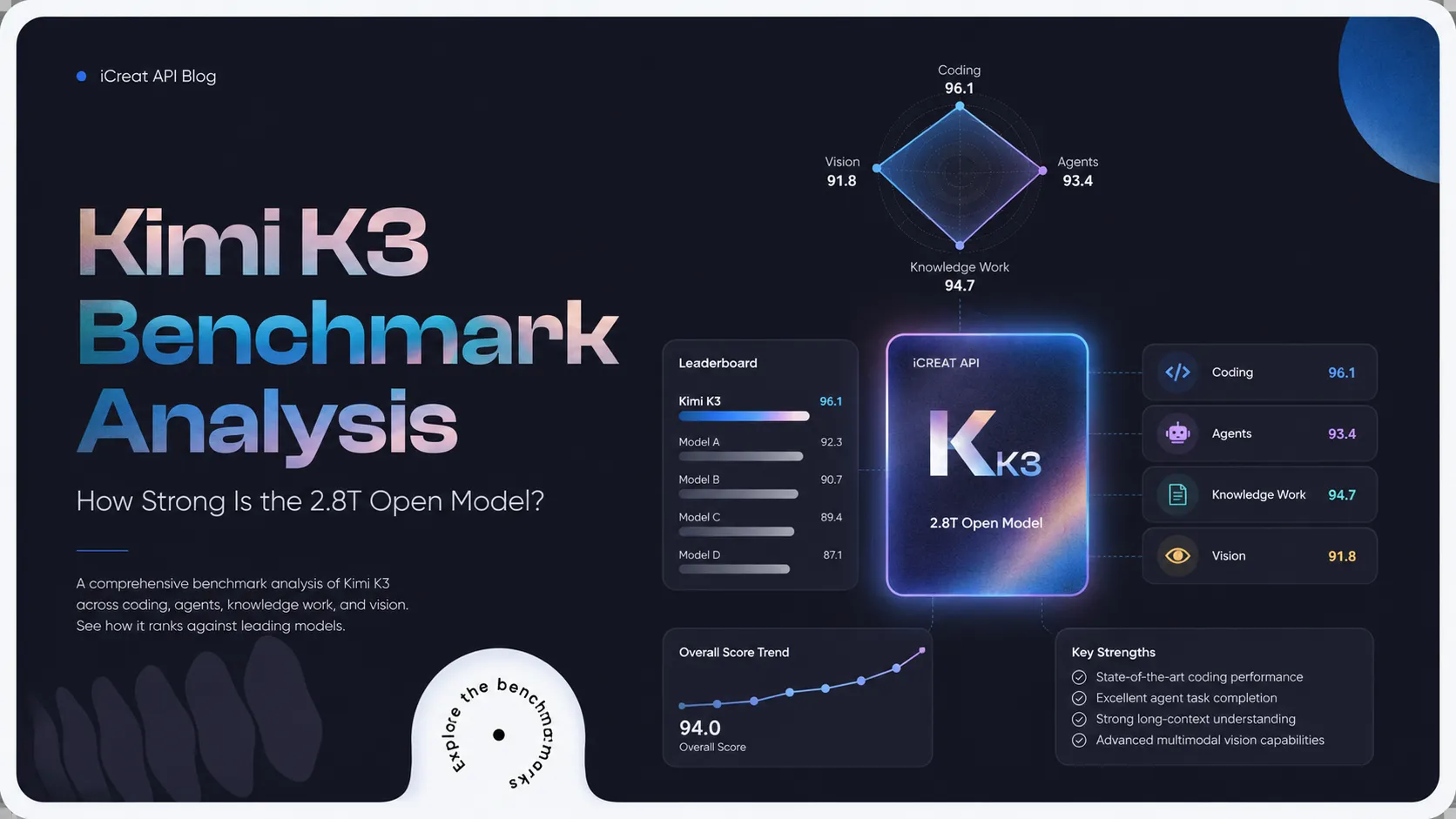
This analysis breaks down Kimi K3’s official results across coding, agents, knowledge work, and vision. It also explains the gap between benchmark performance and production value.
What Is Kimi K3?
Kimi K3 is Moonshot AI’s latest frontier model. According to the official Kimi K3 release, it has 2.8 trillion total parameters, native vision capabilities, and a 1-million-token context window.
It uses a Mixture of Experts architecture, which means it does not activate every parameter for every token. Kimi states that the model activates 16 out of 896 experts through its Stable LatentMoE framework.
The model also introduces two major architectural components:
Kimi Delta Attention, or KDA, is designed to make attention more efficient as context length grows.
Attention Residuals, or AttnRes, changes how information is retrieved across model depth instead of simply accumulating representations layer by layer.
Moonshot positions K3 around three main areas:
- Long-horizon coding
- Knowledge work
- Complex reasoning
The model is already available through Kimi’s own products and API. The full weights are scheduled for release by July 27, 2026, making K3 the first open model in the 3-trillion-parameter class.
That scale matters, but it should not be confused with automatic superiority. Total parameter count tells us something about the size of the system, not how reliably it will complete a particular task.
How to Read the Kimi K3 Benchmark Results
Before comparing scores, it is important to understand how Kimi K3 was tested.
Kimi reports its K3 results using the maximum reasoning-effort setting, with a temperature of 1.0 and top-p of 1.0. Depending on the benchmark, models were tested through different agent frameworks, including Kimi Code, Claude Code, and Codex.
That creates several limitations.
Different Models Used Different Agent Frameworks
A coding model is not evaluated in isolation. The surrounding agent framework determines how the model reads files, runs commands, manages context, retries failed actions, and edits code.
Kimi K3 often used Kimi Code, while GPT-5.6 Sol frequently used Codex. Claude models were commonly tested with Claude Code.
The final score therefore reflects both the underlying model and the quality of its agent framework.
A higher score does not always prove that one raw model is more intelligent. It may mean that the model works especially well with its native tools.
Some Benchmarks Are Internal
Kimi’s table includes public benchmarks such as BrowseComp, Terminal-Bench, and MMMU-Pro. It also includes internal evaluations such as Kimi Code Bench 2.0, DECK-Bench, and PerceptionBench.
Internal benchmarks can provide useful evidence about real product workflows, but external developers cannot always reproduce them independently.
They should be treated as directional evidence rather than final proof.
Maximum-Effort Results May Not Reflect Everyday Cost
The published K3 results use maximum reasoning effort. That setting is useful for measuring peak capability, but real applications often need to balance accuracy against speed, token use, and cost.
A model that performs extremely well at maximum effort may be less attractive for high-volume applications that require fast responses.
The correct question is therefore not simply, “Which model has the highest score?”
It is:
Kimi K3 Benchmark Summary
The official benchmark table compares Kimi K3 with Claude Fable 5, GPT-5.6 Sol, Claude Opus 4.8, GPT-5.5, and GLM-5.2.
The broad pattern is clear.
| Area | Kimi K3’s position | Main takeaway |
|---|---|---|
| Coding execution | Near the top | Competitive with GPT-5.6 Sol and Fable 5 |
| Open-ended software planning | Very strong | Usually behind Fable 5 but ahead of GPT-5.6 Sol |
| Long-horizon coding | Leading on some tests | Strong ability to sustain complex work |
| Browser research | Leading | One of K3’s clearest strengths |
| Office automation | Leading or near-leading | Strong for spreadsheets and multi-step tasks |
| General professional agents | Usually second or third | Competitive but not dominant |
| Vision and documents | Strong | Especially effective in document understanding |
| General reasoning | Frontier-level | Still behind the strongest result on several tests |
Kimi K3 is not consistently number one. Its more important advantage is that it remains competitive across almost every major category.
That makes it a strong general-purpose agent model rather than a narrow specialist.
Kimi K3 Coding Benchmark Analysis
Coding is one of the strongest parts of the Kimi K3 release.
However, “coding ability” includes several different skills. A model may be good at following a precise issue description but weaker at planning a large architectural change. Another model may generate excellent plans but make more implementation mistakes.
The Kimi results show both sides.
Precise Software Engineering Tasks
On DeepSWE, Kimi K3 scored 67.5. GPT-5.6 Sol scored 73.0, while Claude Fable 5 scored 70.0.
DeepSWE focuses on whether an agent can understand a concrete software issue, navigate a repository, make the correct changes, and avoid introducing new errors.
K3’s result is strong, but GPT-5.6 Sol retains an advantage in this type of precise implementation work.
The pattern is even closer on Terminal-Bench 2.1:
| Model | Terminal-Bench 2.1 |
|---|---|
| GPT-5.6 Sol | 88.8 |
| Kimi K3 | 88.3 |
| Claude Fable 5 | 84.6 |
| Claude Opus 4.8 | 84.6 |
| GPT-5.5 | 83.4 |
A difference of 0.5 points does not support a broad claim that one model will always code better than the other. It shows that K3 and GPT-5.6 Sol are both highly competitive in terminal-based engineering tasks.
K3 also scored 77.8 on Program Bench, slightly above GPT-5.6 Sol at 77.6 and Claude Fable 5 at 76.8.
Planning and Open-Ended Engineering
FrontierSWE measures harder software engineering tasks that may require deeper system understanding, creative planning, and less obvious solutions.
Claude Fable 5 led this benchmark with 86.6. Kimi K3 scored 81.2, while GPT-5.6 Sol scored 71.3.
This is an important result because it shows K3 performing better on a planning-heavy coding benchmark than GPT-5.6 Sol, even though GPT leads K3 on more precise execution benchmarks.
The likely practical interpretation is:
- GPT-5.6 Sol is highly reliable when the target is clearly defined.
- Kimi K3 is competitive when the agent must explore and design a broader solution.
- Claude Fable 5 remains the strongest model in the published FrontierSWE results.
K3 also led SWE Marathon with a score of 42.0, compared with 39.0 for GPT-5.6 Sol and 35.0 for Claude Fable 5.
SWE Marathon focuses on sustained work rather than a single short coding action. This supports Moonshot’s positioning of K3 as a long-horizon engineering model.
Coding Verdict
Kimi K3 is clearly a frontier coding model.
It does not defeat every closed model on every benchmark, but it combines strong execution, planning, and sustained task performance unusually well.
Developers should not read the results as “K3 is always better than GPT” or “K3 replaces Claude.”
A more accurate conclusion is:
Kimi K3 Agent and Knowledge Work Benchmarks
K3’s strongest benchmark story may be its agent performance rather than traditional question answering.
An agent benchmark tests whether a model can use tools, browse information, work across multiple steps, make decisions, and produce a finished result.
Browser Research
Kimi K3 scored 91.2 on BrowseComp, the highest result in the comparison table.
GPT-5.6 Sol followed at 90.4, while Claude Fable 5 scored 88.0.
BrowseComp evaluates whether a model can search for difficult information across the web, understand evidence, and reach a correct answer. This is closely aligned with Kimi’s long-standing focus on search and research workflows.
However, Kimi notes that its 91.2 result used a context-compaction strategy. When tested with the full 1-million-token window and no context management, K3 scored 90.4.
The result remains strong, but it also demonstrates how much agent design and context management can affect the final score.
Automation and Spreadsheet Work
Kimi K3 ranked first on Automation Bench with 30.8, ahead of GPT-5.6 Sol at 29.7 and Claude Fable 5 at 29.1.
It also scored 34.8 on SpreadsheetBench 2, narrowly ahead of Claude Fable 5 at 34.7 and GPT-5.6 Sol at 32.4.
These results suggest that K3 can be effective for workflows involving:
- Data cleaning
- Formula creation
- Report generation
- Repeated tool operations
- Multi-step office tasks
A one-point benchmark difference should not be treated as a guaranteed product advantage. Still, K3’s consistent placement near the top supports the claim that knowledge work is one of its main strengths.
Broader Professional Agent Performance
K3 does not lead every general agent benchmark.
On GDPval-AA v2, Claude Fable 5 scored 1760, GPT-5.6 Sol scored 1748, and Kimi K3 scored 1668.
On AA-Briefcase, Fable 5 scored 1583, K3 scored 1548, and GPT-5.6 Sol scored 1495.
On Job Bench, K3 scored 52.9. That placed it behind Fable 5 at 57.4 but ahead of GPT-5.6 Sol at 46.5.
These mixed results reveal an important pattern: K3 is especially strong in research, automation, and long workflows, but it does not consistently beat the strongest proprietary model across every type of professional work.
Kimi K3 Vision Benchmark Analysis
Kimi K3 is a native multimodal model. It can process visual information as part of coding, research, document, and creative workflows.
The official results show strong vision performance, but not a complete lead.
On MMMU-Pro, K3 scored 81.6. GPT-5.6 Sol scored 83.0, while Claude Fable 5 scored 81.2.
When Python tools were added, K3 reached 83.4, behind Fable 5 at 86.5 and GPT-5.6 Sol at 84.6.
On MathVision, K3 scored 94.3 without Python and 97.8 with Python. The tool-assisted score tied GPT-5.6 Sol but remained slightly below Claude Fable 5 at 98.6.
K3 performed particularly well on OmniDocBench, scoring 91.1. That was higher than Claude Fable 5 at 89.8 and GPT-5.6 Sol at 85.8.
This suggests that K3’s multimodal strength may be most valuable when images are connected to structured information, documents, interfaces, diagrams, or software output.
That fits Moonshot’s product demonstrations, where K3 repeatedly moves between screenshots, code, charts, presentations, and interactive interfaces.
The correct conclusion is not that K3 has the best vision model in every situation.
It is that native vision is deeply integrated into its agent workflow rather than added only as a separate image-understanding feature.
API Pricing Changes the Comparison
Benchmark leadership matters only if teams can afford to use the model at the required scale.
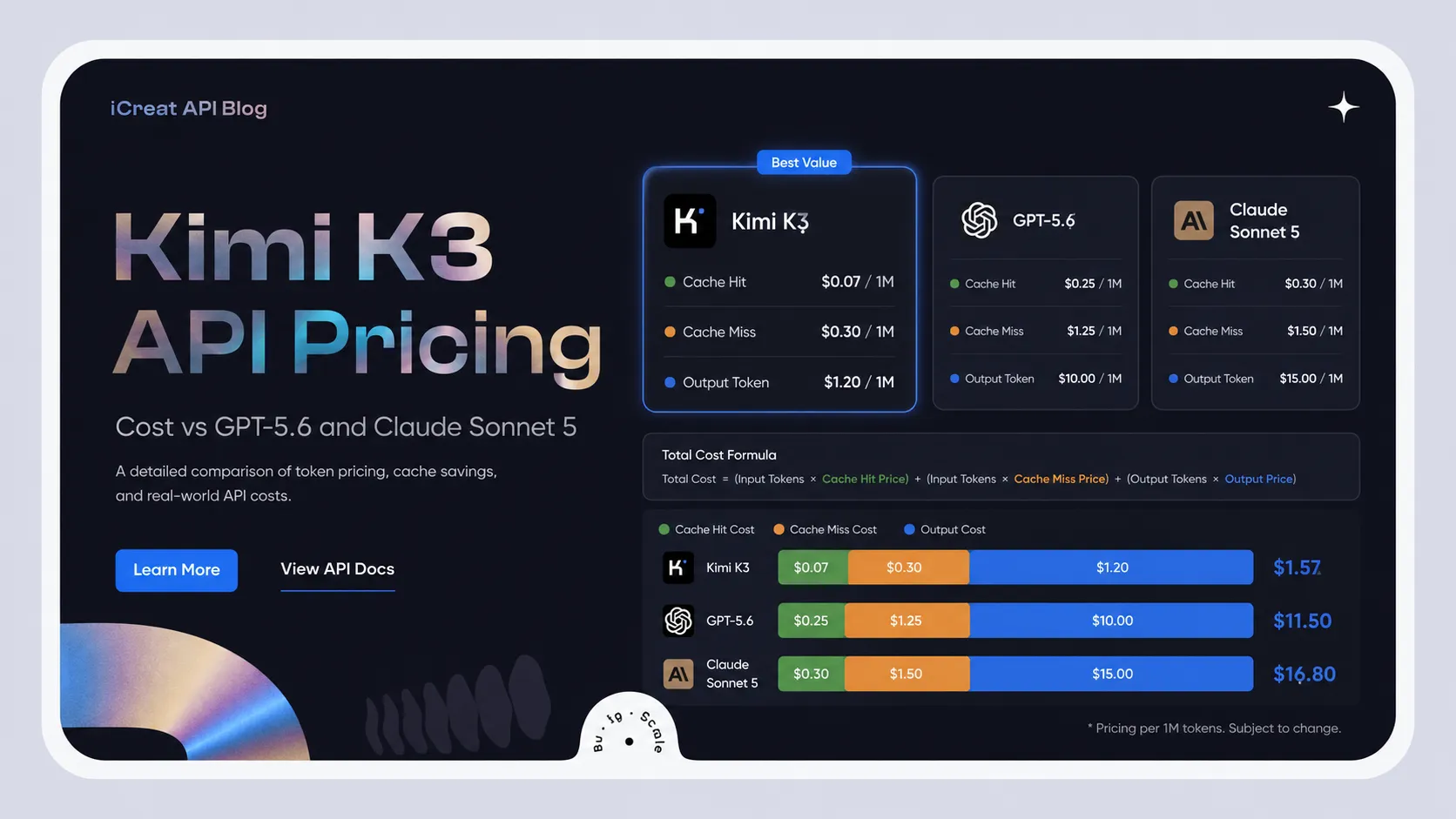
The official Kimi K3 API pricing is:
| Token type | Kimi K3 price per 1M tokens |
|---|---|
| Cache-hit input | $0.30 |
| Cache-miss input | $3.00 |
| Output | $15.00 |
Kimi states that its official API achieves a cache-hit rate above 90% in coding workloads. That is an official platform claim rather than a guarantee for every application, so developers should calculate costs using their own prompt structure and cache behavior.
For comparison, GPT-5.6 includes several capability tiers. GPT-5.6 Sol is priced at $5 per million input tokens and $30 per million output tokens. Terra is $2.50 input and $15 output, while Luna is $1 input and $6 output.
Claude Sonnet 5 is priced at $3 per million input tokens and $15 per million output tokens.
K3’s uncached input and output prices therefore match Claude Sonnet 5 closely. Its cached input is much cheaper, but the real saving depends on whether the workload repeatedly reuses the same context.
A coding agent that keeps a large repository context may benefit more from caching than a consumer chatbot handling unrelated conversations.
Open Weights Do Not Mean Easy Self-Hosting
Kimi K3 is an open model, but its size creates a major deployment challenge.
The model has 2.8 trillion total parameters and uses MXFP4 weights with MXFP8 activations. Moonshot recommends supernode configurations with 64 or more accelerators for efficient inference.
That means the full open-weight release will be important for research, optimization, and infrastructure providers, but most individual developers will not run K3 on a local workstation or a small GPU server.
For many teams, the realistic choices will be:
- Use the official Kimi API.
- Wait for specialized inference providers to host K3.
- Use another production-ready model that already meets the application’s requirements.
This is why API availability, latency, reliability, and billing remain important even when the underlying model is open.
Which Models Can Developers Use Through iCreat Today?
Kimi K3 is now available through iCreat, so the benchmark results in this article can be tested directly rather than treated as reference material for a model you cannot reach.
Pricing matches the official first-party rates: $3.00 per million cache-miss input tokens, $0.30 per million cache-hit input tokens, and $15.00 per million output tokens.
This matters for benchmark validation. Scores depend on the agent framework, reasoning setting, and tools, which means the only reliable test is your own workload. Running K3 alongside other models on the same prompts is more informative than comparing published leaderboard numbers.
For precise reasoning, complex professional tasks, and coding, developers can use GPT-5.6 through iCreat.
For balanced coding, agents, analysis, and knowledge work, Claude Sonnet 5 is also available.
Teams can also evaluate models such as Gemini 3.1 Pro Preview, DeepSeek V4 Pro, and other text, image, and video models from the iCreat model library.
The benefit is not that one platform declares a permanent benchmark winner.
The benefit is being able to change models as the workload changes.
A development team might use:
- GPT-5.6 for high-precision reasoning and execution.
- Claude Sonnet 5 for agent planning and knowledge work.
- Gemini for multimodal workflows.
- A smaller model for classification or high-volume requests.
- Image and video models for creative output.
Through an OpenAI-compatible integration, teams can test these models without building and maintaining a separate integration for every provider.
iCreat also provides unified billing and pay-as-you-go access, allowing developers to compare available models using real application data rather than relying only on benchmark charts.
Is Kimi K3 the Best Open Model?
Based on Moonshot’s published evaluation table, Kimi K3 is one of the strongest open models available and is competitive with the leading proprietary models across coding, agents, knowledge work, reasoning, and vision.
Calling it the single “best” model still requires qualification.
K3 performs exceptionally well in browser research, automation, long-horizon coding, spreadsheet work, and document understanding.
It remains behind Claude Fable 5 or GPT-5.6 Sol on several other tasks. The differences also depend on the agent framework, reasoning effort, tool configuration, and benchmark methodology.
A more defensible conclusion is:
FAQ
Final Verdict
The Kimi K3 benchmark results are significant because they show an open model competing near the top across multiple demanding categories, not just one carefully selected test.
Its strongest areas are long-horizon coding, browser research, automation, spreadsheets, document understanding, and multimodal agent workflows.
But the scores do not prove that K3 is universally better than GPT-5.6 Sol or Claude models. Benchmark outcomes depend on the task, agent framework, reasoning setting, tools, and evaluation method.
For developers, the right strategy is not to wait for one model to win every leaderboard.
It is to build an architecture that can use the best available model for each workload.
Developers can review current iCreat API pricing and start testing available models with one account, one billing system, and one OpenAI-compatible integration.