



Why Complex Garments Break Simple Reference Sets
The standard apparel image set taught across most photography guides is some version of front, back, side, and one or two detail shots. Practical Ecommerce's widely-cited angles framework lists six must-haves: front, profile, 45-degree, back, top, and macro. That set works for a t-shirt, a hoodie, a pair of joggers. It also fails a tailored jacket on the first shoot.
The failure is not visible until the catalog goes live. A shopper looking at the jacket PDP cannot tell whether the lapel rolls or lies flat. They cannot see whether the buttons are functional or decorative. They cannot evaluate the lining. They cannot judge the shoulder seam. Every one of those is a structural detail the standard six-angle set was never designed to capture, because the framework was generalized across product categories, not built for the garments that carry the most structural information.
AcquireConvert's 2026 fashion photography guide is one of the few sources that names this directly: front, side, and rear views are "especially useful for dresses, jackets, denim, and tailored pieces" — implying, correctly, that those garments need more than the baseline set. The practical consequence is that complex garments suffer the highest return rates and the worst PDP engagement in most apparel catalogs, not because the photography is bad, but because the reference set was structured for a simpler garment.
The fix is not to shoot more images. It is to structure the set against the structural complexity of the specific garment in front of you.
What a Reference Set Actually Is (and Is Not)
The phrase "reference set" gets used three different ways in apparel production, and most of the confusion around complex garments comes from collapsing them.
- Shot list is a production-planning document. It tells a photographer what to capture on set. It is forward-looking and human-facing.
- Editing reference is one approved image a retoucher matches the rest of a batch against for color, exposure, and background consistency. It is post-production and singular.
- Reference set is the structured collection of input images that fully document one garment for downstream consumption — by a retoucher, a buyer, an AI image model, or a marketplace listing. It is the input layer.
A reference set is what you would hand someone (or some model) who has never seen the physical garment and ask them to represent it accurately. For a t-shirt, that set can be thin. For a tailored jacket, the set has to carry enough information that the downstream consumer does not have to invent or guess structural details.
This distinction matters because most teams build shot lists and call them reference sets, then hand a thin set to an AI tool and wonder why the regenerated jacket has the wrong lapel. The set was structured for a human who could infer from context, not for a model that consumes only what it is given.
The Complexity-Tier Framework: Simple, Structured, Complex, Highly Structured
Not every garment needs the same set. Use this four-tier framework to size the reference set before you capture a single image.
| Tier | Garment examples | Reference set size | Why this size |
|---|---|---|---|
| Simple | T-shirt, tank top, basic leggings, simple scarf | 3–4 images | Few structural details; shape and color carry most of the information |
| Structured | Hoodie, sweater, button-down shirt, basic jeans | 5–6 images | Adds closure, cuff, pocket, and fabric-weight detail that a simple set misses |
| Complex | Tailored jacket, blazer, structured dress, outerwear with lining | 7–9 images | Carries back closure, lining, hardware, shoulder structure, vent, and interior detail that define the garment |
| Highly structured | Coat with multiple closure systems, gown with train, tailored suit, leather jacket with quilting | 9–12 images | Every structural system is a buyer decision; omitting any one creates an expectation gap |
The numbers are floors, not ceilings. The point is that reference set size is a function of how many independent structural systems the garment carries, not how premium it is. A plain $300 t-shirt is still a tier-one set. A $200 tailored jacket is still tier three.
A practical test: if you can describe the garment to a buyer in three sentences, it is probably tier one. If you need to walk them through how it opens, what the interior looks like, and how it moves, it is tier three or four.
Structural Detail Checklists by Garment Type
Once the tier sets the size, the structural details decide what fills it. These checklists name the must-capture features per garment type. They are not universal angle lists — they are the specific structural information the set has to carry.
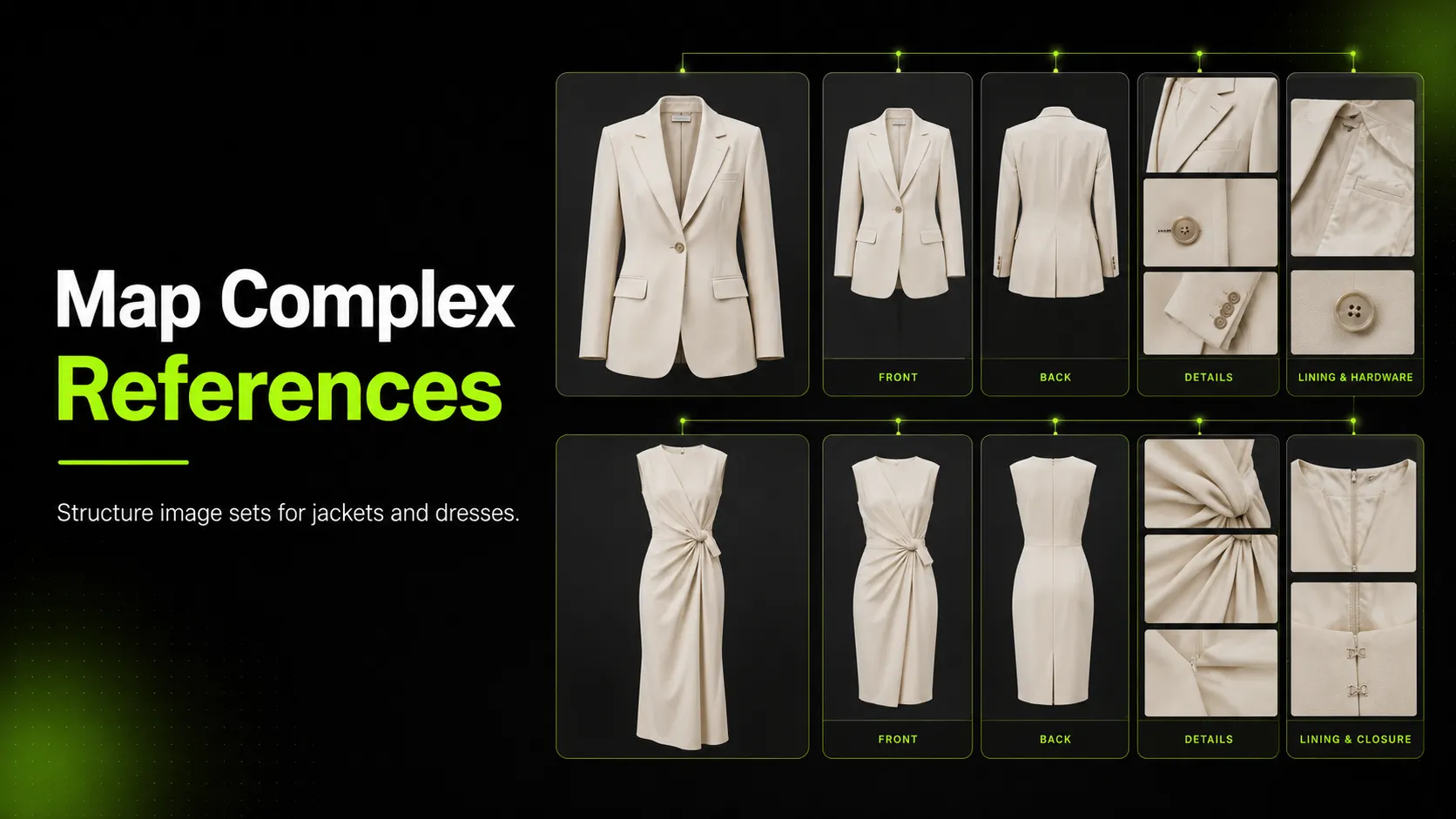
Tailored jacket (tier three: 7–9 images)
- Front, closed (zipped or buttoned) — shows the silhouette the buyer will see in the mirror
- Front, open — shows layering, lapel roll, interior placket
- Back — vent, shoulder seam, length
- Shoulder and lapel detail — the single feature that signals tailoring quality
- Cuff and closure hardware — buttons, snaps, zippers, functional or decorative
- Lining or interior — the feature most often missing from jacket sets and most often cited in returns
- Side profile — shows structure and drape on the body
Midi or maxi dress (tier three: 7–9 images)
- Front, full-length — silhouette at a glance
- Back, full-length — closure, zipper, train if relevant
- Side profile — drape and volume, the feature that distinguishes a dress from a skirt-and-top
- Movement frame — one walking or turning shot showing how the fabric behaves
- Still frame — one static shot confirming the true silhouette, because movement shots can exaggerate drape
- Waistline or seam detail — defines fit and proportion
- Strap, neckline, or sleeve detail — the features that cause fit returns when misread
- Lining or sheerness close-up — sets expectation on opacity, which is a top return reason for dresses
Structured jeans or denim (tier two: 5–6 images)
- Front — rise, taper, leg opening
- Back — pocket placement, yoke, back-rise
- Side profile — taper and break
- Wash and whiskering detail — the feature that defines denim character
- Pocket bag or interior — signals construction quality
- Waistband close-up — button, rivet, sizing cue
Hoodie or structured sweater (tier two: 5–6 images)
- Front — silhouette and graphic or print if any
- Back — hood construction or back detail
- Hood up and hood down — if the hood is a structural feature, both states are buyer-relevant
- Cuff and hem detail — ribbing, stretch, finish
- Interior or fleece close-up — weight and warmth signal
- Side profile — fit and bulk
These checklists are the operational core of the framework. A reference set is complete when every line on the relevant checklist has a corresponding image.
Human-Consumer vs. AI-Consumer Reference Sets
The same garment needs a different reference set depending on who is consuming it. This is the distinction most teams miss, and it is the one that determines whether AI-assisted production succeeds or fails.
| Dimension | Human retoucher / buyer | AI image model |
|---|---|---|
| Set size | Smaller acceptable — a human infers missing detail from experience | Larger required — the model consumes only what it is given |
| Background | Brand-defined; lifestyle context is fine | Clean, plain, well-lit; cluttered backgrounds degrade output |
| Angle coverage | Front + back + one detail often enough | Front-and-back flat-lays minimum; more angles improve fidelity |
| Lighting consistency | Tolerates variation; a retoucher corrects | Must be even and consistent; harsh shadows create artifacts |
| Interior / lining shots | Optional; a buyer can request | Required if the garment has structural interior features the model must reproduce |
| Movement frames | Helpful for lifestyle context | Risky for AI; movement can exaggerate drape and produce inaccurate output |
The AI-consumer column reflects guidance from uwear.ai's 2026 AI product photography guide, which identifies input photo quality as the single largest determinant of AI output quality and specifically notes that front-and-back flat-lays give the model more information to work with. The principle holds regardless of which AI tool consumes the set: a model cannot reproduce a lapel roll it has never been shown, and it cannot infer a lining color from a single front image.
This is also where iCreat AI's AI Fashion Lookbook Generator earns its place in a complex-garment workflow. The tool is built around a three-image input — main image, detail image, and back-view image — that mirrors exactly what a complex garment needs an AI to see. For garments that exceed three images, AI Product Photography supports up to ten reference images, which is enough to cover a tier-three or tier-four set. The reference set structure this article describes is the same structure those tools were designed to consume.
The practical rule: if the reference set will feed an AI workflow, build it to the AI-consumer column. If it will only ever be seen by humans, the human-consumer column is sufficient. Building a hybrid set (one that serves both) costs little extra and protects against switching workflows later.
Step-by-Step: Build a Reference Set for a Complex Garment
Use this workflow to turn the framework into an operational set for any complex garment.
- Audit the garment's complexity. Place it in a tier using the four-tier framework. Count the independent structural systems (closures, lining, hardware, drape, interior). If there are four or more, it is tier three or four.
- Pull the structural detail checklist for that garment type. Use the jacket, dress, denim, or hoodie checklist above as the starting point. Add any garment-specific feature not on the list (an unusual closure, a print, a removable component).
- Assign an angle to every checklist line. Each structural detail needs at least one image that captures it. If one image can cover two lines (a back shot that shows both the vent and the shoulder seam), combine — but only when both features are clearly readable in that frame.
- Capture or assemble the set. For a studio shoot, the checklist becomes the shot list. For an AI workflow, the checklist becomes the reference image upload set. Use clean backgrounds and consistent lighting if the set feeds an AI; the Background Remover helps standardize inputs that came from mixed sources.
- Validate completeness. Walk through the checklist image by image. Every line must have a corresponding image that a buyer or model could read accurately. If a line is uncovered, the set is not complete — shoot or assemble the missing image before the set moves downstream.
The workflow is the same whether the consumer is a human or an AI. The difference is in step four: AI sets need cleaner inputs and broader angle coverage, per the comparison above.
Worked Reference Sets: Tailored Jacket and Midi Dress
Two complete examples showing the framework applied end to end.
Tailored jacket (tier three, 8 images)
- Front, buttoned — silhouette
- Front, open — lapel roll, interior placket
- Back — vent, shoulder seam, length
- Shoulder and lapel detail close-up — tailoring quality signal
- Cuff and button hardware close-up — functional or decorative
- Lining interior — color and construction
- Side profile — structure and drape
- Optional: on-model or styled context — fit on a body
Every line on the jacket checklist has an image. A buyer or an AI model consuming this set has enough information to represent the garment without inventing detail.
Midi dress (tier three, 8 images)
- Front, full-length — silhouette at a glance
- Back, full-length — closure, zipper
- Side profile — drape and volume
- Movement frame — walking, fabric behavior
- Still frame — true silhouette confirmation
- Waistline or seam detail close-up — fit and proportion
- Strap and neckline detail — fit return driver
- Lining or sheerness close-up — opacity expectation
The movement-plus-still pairing is the dress-specific nuance. Movement shows how the fabric behaves; the still confirms the silhouette the buyer will see when the garment is not in motion. AI workflows in particular need both, because a model fed only a movement frame can exaggerate drape in regeneration.
Common Reference-Set Mistakes and How to Fix Them
- Mistake: Treating a shot list as a reference set. A shot list plans a shoot; a reference set documents a garment. Fix: Build the set from the structural detail checklist, then derive the shot list from the set — not the other way around.
- Mistake: One angle for drape on a dress. A single movement shot exaggerates drape and misrepresents the silhouette. Fix: Pair every movement frame with a still frame so the true silhouette is documented.
- Mistake: No back-closure capture on a jacket. The most-cited return reason for tailored pieces is closure misrepresentation. Fix: Back view is non-negotiable for tier three and four; the closure must be readable in that frame.
- Mistake: Lining never shown. Buyers cannot evaluate interior quality they cannot see; AI models invent it. Fix: Add an interior or reverse-capture image for any garment with a structural lining.
- Mistake: Feeding an AI a single flat-lay. The model has no back, no structural detail, and no interior to work from. Fix: Match the AI input to the complexity tier; a tier-three garment needs a tier-three input set.
- Mistake: Mixed angles within one set. Different camera heights and distances across the set make it incoherent for both humans and AI. Fix: Lock camera height, anchor discipline, and lighting across the entire set.
Each mistake shares a root cause: the set was structured for a simpler garment or a different consumer than the one actually downstream.
Pre-Publish QC Checklist for Complex-Garment Reference Sets
Before a complex-garment reference set moves downstream — to a retoucher, a PDP, a marketplace listing, or an AI workflow — review it against this quality-control checklist. A set that skips this review is the one that misleads shoppers or forces an AI to invent structural detail, and both outcomes cost more than the review itself.
- [ ] Back coverage. Every complex garment has a back view, and the closure is readable in that frame.
- [ ] Structural detail completeness. Every line on the garment-type checklist has a corresponding image.
- [ ] Interior or reverse capture. Lining, reverse side, or interior structure shown for any garment where it affects buyer understanding.
- [ ] Drape and movement representation. Fluid garments have at least one still silhouette frame plus one movement frame.
- [ ] Angle consistency across the set. Same camera height, same anchor discipline, same lighting across every image.
- [ ] Color and texture fidelity. Fabric color and texture captured cleanly enough that a retoucher or AI model can reproduce them without inventing detail.
- [ ] AI-input readiness. If the set feeds an AI workflow, images are clean, well-lit, plain-background, and front-and-back covered.
If any of these fail, the set is not complete. Fix it before the garment moves downstream — the cost of a missing image is always lower than the cost of a misrepresented garment reaching a buyer.
FAQ
Closing
Structuring a reference set for complex garments is less about shooting more and more about shooting the right structural details. The teams that represent tailored jackets and dresses accurately online are the ones that matched the set size to the garment's complexity, named the must-capture features per garment type, and built the set for the consumer actually downstream — human or AI.
If a single reference image is not enough to represent your complex garments, log in to iCreat AI and build your next jacket or dress reference set with the AI Fashion Lookbook Generator and AI Product Photography, both designed around multi-image reference inputs.