



BytePlus, iCreat, fal, MuAPI, Atlas Cloud, Runway, and ComfyUI compared
Seedance 2.0 now has an official API, several hosted routes, two creative workspaces, and a growing number of sites that place the model name on a landing page. Those options do not give you the same product.
If your team has not decided whether it needs an API at all, read our Seedance 2.0 web versus API guide first. It separates manual prompt work from user-triggered generation, repeatable jobs, and production status tracking. This comparison begins at the next decision, once an API or automated workflow is already required.
We built this shortlist from the Seedance access and workflow platforms that appeared in the most active Reddit discussions we reviewed during the 30 days ending August 6, 2026, the day this guide was written. It is a decision set, not a literal mention-count leaderboard. Runway and ComfyUI also recur in questions about where Seedance is actually available and how it fits into an existing workflow. iCreat is included because this is our product and the route we can explain most precisely.
BytePlus has the lowest verified standard unit price here. If your product only calls Seedance and demand is steady, BytePlus is the rational cost choice. iCreat is for products that use LLM, image, and video models together or expect to change models as quality, price, and availability move. The higher Seedance rate also pays for one account, key group, balance, task flow, and usage log across the broader model stack.
The short answer
| Your priority | Best place to start | Why |
|---|---|---|
| Direct access from the model provider | BytePlus ModelArk | Official ByteDance route and the lowest verified standard rate here |
| One API for many creative models | iCreat | One account, key group, balance, task flow, and usage log |
| Mature hosted SDK and queue tooling | fal | Python and JavaScript clients, webhooks, storage, and detailed endpoint schemas |
| Many Seedance variants and content-policy routes | MuAPI | Global, Chinese, VIP, Mini, and other routes under one account |
| One OpenAI-compatible key across many model types | Atlas Cloud | Transparent per-second billing and a broad text, image, and video catalog |
| A creative suite and API in one vendor | Runway | Seedance sits beside Runway models, assets, and production tools |
| Visual multi-step workflows | ComfyUI | Seedance Partner Nodes can connect to local and cloud nodes |
We have kept the same five-second workload across providers, linked the rate cards beside claims that can change, and recommended BytePlus where the official route is the better economic decision. Prices, regional access, and model policies can still move after publication.
What the same five-second test costs
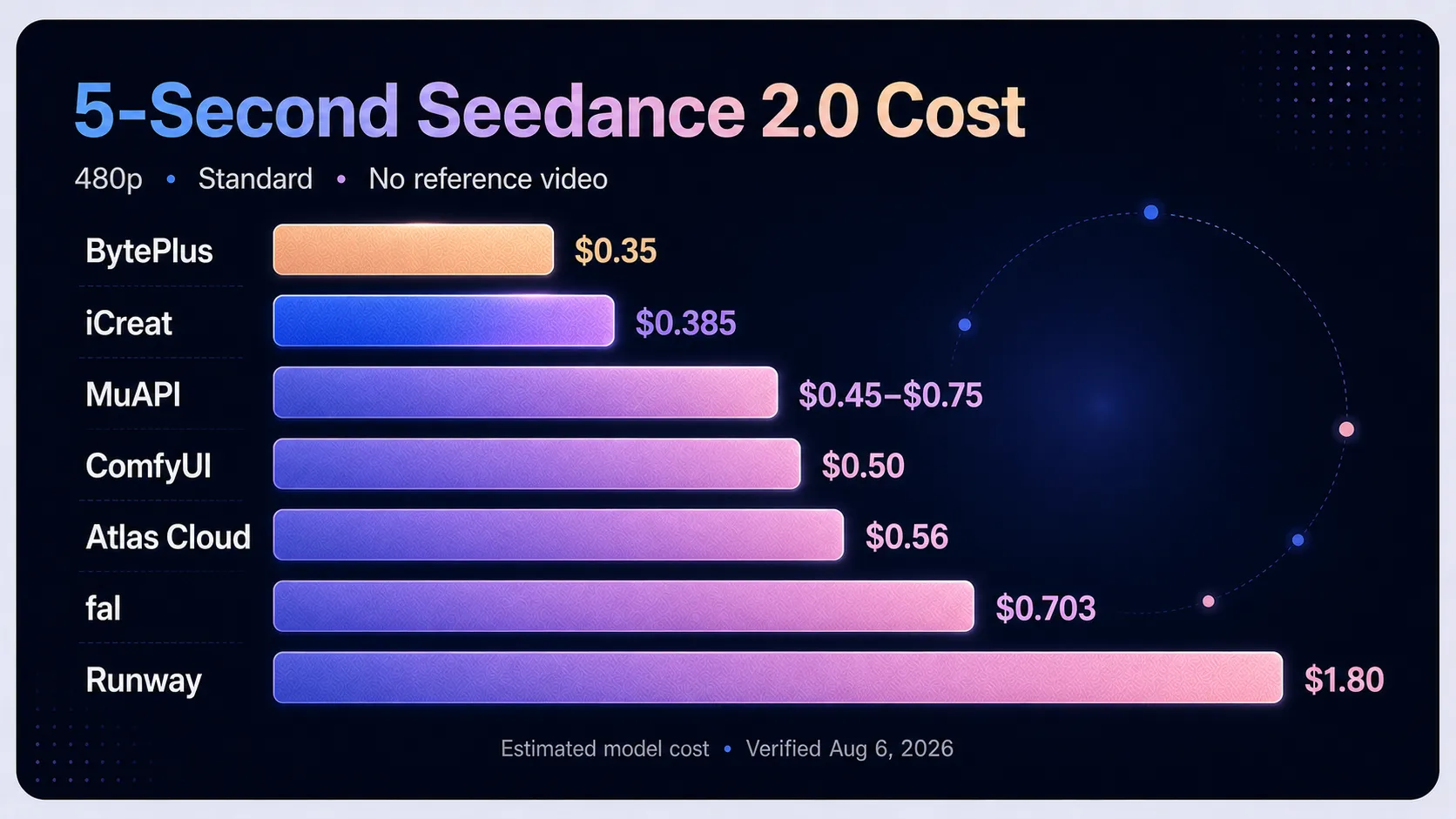
Headline prices become misleading as soon as one page quotes credits, another quotes tokens, and a third gives a monthly allowance. We normalized the most comparable public figures to one small test.
The workload is a five-second, 16 by 9, 480p Seedance 2.0 standard video with no reference video. Generated audio is included where the provider supports it. The table covers model charges only, before tax, storage, transfer, or subscription waste.
| Route | Type | Estimated model cost | What affects the number |
|---|---|---|---|
| BytePlus ModelArk | Direct official API | About $0.35 | Official five-second example, rounded from token usage |
| iCreat | Model hub, API, and Playground | $0.385 | $0.077 per output second |
| MuAPI | Aggregated hosted API | $0.45 to $0.75 | Public Chinese 480p range of $0.09 to $0.15 per second |
| ComfyUI Partner Node | Visual workflow calling a hosted API | About $0.50 | 106.06 Comfy Credits at 211 credits per dollar, excluding Comfy Cloud runtime |
| Atlas Cloud | OpenAI-compatible model API | About $0.56 | Published standard planning rate of about $0.112 per output second |
| fal | Hosted partner API | About $0.703 | Public token formula at 864 by 496 and 24 frames per second |
| Runway API | Creative platform API | $1.80 | 36 API credits per second at $0.01 per credit |
BytePlus wins this narrow price test. It also requires a prepaid resource pack before the Seedance 2.0 series can be activated. The smallest standard pack is one million tokens at $4.30 with a minimum purchase of seven packs, which puts the initial purchase at $30.10. The packs expire after 90 days and are non-refundable. At the official five-second estimate, that first purchase represents roughly 86 clips. It is good value when you will use it, and poor value when a prototype stops after three attempts.
Our price is 3.5 cents above the BytePlus example for this test. It is about 31 percent below Atlas Cloud, 45 percent below fal, and 79 percent below Runway API. The extra 3.5 cents does not improve Seedance output quality. It pays for the common access layer around the model. Whether that is worthwhile depends on whether the product calls Seedance alone or also needs image models, LLMs, alternative video models, and later versions.
This is one specification. It does not prove that one provider is cheapest at every resolution or input mode. A reference video changes the formula because its duration may be billed along with the output. Fast and Mini are different models, even when a catalog puts them beside the standard version.
BytePlus is cheaper, so what does the iCreat fee pay for
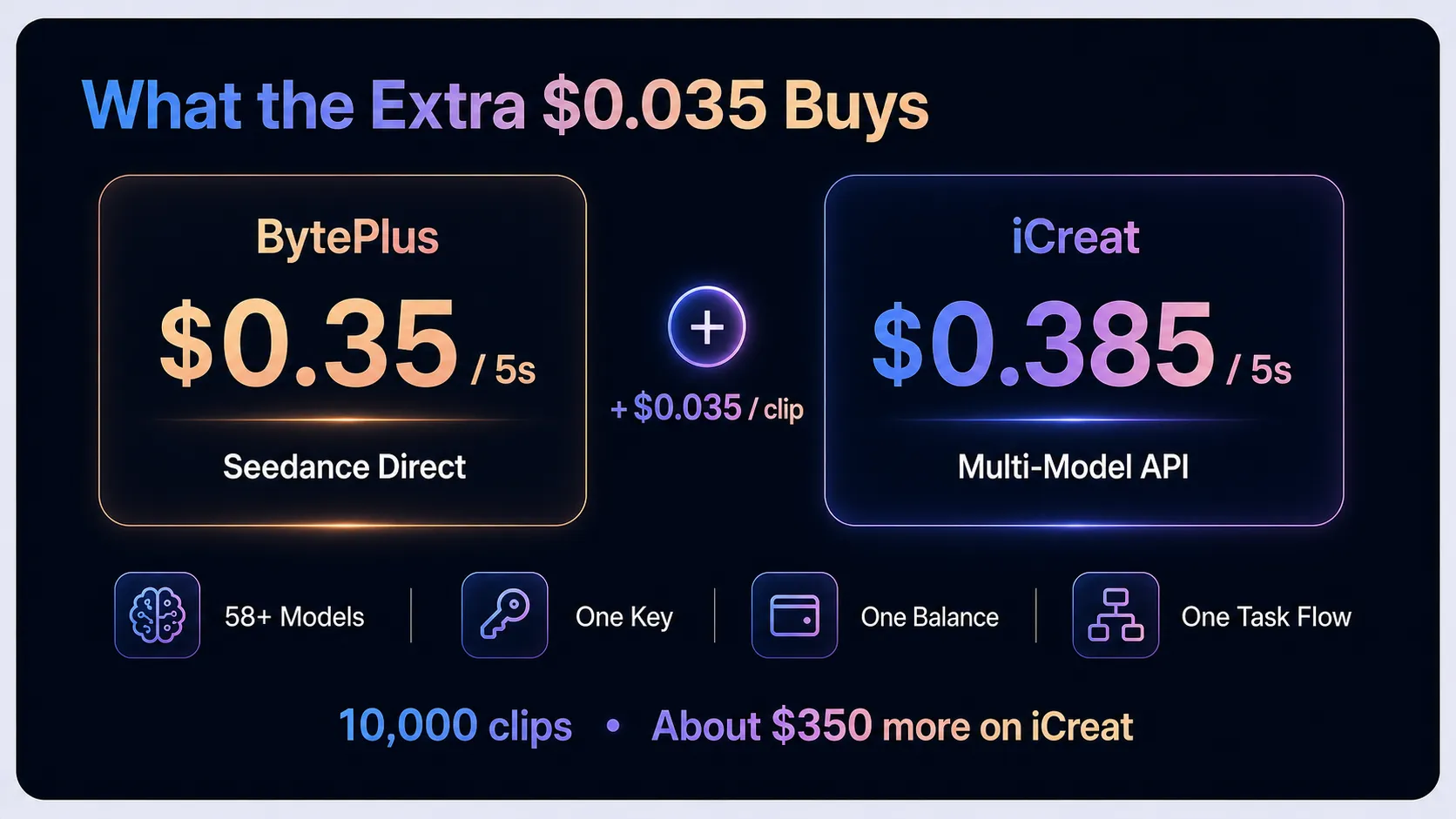
If the backend only needs Seedance and volume is steady, direct BytePlus access costs less. The five-second standard example saves 3.5 cents per clip. Across 10,000 matching videos, the difference is about $350. At larger scale, the official unit-price advantage becomes more important.
Many generative products quickly grow beyond that simple case. A product video may begin with an LLM that prepares the script, use GPT Image 2, Nano Banana, or Seedream for reference frames, and then use Seedance for motion. When a queue grows, a price changes, or a model stops fitting the job, the team may also test Happy Horse, Seedance Fast, Mini, or a later release. Direct integrations mean separate accounts, keys, balances, request fields, task states, error formats, and usage records.
Model choice also changes by job. Our Seedance 2.0, Kling, Veo, and Hailuo comparison breaks down reference control, native audio, duration, resolution, listed cost, and API workflow. A product that needs different strengths for different jobs is more likely to feel the maintenance cost of separate provider integrations.
iCreat pulls that repeated work into one access layer. One account and API cover more than 58 models from OpenAI, Google, ByteDance, Anthropic, Alibaba, and other providers. The default API key group can access every available model. Image and video tasks follow the same three-step lifecycle of submitting a task, checking its status, and retrieving the result. A model switch changes the capability code and model-specific parameters, while authentication, polling, and result retrieval keep the same basic structure.
Billing is consolidated as well. The team maintains one prepaid balance, and every call appears in the same usage log. Finance has fewer top-ups and statements to reconcile. Engineering has fewer balance alerts, spend reports, and provider-specific job wrappers to maintain. Those savings may not repay the markup for a Seedance-only product. They become material when a product uses several models.
The tradeoff is measurable. At 10,000 five-second 480p clips, iCreat costs about $350 more than the public BytePlus example. If connecting two or three additional model vendors creates more than $350 of development, monitoring, billing, and incident-handling work, the aggregator has the lower total cost. At hundreds of thousands of predictable Seedance clips per month, the unit-price gap is likely to dominate and BytePlus is the better fit.
iCreat is strongest when the product is expected to change. A team can move from Seedance 2.0 to a later version, add an image model, or introduce another video route while keeping the same account, keys, balance, logs, and task lifecycle. The small model markup buys fewer future integrations, not a better Seedance render.
Why Seedance 2.0 prices are so easy to compare badly
The model uses token billing under the hood. A useful estimate multiplies video duration by output width, output height, and 24 frames per second, then divides by 1024. Providers may expose that calculation directly, convert it to credits, or publish a simpler per-second rate.
Resolution has a large effect. BytePlus estimates a five-second standard clip at about $0.35 for 480p, $0.76 for 720p, $1.87 for 1080p, and $3.89 for 4K when there is no input video. iCreat lists the same four tiers at $0.385, $0.82, $2.045, and $4.15.
Reference video pricing needs an extra check. iCreat lists a lower unit rate when a reference video is used, then charges that rate across the reference duration and output duration together. A five-second 480p output with a five-second reference costs $0.68, not the $0.34 output subtotal shown by multiplying only the generated length.
Audio does not normally create a separate Seedance charge on the routes reviewed here. Turning audio off also does not automatically reduce the model rate. If audio is part of the product, include it in the first evaluation before selecting the visual route.
BytePlus ModelArk offers the direct official API
BytePlus ModelArk
is the direct route from ByteDance for international developers. The current model
ID is dreamina-seedance-2-0-260128. Fast and Mini have separate IDs.
The standard model accepts text, up to nine images, three videos, and three audio files. It can generate, edit, and extend video. Output runs from four to fifteen seconds. The standard route supports 480p, 720p, 1080p, and 4K, while Fast and Mini stop at 720p.
BytePlus uses an asynchronous task API. You submit a task, save the returned ID, and either poll for status or provide a callback URL. Failed generations caused by moderation or similar errors are not charged, according to the public pricing page.
The tradeoff appears before the first request. You need a BytePlus account, an API key, model activation, and a prepaid resource pack. The direct Seedance service is also unavailable in the United States under the current specific terms. Real-person reference material requires an authorized asset flow instead of an ordinary upload.
Choose BytePlus when direct vendor access, official pricing, and enterprise controls matter more than a quick first test. It becomes especially attractive when you know the model already fits the product and you expect to use the prepaid quota before it expires.
iCreat puts many models behind one task flow
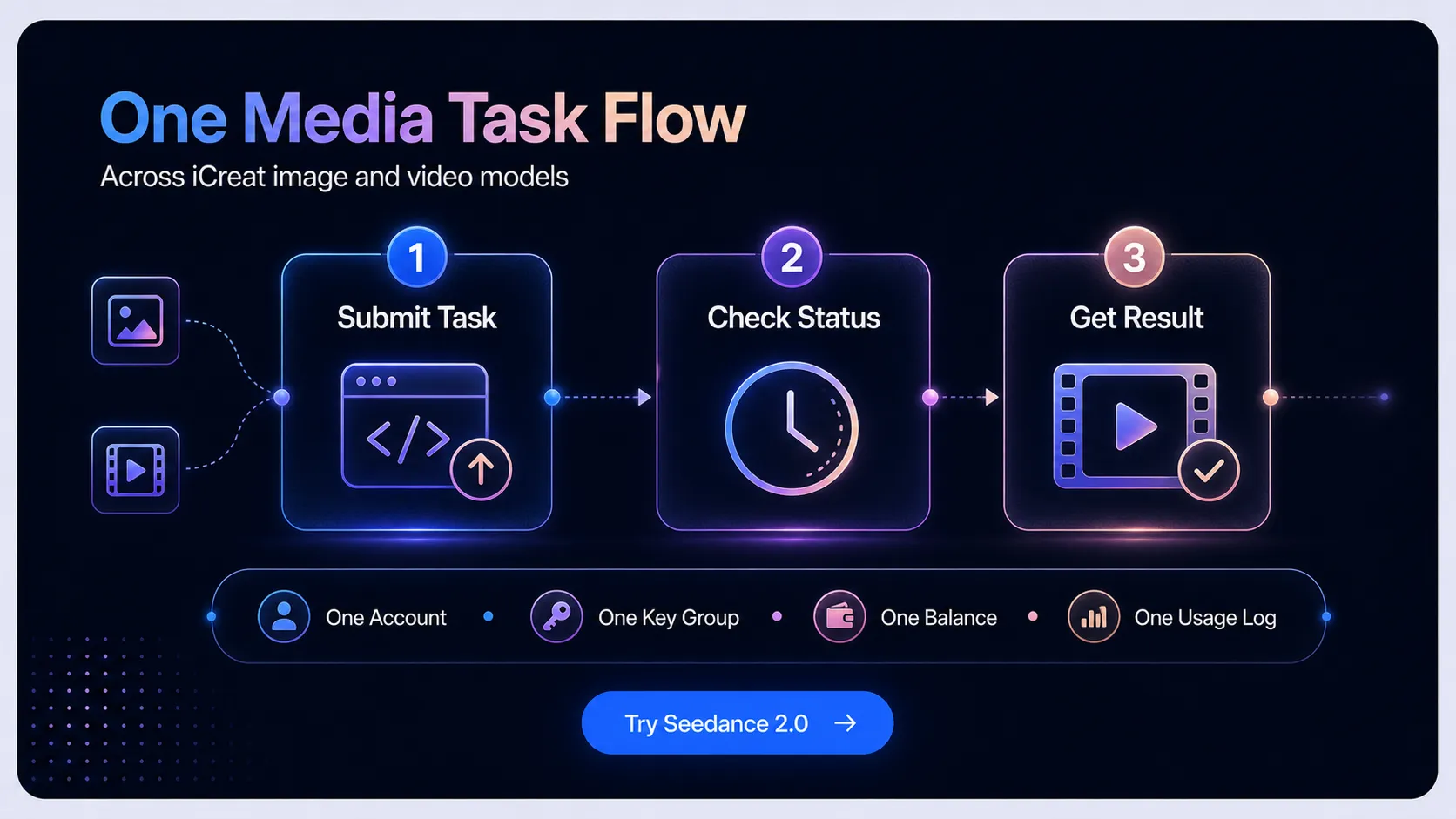
iCreat currently offers more than 58 LLM, image, and video models through one account and API. Seedance 2.0 is one capability code in that catalog. Our Seedance 2.0 model page keeps the supported inputs, exact dollar rates, Playground, and API example together. Calls to other models are recorded against the same balance and usage log.
The standard 480p rate without reference video is $0.077 per second. The equivalent 720p rate is $0.164, 1080p is $0.409, and 4K is $0.830. The page also lists Seedance 2.0 Fast from $0.062 per second and Mini from $0.0385 per second for their lower-cost routes.
Our API exposes the full multimodal input pattern. A request can contain text, up to
nine images, three videos, and three audio files. It supports first and last frames,
reference media, native audio, editing, aspect ratios from 21 by 9 to 9 by 16, and
four to fifteen-second output. When faces or copyrighted material appear in a
reference, the request can set need_review so the material enters the
required review path.
A submission uses one server-side request.
curl --fail-with-body \
  -X POST https://api.icreat.ai/v1/task/submit/bytedance/seedance-2-0 \
  -H "Authorization: Bearer ${ICREAT_API_KEY}" \
  -H "Content-Type: application/json" \
  -d '{
    "content": [
      {
        "type": "text",
        "text": "A slow product camera orbit with clean studio light and synchronized mechanical sound"
      }
    ],
    "generate_audio": true,
    "ratio": "16:9",
    "resolution": "480p",
    "duration": 5,
    "watermark": false
  }'
The response returns a task_id. The normal flow is submit, poll, and
retrieve. Our documentation advises allowing roughly one to five minutes for video
generation and polling every ten to fifteen seconds. GPT Image 2, Nano Banana,
Seedream, Happy Horse, and other media models use the same submit, status, and
result lifecycle.
We are not the cheapest line in every table. BytePlus is slightly cheaper on the standard official route, and another hosted API may temporarily discount one model variant. iCreat fits products that need several models without adding another account and task interface each time. When a model changes, the existing authentication, task state handling, balance management, and usage logs can stay in place.
Run the five-second iCreat Playground test with a prompt from your real product. Use 480p for the first pass, then repeat the accepted prompt at the delivery resolution. Those two runs tell you more than a provider's demo reel.
fal has the strongest model-specific developer experience
fal provides separate text-to-video, image-to-video, and reference-to-video endpoints for Standard and Fast. Its pages include interactive schemas, Python and JavaScript clients, queue methods, webhooks, file upload handling, and complete response examples.
The standard 720p route is about $0.3034 per generated second. Fast is about $0.2419. The 480p standard rate works out near $0.1406 per second under fal's published token formula. Standard supports 1080p on the image and reference routes, while the Fast routes stop at 720p.
fal is a sensible choice when the engineering team values a mature SDK and already uses fal for other media models. The premium is substantial for this particular model. A thousand five-second 480p tests would cost about $703 on fal and $385 on iCreat at the listed rates.
Do not compare fal's discounted video-reference rate with a text-only request. When a video input is supplied, fal applies a lower multiplier but counts input and output duration in the token calculation. That can be cheaper or more expensive depending on the length of the reference.
MuAPI gives you the widest set of Seedance routes
MuAPI treats Seedance as a family of many routes. Its public page lists Global, Chinese, VIP, Mini, and reduced-filtering variants, along with text, image, first and last frame, reference, edit, extend, and character workflows.
The cheapest listed Mini route starts at $0.08 per second. Chinese 480p text and image routes are shown at $0.09 to $0.15 per second. Global Fast starts at $0.15 for 720p, while the standard Global route is $0.25. VIP adds a priority queue and reaches 1080p or 4K at much higher rates.
That breadth is useful when a product needs several routing choices behind one key. It also makes comparison harder. Region label, moderation policy, queue priority, resolution, and model tier can all change at the same time. A team should approve exact model IDs and keep them fixed in production instead of asking for whichever route is cheapest that day.
MuAPI is the better fit when route variety and a large multi-model catalog matter more than a compact decision path. For a first standard 480p test, iCreat has the lower fixed public rate and a clearer single-model calculation.
Atlas Cloud offers a broad API catalog at a middle price
Atlas Cloud puts Seedance 2.0, Fast, and Mini behind one OpenAI-compatible API key. Its public planning rates are about $0.112 per output second for Standard, $0.090 for Fast, and $0.056 for Mini. A five-second Standard clip is therefore about $0.56 before tax or any live promotion.
Atlas Cloud earned its place in this comparison through current user discussion as well as public documentation. In the Reddit provider thread reviewed for this article, one user who had tried both Atlas Cloud and fal reported a similar experience on each and preferred Atlas on price. Another user preferred Atlas while pointing out that policy and reference handling can matter more than the cheapest line in a table. Those are individual reports, not a reliability benchmark, but they are more useful than a provider landing page with no first-hand detail.
The platform is attractive when a team wants text, image, and video models behind an OpenAI-compatible interface. Atlas Cloud also publishes SOC 2 and HIPAA claims for buyers with a compliance review. Its Seedance standard rate is still about 60 percent above BytePlus and 45 percent above iCreat for the fixed test in this article.
Choose Atlas Cloud when API compatibility, catalog breadth, and one billing account matter more than the lowest Seedance-only rate. Recheck the live price beside the Playground Run button because its own pricing guide notes that model promotions change.
Runway makes sense when Seedance is part of a larger creative stack
Runway added Seedance 2.0 to its API in May 2026, followed by Fast and Mini in June. The API supports text-to-video, image-to-video, and video-to-video. It also exposes keyframes, reference media, and generated audio through Runway's task system.
The API price is easy to convert. Runway sells API credits at $0.01 each. Standard Seedance costs 36 credits per second at 480p or 720p, 40 credits at 1080p, and 150 credits at 4K. Fast costs 29 credits per second. Mini costs 16 credits per second with a 64-credit minimum per generation.
That puts a five-second standard 480p clip at $1.80. The same test is $0.385 on iCreat. Runway also requires a minimum $10 API credit purchase, and credits bought for the Runway web app are separate from API credits.
The extra cost can make sense when the team already keeps assets, reviews shots, and uses Runway's own models in the same production environment. It is harder to justify for a backend that only needs a Seedance endpoint.
ComfyUI is a workflow interface, not a local Seedance model
ComfyUI now has official Seedance 2.0 Partner Nodes and downloadable workflow templates. You can connect a Seedance result to local upscaling, masks, compositing, frame processing, or another cloud model without writing a custom editor.
The word local causes confusion here. ComfyUI itself can run locally and remains open source. Seedance 2.0 is a closed model. Its Partner Node sends the prompt and reference media to a provider-hosted cloud service and consumes Comfy Credits. It does not download Seedance weights to your GPU.
Comfy states that 211 credits equal one dollar. Its standard Seedance rate for 480p and 720p without video input is 2.112 credits per thousand tokens. Under the same five-second 480p formula used above, the model charge is about 106 credits, or $0.50. A workflow running on Comfy Cloud can also consume runtime credits. A local ComfyUI workflow avoids that cloud GPU runtime charge.
Partner Nodes require a Comfy account and prepaid credits. The current testing version does not support bringing your own provider key. Real-person portraits go through ByteDance's liveness and identity flow.
Choose ComfyUI when Seedance is one node in a larger visual pipeline. Choose a direct API provider when Seedance is a feature inside your application and the node canvas would add an unnecessary layer.
The provider changes more than the bill
The same model name does not guarantee identical production behavior. Providers wrap Seedance with their own defaults, queues, moderation steps, file storage, error handling, and parameter names. Four checks matter more than a small difference in list price.
Confirm the exact model and route
Standard, Fast, and Mini trade quality, latency, resolution, and price. A label such as Seedance 2.0 can also hide a Chinese, Global, VIP, or reseller route. Record the model ID returned by the service and keep it in the evaluation notes.
Test human and copyrighted references early
BytePlus requires special handling for identifiable real people. ComfyUI exposes a liveness verification workflow. iCreat provides a review flag for face or copyrighted references. Other providers may reject, route, or moderate the same asset differently. Test only material you are authorized to use.
Measure cost per accepted result
Create a set of at least 30 prompts and references from the actual product. For every provider, track submitted cost, successful cost, accepted output cost, completion time, timeout rate, moderation rate, and the number of retries. A route that is 20 percent cheaper per request can lose the advantage after one extra retry.
Keep a provider boundary in your code
Every route here is asynchronous. Your application will submit a task, store an ID, wait for a terminal status, and save the result URL. Put those steps behind a small internal interface. It will make a fallback provider or future price change much less painful.
Our recommendation
Use BytePlus when you need the direct official relationship, can access the service in your region, and expect enough volume to justify the resource-pack purchase.
Use iCreat when the product calls LLM, image, and video models and the team wants one account, key group, balance, usage log, and asynchronous task flow. The Seedance unit price is slightly higher. The main return is having fewer interfaces and bills to maintain.
Use Atlas Cloud when an OpenAI-compatible endpoint and a broad text, image, and video catalog matter more than the lowest Seedance rate. Use fal when SDK quality, queue tooling, and an existing fal integration justify the higher price. Use MuAPI when route variety matters. Use Runway when Seedance belongs inside a Runway-centered creative operation. Use ComfyUI when you need a reusable node workflow.
One test is enough to make the next decision. Open the iCreat Seedance 2.0 Playground, use a real prompt, choose five seconds and 480p, then run the same accepted prompt at your delivery resolution. If both results work, continue with the iCreat API documentation.
Frequently asked questions
dreamina-seedance-2-0-260128. The service
requires a prepaid resource pack for activation and is not available in the United
States under the current terms.